

4
•••:',45:
•
Health
Blood
Brothers
ALAN HITSKY
Associate Editor
I
t wasn't as emotional as
their first face-to-face
meeting last vear, or as
life-saving as two years
Two men,
linked by
genetics,
ago.
Ed Cherkinsky, 52, is a
lawyer. Bini (Binyarnin)
Zomer, 26, just graduated
law school. So they would
have lots to talk about even if
Zomer hadn't donated bone
marrow in 1997 that helped
save Cherkinsky's life.
In 1996, Cherkinsky vas a
successful personal injury
attorney, with a wife, two
sons and a home in
Farmington Hills. Then a
nagging cold that wouldn't
go away was diagnosed as two types
of aggressive leukemia.
But Cherkinsky describes himself
as lucky: lucky he was diagnosed
early, lucky a good pharmacologist
mixed his chemotherapy lucky to
have good health insurance, that he .
found a bone marrow match (his sib-
lings were not good matches) and
that he went into remission immedi-
ately.
He's also lucky that he and Zomer
are so compatible — genetically and
personally. Their match was one of
1,200 nationally in 1997 of non-
related persons.
Zomer was a freshman at the
University of Texas in 1992 when he
attended an America Israel Public
Affairs Committee policy conference
in Washington, D.C. Two Israeli boys
with cancer needed bone marrow
transplants. Because Ashkenazi Jews
are the best chance for a compatible
match for other Ashkenazi Jews,
" what better place for a bone marrow
drive than a conference of 5,000
Jews," Zomer said.
Zomer donated blood and was
placed in the National Bone Marrow
Registry. His senior year at Texas, he
share a
second
reunion.
6/18
1999
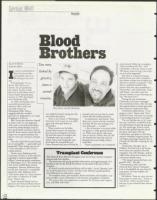
Bini Zomer and Ed Cherkinsky
was called for further testing but did
not match the patient.
Then in law school, at Washington
University in St. Louis, he was called
again and ultimately linked to
Cherkinsky.
Three months went by before
Zomer's bone marrow was extracted
from his hip and shipped to Detroit.
He had final exams to complete and
Cherkinsky had a bar mitzvah to
attend. Zomer and Cherkinsky were
tested again for compatibility and
Zomer donated three pints of blood for
himself in the rare case that he would
need it after the marrow donation.
In preparation, said Zomer, "they
show you a movie of what's involved
and they tell you you're going to be
sore afterwards — I wasn't."
A liter of marrow is extracted while
the patient is under general anesthe-
sia. While most donors take some
time to recover, Zomer, then 24, left
the hospital the same day and was
playing tennis and riding a bike a
week later.
Donor and patient can correspond
N
Transplant Conference
The National Bone. Marrow Transplant Link serves bone marrow transplant
patients and their families.
The seven-year-old group provides information and support groups. It is
funded in part by the Jewish Fund from the proceeds of the sale of Sinai
Hospital.
It's fourth annual educational forum will be held 1-5 p.m. Saturday, June
26, at the Livonia Civic Center. The free event will have a panel presenta-
tion followed by six discussion sessions:
Pre-transplant issues, post-transplant, breast cancer/stem cell transplants, sup-
port providers, cancer information on the Internet, and pediatric transplants.
The event is free, but registration is required. For 24-hour-a-day registra-
tion, call (800) 546-5268.
anonymously following a transplant.
"After something like this," said
Cherkinsky, "everyone wants to meet.
The donor wants to know the recipi-
ent and what happened."
But there is a national waiting
period of one year after transplanta-
tion before a donor and recipient are
allowed to directly correspond. "The
donor would feel terrible if the
patient died after they established a
relationship," said Cherkinsky. "And,"
said Zomer, "you don't want the
patient's family on your doorstep say-
ing, We need more.'"
During the year moratorium,
Cherkinsky and Zomer exchanged
three anonymous letters. After the year,
they signed releases a month apart that
they wanted to contact each other.
Cherkinsky called Zomer. "I was
going to write," Zomer said, "but I
called him back. My mom was crying
in the background and I was shaky "
The two families met in St. Louis
last year, and had a wonderful week-
end sightseeing and getting acquaint-
ed. Two weeks ago, Zomer visited
Detroit after graduating law school.
He spent three days with the
Cherkinskys and spoke to Ed's bone
marrow transplant support group. He
will begin practicing corporate law in
Chicago this fall after studying for the
bar exam.
Cherkinsky, who grew up in
Midland, has had to give up his per-
sonal injury law practice since the
transplant. His wife, Barbara, said he
suffers from short-term memory loss
and cannot handle stress.
"The support group has been very
good for him," she said.
"Volunteering at the Link (the
National Bone Marrow Transplant
Link in Southfield), he can relate his
experiences. It's been helpful and
good for him."
Ed believes "there are ways you can
help people in small ways." Zomer is
more direct: "Have yourself tested
and put on the national bone marrow
registry" Ei