

Star Seaz•ch
The American Film Institute names the silver screen's 50 greatest legends in a TV special airing Tuesday.
GAIL ZIMMERMAN
Arts 6. Entertainment Editor
1
f you enjoyed last June's
American Film Institute salute to
the 100th anniversary of
American movies —AFI's 100
Years ... 100 Movies, which revealed a
countdown of the 100 greatest films of
all time — you'll probably want to
tune in Tuesday, June 15, when CBS
airs AFI's 100 Years ... 100 Stars.
During the broadcast, a list of 50 of the
top screen legends of all time will be
revealed by 50 of today's biggest stars.
The AFI defines an "American
screen legend" as "an actor or team of
actors with a significant screen presence
in American feature-length films whose
screen debut occurred in or before
1950, or whose screen debut occurred
after 1950 but whose death has marked
a completed body of work."
In addition to the countdown of the
25 top male and female screen legends,
50 contemporary stars — including
Richard Dreyfuss, Goldie Hawn, Dustin
Hoffman, James Caan, Billy Crystal, Jeff
Goldblum and Martin Landau — will
commemorate the lives and careers of
the winners with film clips, bringing
back memories of their work.
More than 1,800 leaders from
across the film community received
6/11
1999
88 Detroit Jewish News
ballots asking them to select the leg-
ends from a list of 250 nominees in
each gender category, as compiled by
AFI historians. The jury included film
artists (directors, screenwriters, actors,
etc.), critics, historians, executives and
other cultural leaders.
Jurors were asked to consider the
following criteria:
• Star quality — an actor's charisma
and unique personal characteristics
that create a strong on-and-off screen
presence.
• Craft — an actor's ability to
embody distinctly different characters
through the use of strong acting tech-
niques and other creative methods.
• Legacy — an actor's body of work
that enriches American heritage and
continues to inspire artists and audi-
ences today.
• Popularity — an actor's public
following over time.
• Historical Context — the role of
world events, politics and social mores
in shaping, promoting or curtailing a
legend's status and career.
AFI's two-year celebration com-
memorating the first 100 years of
American movies also includes a mul-
timedia, interactive touring exhibition,
"AFI's American Film Centennial
National Tour," which travels to
Oakland Mall in Troy June 25-27.
Among the 250 males nominated
as screen legends are the following
actors with Jewish backgrounds:
• Jack Benny — Born Benjamin
Kubelsky, he made his film debut in
Hollywood Revue of 1929, but his best
film vehicles include Charlie's Aunt
(1941), To Be or Not to be (1942) and
George Washington Slept Here (1942).
• Milton Berle — Born Milton
Berlinger, as a child he starred in The
Perils of Pauline serial. He made his
adult film debut in New Faces of 1937
• George Burns — Born Nathan
Birnbaum, he made his debut in The
Big Broadcast of 1932 and won an
Oscar for his performance in The
Sunshine Boys (1975).
• Eddie Cantor — Born Eddie
Israel Iskowitz, he made his screen
debut in Kid Boots (1926).
• Lee J. Cobb — Born Leo Jacob,
he shot to fame on the basis of his
performance on stage as Willie Loman
in Death of a Salesman. He made his
name in film with On the Waterfront
(1954).
• Tony Curtis — Born Bernard
Schwartz, his film highlights include
The Sweet Smell of Success (1957), The
Defiant Ones (1958) and Some Like It
Hot (1959).
• Sammy Davis Jr. — The popular
black entertainer, who converted to
Judaism, made his Hollywood debut
in The Benny Goodman Story (1956).
• Kirk Douglas — Born Issur
Danielovitch, he emerged as a front-
rank star with his performance as an
unscrupulous boxer in Champion (1949).
• Melvyn Douglas — Born Melvin
Edouard Hesselberg, he won Best
Supporting Actor Oscars for Hud
(1963) and Being There (1979).
• John Garfield — Born Julius
Garfinkle, he became famous for his
role in Body and Soul (1947) and
starred as a Jewish G.I. in Gentleman's
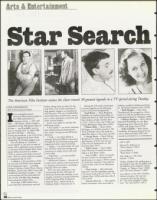
Left to right:
Edward G. Robinson in
"Smart Money" (1931).
Cornel Wilde in
"Road House" (1948).
Peter Sellers in "The Pink
Panther" (1964).
Paulette Goddard: Her abiding fame is
due largely to two roles she played under
the direction of her husband, Charlie
Chaplin, in 'Modem Times" (1936)
and "The Great Dictator" (1940).
Luise Rainer at the 1937 Academy
Awards ceremony She won two
consecutive Best Actress Oscars,
for "The Great Ziegfeld" (1936)
and "The Good Earth" (1937).