
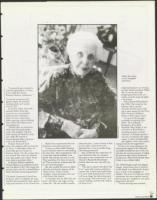

Mabel Rose Alvin
in her Southfield
apartment.
"I eventually got involved in
a Jewish organization, in Utica.
It was called the Young
Women's Hebrew Association."
The Jewish community held
together despite the economic
hardships of the stock market
crash of 1929.
In the late 1920s, the newly
married Mabel Alvin had
moved to her new husband
Robert's home of Pontiac,
Mich. He was a shoe buyer
before opening a men's clothing
store, where she helped as his
top salesperson.
"Shortly after we married in
1929 came the stock market
crash," she recalled. "My hus-
band was out of work for a year
and a half. We moved to
Detroit because there was more
work to be found there."
Despite financial hard-
ships, her religious life maintained
its roots. "I remember when we
eventually got our house on
Richton Street. On the corner there
was a bank that went out of busi-
ness they made into a shul. There
were shuls everywhere then."
In Detroit, Robert worked for
Detroit Edison in its architectural divi-
sion. He died in 1965. The couple had
one son, Jerry, now 67, a retired Wayne
State University accounting professor.
The Jewish Community Council was
formed in 1937 to strengthen the orga-
nized Jewish community's resolve against
rising anti-Semitism in the Detroit area.
Organized Judaism was thriving
as metro Detroit prospered. World
War II and the years after
brought good times to the car-
makers, and the rising tide lifted
a lot of boats.
Alvin's Jewish life bustled in
the 1940s. The award on her
hallway wall is a proud
reminder of those years work-
ing to raise money for the B'nai
B'rith Women's Children's
Home in B'ait Vagen, Israel.
"It was over 50 years ago,
everybody was joining B'nai
B'rith," Alvin reflected. "I
belonged to B'nai B'rith,
Hadassah, Bikur Holim. I was
very active in B'nai B'rith as
recording secretary, sunshine
chairman, in dramatics groups. I
0
was very, very good in the organi-
0
zations. I used to sell tablecloths
and napkins. I was a busy person
raising money for the organization."
For her, as for many Americans, the
monumental tragedy of the Holocaust
was hidden beneath the news of the war
and then the common practice of urging
the survivors who came to America to
not discuss it. When Alvin learned about
it later, it was a distant reality.
.
O
Mabel Alvin experienced that anti-
Semitism in housing restrictions.
"I went to a place called Gennesee
once in Detroit, where we were looking
for a four flat," Alvin remembered, and
I must have told the landlady I was
Jewish. She said she can't rent it to me.
They would say, 'I'm sorry, it's restrict-
ed.' They wanted me to know they did-
n't rent to Jewish people."
She also recalled the airwaves filled
with the anti-Semitic rhetoric of the
"Radio Priest," Father Charles
Coughlin, whose broadcast came out
of his Royal Oak church.
"I remember how he didn't like the
Jews, " said Alvin, the anger stirring
within her. "He said terrible remarks
about the Jews. I used to listen to him
on the radio. I don't know who
believed him. It was a terrible thing,
like being prosecuted."
She recollected the undertone of
anti-Semitism that ran rampant
throughout the community, even at
Detroit's Roosevelt Elementary
school when her son was still very
young.
One day in school when Jerry was
6 or 7 years old, I went to school on
visitors' day. I didn't look Jewish then.
I've never really looked Jewish. And I
will never forget the lady sitting next
to me saying, 'look around you'. So I
started looking. And she said, look at
all those Jews.
The 1950s brought social and religious
changes. Conservative Jews in America
in this decade were allowed, for the first
time, to drive to the synagogue on
Shabbat. This led to the dispersion of the
community, but also re-ignited issues of
fair housing, fair employment and equal
opportunity education.
The fair-housing issue touched
6/11
1999
Detroit Jewish News
19