

•
A
el
DIANA LIEBERMAN
Special to the Jewish News
he best-known
superhero in the
Bible appears in the
T coming week on the
stage of the Detroit Opera
House, as the Michigan Opera
Theatre presents Camille Saint-
Saens' Samson and Delilah.
The opera has all the fanfare
and bombast of an adventure
story, with the pathos of a
morality play. Its musical score
fits snugly within the 19th-cen-
tury operatic tradition.
But, when Mark Lundberg
makes his Michigan Opera
Theatre debut on opening
night, Samson will sing with a
voice informed by Jewish litur-
gy. After performing the role 22
times in venues from New
Orleans to Edinburgh,
Scotland, the tenor, who is the
son of an Episcopalian minister from
Littleton, Colo., decided to take a
more introspective approach.
"The role is oftentimes done with
great declamation, everything very
Diana Lieberman is a freelance writer
based in Bloomfield Hills.
cumbing to lust but, more
fundamentally, on disobey-
.
ing God.
"Here is -a man who has a
real relationship with God,"
Lundberg says. "The rest of
us have 10 rules; he had one
rule he was supposed to fol-
low — don't tell the secret of
your strength."
Lundberg feels this is the
real conflict in the story —
not between Samson and the
Philistines, but within
Samson himself "God spoke
to him, and yet he betrayed
oantso
this trust because of love, of
lust," he says. "The conflict
The
vi‘
must have been tremendous."
e moral
With the story's biblical
roots in mind, Samson's
third-act aria has majesty as
well as poignancy. This is the
scene in which Samson,
blinded and in chains, turns
a millstone in the prison.
Israel as well as the United States, has
"It's really an Old Testament lamenta-
given Lundberg an abbreviated course
tion,"
Lundberg says. "He is not just cry-
in cantorial singing.
ing
in
his beer, so to speak. He is giving
Would Saint-Saens have approved?
over
his
soul to God, speaking to God."
"Absolutely," Lundberg says. "It may
Performing the lead in Samson and
even have been refreshing for him."
Delilah requires a high degree of physical
According to the biblical story
endurance as well as emotional depth.
found in the Book of Judges, Samson's
Lundberg has been keeping his res-
downfall was based not simply on suc-
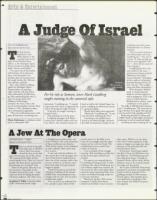
For his role as Samson, tenor Mark Lundberg
sought training in the cantorial style.
stentorian," Lundberg says. "I wanted
to get away from that, to approach the
role as his being the judge of Israel."
To do this, he sought training in
cantorial style.
That training was not far away.
Lundberg's manager, Joel Bloch,
comes from a family replete with can-
tors. Bloch, who maintains homes in
A Jew At The Opera
JONATHAN S. TOBIN
Special to the Jewish News
T
here is a school of thought
with deep roots in Western
culture which has always
viewed the Jews as the bad
guys. Not because any of the crimes
The Protocols of the Elders of Zion
would ascribe to us. There are a lot of
people who have always resented the
Jews because we "invented" God.
More to the point, they see us as
the inventors of morality in the
broadest sense of the word — what
many are fond of calling the Judeo-
Christian tradition. The 18th-centu-
Jonathan S. Tobin is executive editor
of the Connecticut Jewish Ledger.
1999
90 Detroit Jewish Ne../s
ry Enlightenment philosopher and
writer Voltaire is the most prominent
of these intellectual anti-Semites.
With all due respect to the traditions
of other cultures, these critics may
have a point.
It was only with the collision of
the ancient Jews with the pagan soci-
eties of the Eastern Mediterranean
that a lot of the concepts such as the
sanctity of life (i.e. no human sacri-
fices) and codes of sexual conduct
began to spread.
Think of the Jews as sort of the
Christian Coalition of the ancient
Middle East, and perhaps you can
imagine why we were seen as such a
troublesome people.
This was and is an awkward role
for a people to play. Much of the.
Jewish history in the Bible is the
story of our struggle with the expec-
tations set for us in the Torah. The
culturkampfcomes as often from
within as without.
I was reminded of this struggle
recently while attending a production
of the French opera Samson and
Delilah.
The opera is an unusual place to
be thinking of things Jewish. It often
celebrates the values of hedonism in a
way Voltaire might have enjoyed. Yet
the search for Jews at the opera often
uncovers some interesting finds. Even
there, our biblical heritage sneaks in
every now and then.
Written by the late 19th-century
composer Camille Saint-Saens,
Samson and Delilah is more oratorio
than opera. Which is to say, there
isn't a lot of action going on. Little
seems to happen on stage even when
they get to the good parts like the
famous haircut scene.
In the piece, Saint-Saens loaded
the dice in favor the Philistines over
the Hebrews. The Philistines get all
the really good music. Outside of
Samson's heroic call to revolt, all the
Hebrews seem to do is stand around
the stage and shrei gevalt.
Yet in spite of himself, Saint-Saens
produced a work that was profoundly
moral as well as dramatic. If the
guiding principle of 19th-century
French opera is the triumph of sex
over absolutely everything in life,
then Samson and Delilah can prove
the opposite.
N