

COMMUNITY VIEWS
Finding Family Graves In Romania
JEANNIE WEINER
Special to the Jewish News
A
s a child, I
always thought
it both peculiar
and rather magi-
cal that the members of
my family, with the excep-
don of my sister and some
cousins, had been born
across the ocean in a place
called Austria-Hungary
This meant that the lan-
guage my parents first learned and the
places familiar to them were com-
pletely foreign to me. Had my grand-
parents been alive, I would not even
know how to speak with them!
I never knew any of my grandpar-
ents except through vivid stories about
them. My father, who died at age 87,
never tired of talking about his moth-
er, the oldest child, the only girl, and
her 15 brothers! I heard about my
father's many uncles, one a scientific
explorer who died of malaria in New
Guinea in 1895 and another a busi-
nessman who sold railroad ties
throughout the Austro-Hungarian
Empire. My grandfather worked for
his father-in-law in the little town of
Enyed, now called Auid. Enyed, a
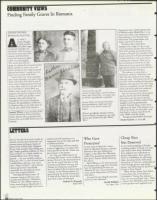
Clockwise from top left:
Amalia Fenichel Mann and Fred Mann,
shown after World War I in Enyed; !J. ley.
are Weiner's grandmother and father.
Jeannie Weiner at the gravesite of her
great-grandparents, Jacob and Gitel
Fenichel, in the Jewish cemetery of
Enyed.
Jeannie Weiner is past president of the
Weiner's grandfather Abraham Mann
lived in Enyed, a Hungarian town that
became part of Romania after World
Wart
Jewish Community Council of Metro-
politan Detroit and was general chair-
person of its recent 60th anniversary cel-
ebration.
Hungarian town, which became part
of Romania after World War I, is an
hour's drive from Cluj (Kolozsvar or
Klausenberg) in the Transylvanian
Mountains. My grandmother and
father were born in Enyed.
Therefore, after a drive from
Budapest and a night in Cluj, it was
with tremendous emotion that my hus-
band and I recently entered the Jewish
cemetery of Enyed. Two members of the
Jewish community of Cluj accompanied
us; they had driven with us to assist us
in finding the cemetery. There are no
Jews remaining in Enyed but we felt
their presence as we passed my father's
high school and the river where the fam-
ily's tanning business had been.
The cemetery is across from a
Romanian cemetery, which has a care-
taker who also "looks out" for things
across the road. The Jewish cemetery sits
on a hill, which is eroding, leaving stones
tipping as they slip down the side. Many
stones are completely covered with high
brush and those made from sandstone
have lost most of their inscriptions.
But the remains of my great-grand-
parents, Jacob and Gitel Fenichel,
were there near the top of the hill,
sharing a scone of black marble! Their
daughter and my grandmother,
Amalia Fenichel Mann, had a stone
right next to them. The cemetery was
full of my family, the Fenichels, who
had died at various times from the
early 1800s until the 1940s.
Our group said Kaddish (the prayer
FAMILY GRAVES ON PAGE 40
LITTERS
Due to the rash of terrorist attacks on
schools, parents and community vol-
unteers armed with guns (many of
them of the military-type "designed
for no other purpose than killing peo-
ple") began guarding children to, from
and at school. As a result, attacks on
schoolchildren have all but disap-
peared — the one notable exception
being the 1997 murder of seven Israeli
schoolchildren during a visit to Jor-
dan's "Island of Peace," where the Jor-
danian government specifically
requested that the parental escorts
leave their weapons behind.
The Talmud clearly states: "If
someone comes to kill you, arise
quickly and kill him." (Sanhedrin,
Volume II, 72a.) While violence is
never something we should seek or
enjoy, in a world fraught with uncer-
6/4
1999
36 Detroit Jewish News
Who Gave
Protection?
tainties and evil intentions, it is
imperative that we be ready and able
to defend ourselves.
A moral person will not commit
In your issue of April 30, I note a
crimes of aggression, no matter how
claim by Abraham Foxman, national
many gunslle or she has. Torah, not
director of the Anti-Defamation
gun control, is the answer.
League, to the effect that Albanians
Mr. Diaz sees NRA rhetoric of
under Nazi occupation protected all
"Gestapo-like forces" to be overblown
their Jews ("Kosovo Holds Meaning
fantasy. However, the disarmament of
For Jews").
Jews by the actual Gestapo in Nazi
Raul Hilberg in The Destruction of
Germany and Poland was very real.
: the European Jews, page 451, describes
Perhaps the Holocaust could have
how the Sanderberg Division, an
been curtailed if the Jews had access to
Albanian SS unit, was involved in the
weapons. In the Warsaw ghetto, 24
arrest and/or deportation of 810 Jews
guns allowed the Jewish community
and others.
to hold off the Nazis for several days.
So much for the alleged protection
Just think if they all had guns.
of Jews by the Albanians.
Andrew D. Kennedy
Gerald Dashkin
Royal Oak
Las Vegas, Nev.
Cheap Shot
Not Deserved
In my small sampling of friends,
including rabbis, I found to a man
and woman that these Orthodox
Jews applaud any individuals or
groups who renew their commit-
ment to Yiddishkeit by affirming
God, elevating Torah, dedicating
themselves to mitzvot, responding to
God through private and public
prayer, and affirming the qualities of
living in Eretz Yisrael.
When Senior Editor Neil Rubin
wrote about this in his Editor's
Notebook ("Voting For Judaism,"
May 21), he concluded with, "What
a shame that Orthodox and Conser-
vative groups won't applaud even