

seek to change with the times.
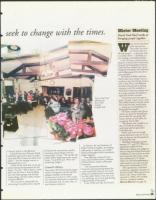
David Gad-Harf
addresses the
Town Hall
meeting
in Royal Oak.
Council, and is it still effective?
Council Executive Director David
Gad-Harf said need is hard to under-
stand and effectiveness not easily mea-
sured — but the straight answer to
both questions is yes.
"Much of the work that we do rep-
resents laying the foundation for the
future," he said. "When there's a crisis,
that's not the time to start building
ties with other groups and develop
relationships with the media and gov-
ernment officials."
The Council is responsible for
advancing the public policy agenda
of the Jewish community, and for
nurturing relationships with the
community'at large. "We are like the
public affairs department of a corpo-
ration," Gad-Harf said. We're not
producing widgets.
"
Council's History
More than 150 Detroit Jewish organi-
zations and agencies met for the first
delegate assembly of the Jewish
Community Council in 1937 as part
of a national movement to respond to
anti-Semitism and, in some cases, to
pro-German sentiment.
In Detroit, the anti-Semitism of
Father Charles Coughlin, the leading
radio priest in America, was widely
heard and brought Jewish community
leaders together.
That reflected a national move-
ment, said Jonathan Sarna, professor
of Near Eastern studies at Brandeis
University.
"The community relations
Councils understood long before the
word existed that America was some-
thing of a multicultural environment,
but they didn't believe that every cul-
ture should go on its own and develop
independently of the other."
In the 1950s and '60s, the Council
Mister Meeting
David Gad-Half works at
bringing people together.
hen David Gad-Harf
picks out pictures
that reflect his career
in Detroit, they are
all with people — a governor here,
a Cardinal there — standing in a
row smiling, and shaking hands.
In his 10 years as the executive
director of the Jewish Community
Council of Metropolitan Detroit,
Gad-Harf has relished the role of
building friendships and coalitions
and bridging gaps between diver-
gent opinions.
The oldest of Walter and Joan
Harf's three sons, he grew up in a
small but close-knit Jewish commu-
nity in Erie, Penn., and followed
the lead of his parents in seeking
volunteer work. He worked at a
Head Start center one summer and
as a camp counselor for disadvan-
taged kids another summer.
"My parents aren't the type to
push," he said. "I grew up in a time
when Reform Jewry was very much
into social activism, social justice
— acting out your Jewishness b y
doing good for people."
His father recalled that David
"always set goals for himself and
knew where he was going. We
weren't always so sure where he
was going, but he did."
"My parents had a belief in us
that we could do anything —
work hard and be optimistic,"
Gad-Harf said.
While only half of his high
school classmates went on to col-
lege, he became the first graduate
to attend Harvard.
Gad-Harf studied government
between 1971 and 1975. When an
organization called the New
Democrat Coalition sent college stu-
dents to help elect liberal Democratic
candidates, he went to Iowa to work
as an intern for Dick Clark, a long-
shot candidate for U.S. Senate.
Clark, one of the first politicians to
walk across his own state, won the
Democratic nominationin 1972.
-
After graduation, Gad-Harf
worked as a legislative assistant in
Senator Clark's office and met his
future wife, Nancy Gad (they
married in 1988), who worked
there as a graduate student.
MISTER MEETING on page 18
6/4
1999
Detroit Jewish News
15