

the young adventurers, countries
began pushing the idea, providing
funding in some places and promo-
tion in others.
In the last 90 years, the interna-
tional movement has grown to
include 4,500 hostels in 60 coun-
tries and offers services to every age
group, including seminars on back-
packing or crosscountry skiing
(Goldstein's group plans bus trips
throughout the year to places like
Michigan ski resorts where travelers
either stay at the resorts or in nearby
hotels) and an online international
booking agency aimed at budget
travel. Last year alone, 4 million
members racked up 31 million
overnight stays in the hostels.
The idea is still more readily
accepted in the European nations
where the highest concentration of
hostels exist, including ones like ships
in the Stockholm harbor and a for-
mer prison in Ireland. In the capitols
and other major cities, the hostels are
generally open 24 hours a day, 365
days a year and can be booked solid
for days at a time.
Each one is different from the
next," Goldstein said. "It is not like
Motel 6 where you get the same thing
no matter if you are in Boston or San
Francisco."
Wherever the hostels are located,
they all pretty much provide the same
basics: local travel information, a
hearty breakfast, a bed, a pillow, a
bathroom and a place to cook meals
for under $20 a night. Most hostels,
in fact, do so for $8 to $12 and some
include amenities like hot tubs, swim-
ming pools, individual rooms and
bathrooms. Rooms are separated by
gender although family sections are
available in most hostels.
Royal Oak resident and former
hostel traveler Danny Samson, 27,
has gone to about 30 hostels in vari-
ous European countries and Israel.
He found most to be spare and clean
but a few were disappointing.
"There is a range and the range
can be within the same city," he said.
"Some are clean with small rooms
and bathrooms and others are like
dorms. Some are gross, and some are
nice. It all depends."
Noah Krugel, 27, of Oak Park
spent five weeks traveling through
Europe after college and another year
in Israel, a lot of the time crashing in
hostels. He enjoyed meeting fellow
Americans and other English-speak-
ing travelers, some of whom he
would travel with to the next stop on
his itinerary. He also favored the all-
you-can-eat breakfasts some of the
hostels offered. "The food was pretty
good and you can load up on rolls
and jelly for later," he said.
In the United States and Canada,
there are 224 hostels with several
dotting the western coasts of both
countries. In Michigan there is one,
Country Grandma's Home Hostel in
New Boston, a national award-win-
ner for its hospitality. Although it
has only six beds and is located away
from main public transportation
lines, the hostel, run by Betty and
Carey Johnson, sees hundreds of
travelers each year when the hostel is
open between March and
November. Most travelers stop not
for sightseeing purposes but rather
because the spot is a half-way point
between more popular hostels in
Chicago and Toronto or Chicago
and New York.
Plans currently calling for another
hostel on the grounds of Sleeping
Bear National Park near Glen Arbor
are under consideration by the park.
Potentially located in two 1880s
abandoned farm buildings, the pro-
ject, if approved, would call for
$250,000 in renovations to the exist-
ing structures.
"We think it would be the perfect
application for the land as they are
looking for environmental education-
al programs," Goldstein said.
Because the planned hostel is on
hold awaiting approval from the
parks' commission and the existing
hostel is well run, Goldstein said
most of her work is concentrated on
helping students plan trips to other
countries. For that, she largely relies
on her own experiences.
Since that first college trip,
Goldstein has been an active mem-
ber of American Youth Hostels, tray-
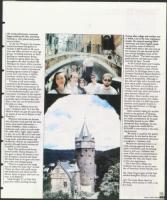
Top: Noah Krugel (right) of Oak Park
traveled throughout Europe in hostels.
Left: The Castle Altena Hostel in
Germany, which opened in 1909, is the
first hostel.
Detroit Jewish News