

Israeli Election
A new Israeli political
landscape emerges from
the election rubble.
DAVID LANDAU
Jewish. Telegraphic Agency
wo political earthquakes rumbled through Israel
on Monday in an election overturning the rules
and realities that have governed the Jewish state
and its policy-making the past three years.
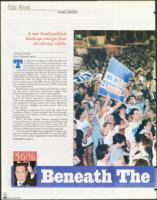
Labor Party leader Ehud Barak's 56 percent to 44 percent
victory over outgoing Prime Minister Binyarnin Netanyahu,
signifying the collapse of the "Greater Israel" ideology, is the
seismic shift that has brought undisguised joy to leaders from
around the world. The margin was the largest for a new
prime minister since Golda Meir 30 years ago, and was built
on a majority of long-time Jewish voters as well as Arab and
recent emigre electors.
But the massive success of the fervently Orthodox, or hare-
di, Shas Party, which draws predominant support from
Israel's Sephardi population, is also a major upheaval.
Shas scored the most dramatic victory in Monday's vot-
ing for the Knesset, boosting its representation from 10
seats in the outgoing Knesset ro a projected 17 seats in the
new legislature. The gain makes it one of the "Big Three"
in the Knesset, alongside the much-reduced Likud and
Labor factions.
According to projections, One Israel, the Labor Party
coalition, will have 27 seats, compared with 34 in the outgo-
ing Knesset; Likud will have 19 sears, a loss of 13 from the
outgoing Knesset.
Given that Shas' strident election campaign focused
almost exclusively on the four-year sentence for bribery and
corruption recently imposed on its leader, Aryeh Deri, the
parry's victory, on the face of it, is a victory for the anti-court
and anti-establishment rhetoric that its leaders espoused.
Deri announced Tuesday he was resigning as a Knesset mem-
ber and withdrawing from political life in a move that could
clear the way for coalition negotiations between Barak and Shas.
LANDSLIDE on page 27
Bene at h Th e
5/21
1999
22 Detroit Jewish News