

SUZANNE CHESSLER
Special to the Jewish News
ik
n American writer who
fought in World War II as a
bomber pilot and a Russian
composer who escaped anti-
Semitism have collaborated on what
they believe is the first opera set in a
concentration camp.
Jack LaZebnik and David Finko
have imagined a love story in the
midst of the horrors of the Treblinka
death camp in Poland and will present
Abraham and Hannah in a perfor-
mance that features members of the
University of Michigan Opera
Department and the Jackson
Symphony Orchestra.
The one-hour staged reading, spon-
sored by the Holocaust Memorial
Center and Temple Israel, will be open
to the community at 2:30 p.m.
Sunday, May 16, at the temple. The
program, which commemorates Yom
HaShoah, will have full cast, chorus
and orchestra presenting selections
making up the major scenes.
"I thought Treblinka was a story
people should know because it was the
only organized rebellion at a camp,"
says LaZebnik, who began working on
the piece 12 years ago while teaching a
course on the Holocaust at Stephens
College in Columbia, Mo., where he
is playwright-in-residence.
"Although only 40 survived and
half of those were killed by Polish free-
dom fighters, they won because they
destroyed the camp. The myth has
been that Jews went to their deaths as
sheep, but there is evidence that many
resisted. Here's a clear-cut case, and
one of our hopes is that the opera will
keep the memory going."
The opera, which celebrates the
human passion for freedom and digni-
ty, moves on from Aug. 2, 1943, the
day 200 prisoners revolted. Nothing
of the original Treblinka remains
because the Germans plowed under
what was left after the uprising.
LaZebnik, born in Detroit and
raised in Jackson, was an Avery
Hopwood winner at U-M. He has
written 25 plays, many about the Civil
War. Among his titles are John Brown,
Kate Chase and The Billiard Game.
His play Sam and Itkah was per-
formed last year at the Jewish
Repertory Theatre in New York.
The LaZebnik family, which
includes comedian Sandra Bernhard,
his niece, has been active in the David
Horodoker Society, a group that
descends from a shtetl that straddled
between Polish and Russian domina-
5/14
1999
88 Detroit Jewish News
Love Sto
Set in Treblinka, 'Abraham and Hannah"
is based on actual events. A staged
reading of the opera will be presented
at Temple Israel on Sunday.
including Yale and the University of
Pennsylvania. A conductor, pianist
and violinist based in Philadelphia, he
has performed in many countries.
"I was 5 years old when the Nazis
invaded," says Finko, who came to the
United States in 1979. "My grandfa-
ther was a cantor, and religion was
always important."
Finko, who has taught privately as
well, also has been commissioned to
write concertos, including one for a
chamber group in Switzerland. In
Russia, he was a member of the corn-
posers union and worked in a music
0
z publishing house.
"We did a concert version of
2g.
Abraham and Hannah at U-M, and
our goal is to do a full production
with sets and costumes," Finko says.
Stephen Osmond, musical director _y
of the Jackson Symphony Orchestra, <=,
and John Major, of the U-M Opera
Department, will work directly with
the performers.
"I worked on an informal presenta-
tion of this with piano and voices
four years ago," recalls Osmond, who
has been a music professor at U-M.
"It addresses a difficult issue in a very
personal way.''
Osmond feels prepared for this
theme after providing background
music for "Echoes of the Children," a
poetry reading of pieces written by
children of the Holocaust. The pre-
sentation was narrated by Ed Asner at
Temple Israel and in Jackson.
"It was very uplifting," Osmond
says. It showed that the human spirit ,\/
cannot be dominated and controlled.
That's one of the reasons I was anx-
ious to get involved with the opera,
which has never been done with a
complete cast and orchestra."
Cantor Orbach believes that the
musical piece has critical significance
today.
"The fact that we're creating an
American Jewish culture involved with
history and the arts is what makes this
work so important," Orbach says.
O
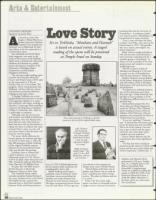
This stark memorial at Treblinka is all that
remains at the site of the original death camp.
Left: Librettist
Jack LaZebnik:
"I thought Treblinka
was a story people
should know because
it was the only
organized rebellion
at a camp."
Right: Composer
David Finko: "Our
goal is to do a All
production with sets
and costumes."
tion. In 1978, LaZebnik ghostwrote
for his mother, Edith LaZebnik, her
autobiography, Such a Life.
Before working on the opera,
LaZebnik read everything he could
find about events surrounding the
rebellion and made Abraham and
Hannah the only fictional characters.
He began incorporating Jewish themes
into his work about 15 years ago and
was referred to the composer by
Temple Israel cantor Harold Orbach.
"[David Finko and I] have met in
Jackson and Detroit, but we work by
mail," LaZebnik says of the writing
routine. "He takes my libretto and sets
it to music."
Finko, who has written eight
operas, was born in Leningrad and has
taught at seven American universities,
❑
Abraham and Hannah will be
performed at 2:30 p.m. Sunday,
May 16, at Temple Israel, 5725
Walnut Lake Road, West
Bloomfield. Complimentary
tickets are available by calling the
temple at (248) 661-5700 or the
Holocaust Memorial Center at
(248) 661-0840. Admission at
the door will be on a first-come,
first-seated basis.