

•
Not Your Average Tour
Now returned to Detroit,
1999 Miracle Mission
participants recall a
rewardingly packed trip.
HARRY KI RS BAUM
Staff Writer
ust back from a whirlwind tour
of Israel, many participants
found Michigan Miracle
Mission III a rewarding, and
occasionally grueling, 10-day trip.
"It was the fullest trip to Israel I
have ever experienced," said Rabbi
Daniel Syme of Temple Beth El, who
had made 50 previous trips to Israel.
"What amazed me was the number of
sites I had never seen before. The mis-
sion succeeded in making a program
as new and fresh for those who had
been to Israel many times as well as
those who were visiting the first time."
More than 600 people in 15 buses
left each morning for tours through
Latrun, Tel Aviv, Old Jaffa, Tiberias,
Safad, Yad Vashem and Jerusalem.
Two participants died of heart
attacks on the trip: Naomi Kline, who
died during the mission (her obituary
ran last week), and Gerald Levin, who
died during the extension tour of
Jordan. (An obituary for A'Ir. Levin
appears on page 150 and a column of
appreciation is on page 39.)
The trip was full and fast-paced, but
participants had the opportunity to take
some mornings off and taxi to their bus
later in the day if they preferred to relax.
"The pace depended on the individ-
ual," Syme said. "Those that felt that
they were not up to a particular activity
stayed at the hotel and took a rest."
Michael Shpiece of Adat Shalom
Synagogue said that all participants were
well aware of the active schedule. Miracle
Mission Chairman Ben Rosenthal "had
said that this was not a lie-by-the-pool
vacation, and he was absolutely right,"
Shpiece said. "From the moment we got
there, we were on the go. "
While Susan Golden of Temple
Israel said the pace was at times "gru-
eling," she added that the trip "was
better than we ever imagined. They
had us aoinab and seeing so much that
if you went on your own or went with
a family, you would never see and do
the things that we saw and did."
Ellen Moss of Temple Beth El said
the mission was a dream, but strenu-
!j
ous. At age 80 plus, "I think that I
was a little old to go," she said.
"There were a couple of nights I
just didn't go to some events because I
wanted to go the next day," she said,
"so I just stayed in my hotel and rest-
ed for the next day.
"When you're in your 40s, 50s and
60s, you can do all those things, but I
think I did pretty well."
Rosenthal called the pace normal for
a UJA mission, and added, "Israel is like
a tel, a 27-layer tel, and I gave them one-
and-a-half. It isn't like going to Rome or
Paris, with a list of seven sights and you
check them of and you've seen the city.
"It's a country; it's a people; it's our
culture; it's our history; it's our reli-
gion," he said. "In order to do that,
it's a more vigorous pace — there's no
question about it. But our people [on
the mission] were very good about it.
They were thrilled with it at the end.
They understood why we did it, and
they didn't want to miss anything."
Syme suggested extending the trip
to two weeks. "Israel can be over-
whelming — factually, emotionally,
spiritually," he said. "You need a little
breather just to take in and absorb it,
and maybe even to be able to discuss
with others what you saw that day."
Rosenthal said the organizers would
look into the suggestion, but noted that
adding four days would increase costs by
40 percent. "Now you're at a $4,500
trip," he said. "That's a lot of money"
All in all, it was a "fabulous mission
on a lot of different levels," according to
participant Robert Aronson, executive
vice president of the sponsoring Jewish
Federation of Metropolitan Detroit.
"If you ask everybody what could
have been done differently, some may
have said that we programmed too
much into each day, but frankly, I'd
rather have that comment than the
comment, 'Gee, we had too much
time sitting around our hotel,'" he
said. "That would not be a comment I
would want to hear." D
Additional coverage of
Michigan Miracle Mission III
is .on pages 40-42.
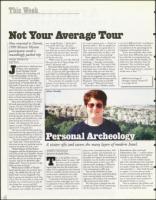
Adrien Chandler
A visitor sifts and savors the many layers of modern Israel.
ADRIEN CHANDLER
Special to the Jewish News
T
el" is the perfect word to
define Israel. It means "old"
but also is used to describe
the multi-layered archeo-
logical digs that dot the Israeli land-
scape. It's an appropriate term because
this is a complex, layered country, and
no first-time, whirlwind visit could
begin to unearth and process it all.
I expected to be fascinated by the
history and the archeology, but I was-
n't prepared to be so affected by Israel
itself— its people, its spirit and its
energy. Casual observation spells out
some of the contradictions here. Old
and new, modern and traditional, co-
exist side by side. Walk the streets of
Jerusalem and against the backdrop of
antiquity you see Israelis scurrying by,
cell phones glued to their ears. One
minute you're studying a 2,000-year-
old ruin, the next you're stuck in a
very contemporary traffic jam.
You see the Orthodox in their
black hats and coats, punkish-looking
teens wearing leather and smoking
cigarettes, and soldiers with automatic
rifles slung across their backs.
We were given a glimpse into the
complexity of the Israeli national psy-
che by being there on Holocaust
RemeMbrance Day and Israel
Independence Day — a roller-coaster
experience that careens from solemn
to joyful in one 24-hour period.
I was in Tel Aviv's Rabin Square
when the remembrance siren sounded.
For two minutes, nothing moved, no
one spoke. People got our of their cars
and stood there — their heads bowed
in respect. I've never seen an entire
country simultaneously galvanized in
memoriam, but it makes sense. No
one in Israel hasn't been touched by
the bloody battles to survive.
Then at sundown, the holiday and
the mood shift radically. The country
turns into one big block parry.