
Food
Channel 50 Airs
Jewish Cooking Series
MATTHEW DORF
Jewish Telegraphic Agency
,
hen Joan
Nathan
serves
gefilte fish
for Passover, she puts a
carrot in the fish head.
St.:
For her, the reason is
simple: That's the way her
mother-in-law always did
it.
"She died in the
Holocaust," Nathan said
during an interview in the
kitchen of her Washington,
D.C., home. Its my way
of remembering her fami-
ly," she said.
Nathan is the author
of Jewish Cooking in
America and the star of a
26-part PBS series by the
same name. The show
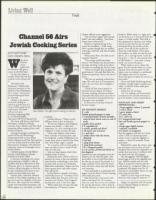
oan Nathan: She offers Jewish cooking in America.
will air at 2 p.m.
Sundays, beginning May
9, on Detroit Public
cooking.
Television (WTVS-Channel 56).
Nathan believes, "There is every
The show will feature chefs from
different kind of Jew in America.
Michigan, California, Florida,
"If you are religious, non-religious,
Arizona, Texas, Illinois and New York
kosher, non-kosher — that's not
preparing dishes ranging from tradi-
important. As a Jew, carrying on the
tional to eclectic.
tradition" is what matters, she said.
Among the people and foods fea-
That's why Nathan, who comes
tured will be Ari Weinzweig's
from a family of German Jews, and
Zingerman's Deli in Ann Arbor,
her husband, a child of Holocaust sur-
Benny Moskovitz of Oak Park and his
vivors, have tried to instill in her three
corn rye bread, and Ann Arbor food
kids "that Friday night is special.
historian Jan Longone, who tells how
"In a country with so many pulls, I
cheescake came to be thought of as a
want my kids to have a sense of who
Jewish dessert.
they are,"she said.
Celebrity guests include Elliott
And to a large degree, that's what
Gould, Cokie Roberts, Mandy
Nathan's show is about.
Patinkin and Julia Child.
During the show, which is shot on
In between sampling trial recipes
location, at times in her sun-splashed,
and preparing a challah to take to
open kitchen overlooking a cozy fami-
Shabbat dinner at the home of Seth
ly room with at least two bookcases
Waxman, the U.S. solicitor general,
filled with cookbooks, Nathan and the
Nathan offered thoughts on why her
show's guests don't only offer recipes,
Jewish cookbooks have been so suc-
they tell stories.
cessful and provided some tips.
In the Passover episode, a 93-year-
Nathan and a volunteer assistant
old fondly known as "Grandma Dora"
tended to four dishes cooking on her
makes gefilte fish. Because of her con-
gas stove and two challahs in the dou-
nection with Nathan, Dora Solganik
ble oven. The recipe for one challah,
has become a star in her own right.
made with bittersweet chocolate, will
When asked how she gets through
likely appear in a new book on Israeli
the monotony of Passover cuisine,
..
5/7
1999
Nathan offered some suggestions.
"Try stir-fried veggies with matzah
farfel," she said, adding, "Jews have
always been substitutors."
Nathan is experimenting with a
recipe for knaidlach — balls made
from a potato dough that are stuffed
with sugar and fruit and then breaded
and fried.
With potato flour, the dish can be
made for Passover.
"This recipe would have been
extinct" had Nathan not discovered it,
she said, pointing to the stove where
the dish was cooking for the first time.
"There are recipes that are gone for
good reasons," she said. But from her
firsthand experience, this is not one of
them.
"We have an amazing cultural her-'
itage. We could lose it in one genera-
don; I do not want that to happen,"
she said.
"Think of how many people in
America have no legacy of recipes,"
she said, recalling countless numbers
of people who have come up to her or
sent e-mail letters mourning the loss
of recipes never recorded.
So here are two of Joan Nathan's
favorite recipes:
MY FAVORITE BRISKET
2 t. salt
Freshly ground pepper to taste
1 5-pound brisket of beef, shoulder
roast of beef, chuck roast or end of
steak
1 garlic clove, peeled
2 T. vegetable oil
3 onions, peeled and diced
1 10-ounce can tomatoes
2 c. red wine
2 stalks celery with the leaves,
chopped
1 bay leaf
1 sprig fresh thyme
1 sprig fresh rosemary
1/4 c. chopped parsley
6 to 8 carrots, peeled and sliced on
the diagonal
Sprinkle the salt and pepper over the
brisket and rub with the garlic. Sear
the brisket in the oil and then place,
fat side up, on top of the onions in a
large casserole. Cover with the toma-
toes, red wine, celery, bay leaf, thyme
and rosemary.
Cover and bake in a preheated 325
degree oven for about 3 hours, basting
often with pan juices.
Add the parsley and carrots and
bake, uncovered, for 30 minutes
more or until the carrots are cooked.
To test for doneness, stick a fork in
the flat (thinner or leaner end of the
brisket). When there is a light pull
on the fork as it is removed from the
meat, it is fork tender. This dish is
best prepared in advance and refrig-
erated so that the fat can be easily
skimmed from the surface of the
gravy. Trim off all the visible fat
from the cold brisket. Then place
the brisket, on what was the fat side
down, on a cutting board. Look for
the grain — that is, the muscle lines
of the brisket — and with a sharp
knife, cut across the grain.
When ready to serve, reheat the
gravy. Put the sliced brisket in a roast-
ing pan. Pour the hot gravy on the
meat, cover and reheat in a preheated
350 degree oven for 45 minutes.
Strain the gravy, or keep the onions, as
you prefer.
Serve with farfel (boiled egg barley
noodles), noodle kugel or potato pan-
cakes. A colorful winter salad goes
well with this.
Yield: 8 to 10 servings.
Tip: Try adding a jar of sun-dried
tomatoes to the canned tomatoes to
give the brisket a more intense flavor.
EGGPLANT AND GREEN
PEPPER KUGEL
1 large eggplant (about 2 pounds)
1 onion, diced
1 green pepper, diced
2 T. pine nuts
1/4 c. olive oil
2 T. chopped fresh basil
Salt and freshly ground pepper to
taste
2 large eggs, lightly beaten
1 matzah, crumbled
2 T. butter or margarine
Peel the eggplant and dice in 2-inch
cubes. Cook in simmering salted
water to cover until the eggplant is
tender — about 20 minutes. Drain
and mash.
Meanwhile, saute the onion, pep-
per and pine nuts in olive oil over
medium heat until the vegetables are
tender but not crisp. Combine with
the basil and salt and pepper.
Mix the eggplant with the lightly
beaten eggs as well as the vegetable mix-
ture. Add the matzah and mix well.
Place in a greased casserole and dot
with butter or margarine. Bake in a
preheated 350 degree oven for 35
minutes or until golden brown on top
and crusty on the sides.
Yield: 6 to 8 servings with butter
(Dairy); with margarine (Pareve).1-1
Recipes are reprinted with the permis-
sion of "Jewish Cooking in America,"
published by Knopf
K
Scanned image of the page. Keyboard directions: use + to zoom in, - to zoom out, arrow keys to pan inside the viewer.
May 07, 1999 - Image 114
- Resource type:
- Text
- Publication:
- The Detroit Jewish News, 1999-05-07
Disclaimer: Computer generated plain text may have errors. Read more about this.