

Rabbinic Smorgasbord
NEIL RUBIN
Senior Editor
Baltimore
ary Robuck, peeking up
from a Jewish history book
he was considering buying,
candidly described the
impression his Rabbinical Assembly
convention left with him.
"I've had a chance to reflect on the
degree to which spirituality and the
search for God will inform my work
as a rabbi, and a husband, and a
father," said the spiritual leader of
Congregation Shaarey Tikvah in
Beachwood, Ohio. "Being a pulpit
rabbi doesn't always allow for that.
He and about 500 colleagues at this
week's Baltimore-hosted R.A. conven-
tion, the annual gathering of
Conservative rabbis, spent their days
dining on a smorgasboard of Jewish
learning, research and debates.
Their most potentially contentious
issue — the placement and ordination
of openly avowed gay and lesbian rab-
binical students — was kept off the
convention floor. On Wednesday after-
noon, the R.A. was expected to go into
a closed session to endorse the "don't
ask, don't tell" policy that it has prac-
ticed; the compromise apparently was
worked out by the Jewish Theological
Seminary and the R.A. with student
and rabbinic gay rights advocates.
The hallways of Baltimore's Sheraton
Inner Harbor second- and third-floor
lobbies were swamped with multi-col-
ored kippot worn by men and women
sampling dozens of booths offering
books, seminars, travel and Judaica.
Rabbinic banter was ceaseless, between
and even during sessions. At one point
the Chesapeake Ballroom was filled
with chatting rabbis. "Rabboti," one
gentleman angrily stood up and said,
you wouldn't want your congregants to
be as rude as you're being right now!"
At an annual Conservative convention,
500 rabbis are chastised and re-energized.
G
)7
"
Fire And Brimstone
Rabbi Arthur Hertzberg spoke like a
fiery preacher as he blasted his
Conservative colleagues for devoting
too little time to Torah study and
teaching in order to chase fads and
preserve their institutional interests.
The problems, he said, are not sis-
terhood raffles, synagogue presidents
or how to improve wages and powers.
Rather, the rabbinate must decide how
to position itself in an increasingly
complex and pluralistic society after a
century of trying to find its place
within a Christian majority
"You had better return to being 'the
Rebbe' of your congregations that sets
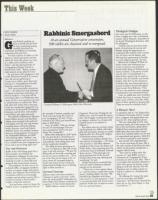
Cardinal William H. Keller greets Rabbi Alan Silverstein.
Theological Dialogue
Jews must put the Holocaust, as awe-
some a tragedy as it was, in historical
context, Ismar Schorsch, chancellor of
the Jewish Theological Seminary, told
his colleagues.
"I believe that we Jews have been
guilty of restricting the canvas and
thereby losing the opportunity to
understand the Catholic faith commu-
nity far better and far deeper, and
allowing that opportunity to fertilize
our own religious growth," he said.
Baltimore's Cardinal William H.
Keeler noted that Holocaust sur-
vivors in America are primarily
Jewish while those in Poland are pri-
marily Catholic. The power of heal-
ing, he said, is encapsulated in a
scene from a recent trip he took to
Poland with 20 Catholic and Jewish
leaders. One Jew on the trip and a
Catholic they met discovered that a
mutual Catholic friend had helped
them escape from Birkenau. They
fell into one another's arms weeping,
recalling their now deceased friend.
Later, he added that some Catholics
"risked their lives as rescuers. Some of
them, most of them, were idle, while
some of them assisted in the genocide.
These are areas for scholarly study"
A Woman's Place?
the example of teacher, preacher and
Torah and stop being the CEOs of
your synagogues," he said. "If you
wanted to be CEOs, you should have
gone to Wall Street."
Later, he added, "Did you change
the rate of intermarriage? Did you
stem assimilation? Did we do any-
thing? Very marginally."
Rather than looking for a fad's "quick
fix," he said, the R.A. should focus on
the Jewish people's long-range interests
and problems, while asking what kind
of role models they should be.
The rabbis he knew growing up as
the son of a Baltimore rabbi left a book
open to go help someone. "We give the
feeling that we have left a meeting and
are on our way to another one ... If we
are to be what we are meant to be, we
must, above all, be people linked to
Torah and whose love for Torah and
deepening knowledge of it is a shining
light to those around us."
Spiritual Yearnings
Judaism today is far more involved in
),
attempts to speak to the heart rather
than the mind, said JTS philosophy pro-
fessor Rabbi Neil Gillman, moderator of
a panel on "A New Jewish Spirituality"
Rabbi Gillman, author of Sacred
"
Fragments: Recovering Theology for the
Modern Jew, said the search for spiritu-
ality "has brought countless Jews back
to religion, whether it's a [Lubavitch]
Chabad house or an ashram in
Pakistan."
But others were not so kind, attack-
ing the pursuit as a selfish, self-indul-
gent and narcissistic attempt to model
Judaism after the "feel good" religion
of American secular society.
Conservative Judaism already con-
tains plenty of spirituality --- for those
who practice it, said Elliot Abrams,
president of the Center for Ethics and
Public Policy. Non-practicing Jews, he
continued, want an informal, watered-
down service. "They don't get any-
thing spiritual [out of the service]
because they never stop chatting and
socializing," he said.
Rodger Kamenetz countered that
what he called "meditative Judaism"
should not be dismissed.
"There's just a new urgency about
it," said the author, whose most recent
book is Stalking Elijah. He said, "We
shouldn't get impatient with those
who come to us with questions. I find
it incomprehensible that Conservative
Judaism would turn its back on some-
one on a personal quest."
A scheduled talk on "An Exploration
of Modern Portrayals of Eve" turned
into a support and appreciation ses-
sion for Dr. Anne Lapidus Lerner.
The vice chancellor of JTS, who
attracted nearly all of the women rab-
bis at the convention, spoke about
biblical Eve's assertiveness and the
difficulties that arise when stories
about her husband Adam can be read
as ungendered and generic, while Eve
can never be placed in such context.
Last month, JTS requested that
Dr. Lerner step down by June. She is
the only woman of the four vice chan-
cellors. So the session turned into a
support rally of sorts.
"You need to realize who this
woman is," said Rabbi Lynn C.
Liberman of Congregation B'nai
Amoona in Saint Louis, Mo. "She is
a rare light that has been allowed to
shine for a group of women strug-
gling to find our identity. For the
Seminary not to make a point to
help her achieve is a fundamental
slap at us.
By offering Dr. Lerner the posi-
tion six years ago, said Rabbi
Liberman, "the Seminary opened the
door for us, but they forgot to clear
the hallway." 17
73
4/30
1999
Detroit Jewish News
21