
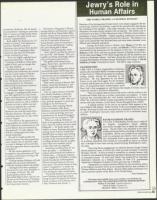

THE FAMILY FRANKS: A COLONIAL DYNASTY
committee. Buckman, like the board,
is committed to creating an institution
that is "serious and halachically based,
but appeals to the wider Jewish com-
munity," explained Roth.
Roth added that Buckman has "an
ability to connect" with adolescents
and that "heartfelt" praise for
Buckman came not just from the fam-
ilies in his own Congregation Beth
Israel, but also from the Milwaukee
Jewish community at large.
He is very highly regarded across
denominational lines," said Roth.
"Orthodox and Reform rabbis spoke
highly of him, and we thought this
was a key attribute."
Buckman has taught in both
Orthodox and community day schools
and has invited modern Orthodox
thinkers, like Israeli scholar Aviva
Zornberg, to speak at his synagogue.
His 730-family shul is known as "a
meeting place for the Orthodox,
Reform and Conservative communi-
ties," said Buckman.
Milwaukee's largest Conservative
synagogue, Congregation Beth Israel is
not fully egalitarian but did recently
begin counting women in the minyan.
The Jewish Academy will have a fully
egalitarian minyan, as well as tradition-
al prayer services in which men and
women are separated by a mechitza.
In Detroit for a quick visit,
Buckman met with the Jewish News
Monday afternoon. He spoke with
enthusiasm about his new job, which
starts in August.
"This school is the opportunity to
bring together the modern Orthodox
and Conservative communities as well
as the Reform who are interested in
this approach," he said, adding, "This
will be a training place for future
Jewish leadership."
He said he would consider the
school a success if its future graduates
were "people who are Zionists, eager
to enter in dialogue with sacred texts
and who appreciate diverse expressions
of Judaism."
He also expects graduates to be
accepted to top universities and "have
a serious commitment to living a life
guided by mitzvot."
In hiring teachers, Buckman will seek
people who can convey information
while also serving as Jewish role models.
Although he has been working in
Wisconsin for nine years, Buckman is
no stranger to Detroit. His wife
Rachel graduated from West
Bloomfield High School, and the cou-
ple met at the University of Michigan
Hillel, where Buckman helped found
the Conservative minyan.
The family is frequently in Detroit
visiting relatives, and Buckman is good
friends with B'nai Moshe Rabbi Elliot
Pachter. Pachter knows Buckman from
the Jewish Theological Seminary, U-M
and the Conservative Movement's
Camp Ramah, where he remembers a
feisty 10-year-old Buckman "leading
the entire dining hall in Birkat
HaMazon," the blessing after meals.
"Every job he's ever had he seems to
do very well," said Pachter. "He's very
capable and brings knowledge, dedica-
tion, enthusiasm and sincerity."
The gabbai of Buckman's syna-
gogue, Marty Stein, said Detroit was
"lucky" to snag his rabbi.
"He's a brilliant young man and an
outstanding teacher. He'll bring with
him an extraordinary level of intellect
and learning and an unequaled capa-
bility to convey that knowledge mean-
ingfully," said Stein.
Beth Israel's executive director, Ben
Steltzer, noted that Buckman is "par-
ticularly good with younger families
and youth."
Now an ardent advocate of Jewish
day schools, Buckman is himself a
product of synagogue schools. He
decided to become a rabbi while start-
ing a graduate program in social psy-
chology at the University of
Minnesota. After studying Talmud
with an Orthodox rabbi there,
Buckman realized he preferred Jewish
texts to social psychology texts and
transferred to the Jewish Theological
Seminary. He was ordained in 1990.
When not working, Buckman is
likely to be spending time with his chil-
dren, whom he and his wife have raised
bilingually — the family speaks only
Hebrew at home. Buckman also enjoys
reading (recent favorites include Pete
Hamill's Snow in August and anything
by John Grisham) and working out. A
member of the male gymnastics team
in college, Buckman recently complet-
ed his third mini-triathlon and he
swims, bikes and runs regularly.
Assuming it enrolls at least 25 stu-
dents per grade — and Buckman
expects approximately 40 students in
the first year — the Jewish Academy
will be eligible for $750,000 in United
Jewish Foundation of Metropolitan
Detroit start-up funds over the next
three years. The school intends to keep
tuition "competitive," to attract stu-
dents, but Buckman declined to dis-
close the figures under consideration.
The Jewish Academy is one of many
non-Orthodox Jewish high schools
being founded throughout the United
States, in places such as Boston, New
York, Cleveland and Atlanta.
Members of the distinguished Franks family were deeply engaged with the
commercial, political and military issues of the period before and during
the founding of the republic. Like other colonists, they were divided in
allegiance, but were mostly aligned with our patriots. The Franks rose to
prominence at a time (1750s) when fewer than 2,500 Jews lived within a
population of some 2,500,000. Yiddish-speaking Ashkenazic newcomers
from Holland, Poland and England formed the majority. The balance was
made up by Sephardim who preceded them and were better educated, more
affluent and culturally advanced.
Among the Franks loyal to Britain were Moses (1719-89), the
family's business representative in London, and David (1720-93) who was
imprisoned by the Americans for the duration of the war. His daughter,
Rebecca (1760-1823), had been a popular charmer in English social circles.
On the other hand, Isaac (1759-1822) fought bravely for the rebellion and
retired as a lieutenant colonel. And later, during the yellow fever epidemic
ravaging Philadelphia, President George Washington took refuge in David
Salisbury Franks' Germantown home. The family saga continues:
JACOB FRANKS
(1688-1769) b. London, England Born of German
parents, the mercantile family's founder emigrated
to New York in 1708 and succeeded in creating a
trading empire linking his homeland to the
provinces. He was appointed by the British
Crown as its sole fiscal agent for the Northern
Colonies and became one of the city's wealthiest
Jews. In ecumenical spirit, Franks helped build
New York's first synagogue as well finance the steeple of Trinity Church
which still stands in downtown Manhattan.
There is evidence that he had served earlier with the militia in the
French and Indian Wars as a civilian commissary and supplier. A noted
historian has concluded that the "real Jewish contributions to the war
effort" lay in the Jews' ability to keep commodities flowing to Washington's
armies and loyal citizens--as did Jacob Franks throughout the conflict.
A lasting memory of his role in our nation's birth appears in the
city's Battery Park district. Said to be New York's most elegant mansion of
the day, the home he built was converted into a landmark: Fraunces Tavern
in which Washington famously bade farewell to his Continental Army
officers.
DAVID SALISBURY FRANKS
(1743-93) b. Philadelphia, PA His story is that of
an English sympathizer whose shifting
convictions brought him to adopt the American
cause. David Franks was educated in his city's
leading university before relocating to Montreal as
a merchant. But he soon irritated local authorities
with his outspoken pro-liberty views and joined
the Continental Army at age seventeen, Sent off
on a military expedition into Canada, he rose rapidly in rank as an officer
and is thought to have been among General George Washington's aides-
de-camp.
Surviving fierce engagements in which he bravely fought, Franks
almost ended his career, if not his life, while a private secretary to General
Benedict Arnold. At first accused of complicity to commit treason with
Arnold, he was cleared by the general's persuasive denial and was promoted
to lieutenant colonel. At war's end, Franks was posted off on important
diplomatic missions as a foreign courier of vital U.S. government
dispatches to Benjamin Franklin in Paris and John Jay in Madrid.
Respected as a trusted consular official, he also served our nation
at the highest executive levels as an occasional advisor and confidant of
Thomas Jefferson and John Adams. His last office before retirement was
that of assistant cashier of the Bank of the United States.
- Saul Stadtmauer
Visit many more notable Jews at our website: www.dorledor.org
COMMISSION FOR THE DISSEMINATION OF JEWISH HISTORY
Walter & Lea Field, Founders/Sponsors
Irwin S. Field, Chairperson
Harriet F. Siden, Chairperson
Detroit Jewish News
4/30
1999
us