

Theater Review
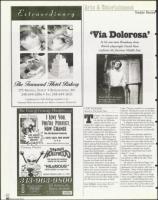
`Via Dolorosa'
In his one-man Broadway show,
British playwright David Hare
confronts the fractious Middle East.
175 MERRILL STREET • BIRMINGHAM, MI
248-644-6506 • FAX 248-644-3632
David Hai e: 90-minute
monologue on what ails
the ProMiseel:Land.
Complimentary Valet Pal-king Available at the
Townsend Hotel Entrance for our Bakery Customers Exclusively!
The Gem
Century Theatres
Gem Theatre
ASK ABOUT
HALF-PRICE
SHOWS!
it
t
pas(nt
LOVE YOU,
YOU'RE PERFECT,
NOW CHANGE
The Hit Musical Comedy
"CUTE CAST, FUN SHOW"
* * *
- Lawrence Define, Detroit Free Press
THE SMASH HIT MUSICAL
SPOOF OF THE MOVIES!
'CRITIC'S CHOICE' Los Angeles Times
If
GRAND OPENING APRIL 14, 1999!
I
-3.13( .963. 9800
3:33 Maths°, vire.
'Dtroit, MI 48226
CENTURY
)
*(di -\1")1( rTroulm of
1.5 or ► u)ly .3/3) 962-2913.
(
4/23
1999
DETROIT'S PREMIER THEATRE LOCATION.
90 Detroit Jewish News
arram,
(248) 645-6666
CURT SCHLEIER
Special to The Jewish. News
I
o begin: Via Dolorosa is not
a play. It is a magazine arti-
cle read by its Christian
author, David Hare, a trav-
elogue that might have appeared in
the old Saturday Review. It is spoken
artfully, is excellently staged and on
the surface appears fair and balanced.
But it is just reportage, not drama,
and ultimately bad reportage at that.
In 1997, Hare — who's conquered
Broadway in the past year with The Blue
Room starring Nicole Kidman, The Judas
Kiss with Liam Neeson and Amy's View,
which just opened with the Oscar-win-
ning Dame Judi Dench — made his first
trip to the Middle East, at the behest of
an international theater organization.
He was one of three playwrights (a
second was Israeli and the third
Palestinian) selected to write about
rule under the British Mandate. Once
there, Hare, 51, decided that writing
about the current situation was more
interesting that delving into history.
So he did what any good journalist
visiting Israel and the West Bank would
do. He interviewed people on both
Curt Schleier writes about the arts
fi-om his home in New Jersey
sides. The play reveals he is an intrepid
reporter. During the course of the play,
he visits, and assumes the personas, of a
series of apparently extremely literate
Israelis and Palestinians — 33 in all —
who provide him with great quotes.
A religious Israeli says the Six-Day
War changed things. Jews seized lands
and became "concerned with more
than ideas," and that was "profoundly
un-Jewish."
A Palestinian excoriates Arafat for
corruption, remarking that "there are
more Palestinians in prison under Arafat
than there ever were under the Israelis."
An Israeli suggests that all the terri-
tories should be turned over to the
Palestinians, and that the Israelis
should just "stand back and watch
them f--- it up."
But, ultimately, and although he
says plenty to offend all sides, Hare
just doesn't get it.
He reports what Benny Begin, son
of the former prime minister and a
spokesman for the settlers, tells him in
Jerusalem: "Most of what happened in
Jewish history happened within 20
miles of here. This is where our kings
ruled, our judges judged, our prophets
prophesied." In describing their com-
mitment, settlers compare Memorial
Day in Israel, where a siren blows and
everyone stands still for two minutes,