
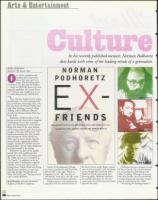

In his recently published memoir, Norman Podhoretz
does battle with some of the leading minds of a generation.
JERRY HERMAN
Special to The Jewish News
O
ne of the problems with
intellectuals is that some-
times they just aren't very
smart. David Halberstam's
1973 book The Best and the Brightest
— about the JFK-LBJ brain trust that
tragically propelled the United States
into Vietnam and couldn't get us out
— made that principle abundantly
clear.
Now Norman Podhoretz has amply
reconfirmed it in a less consequential
but nonetheless interesting arena with
his new book, Ex-Friends: Falling Out
NORMAN
POPHDRETZ
with Allen Ginsberg, Lionel 6-. Diana
Trilling, Lillian Hellman, Hannah
Arendt and Norman Mailer (The Free
Press; $25).
Podhoretz, longtime editor of the
Jewish-oriented, conservative magazine
Commentary, has written a memoir
about the disintegration of his friend-
ships with some of the most influen-
tial American literary and cultural per-
sonages of the past half-century. The
book demonstrates how the consider-
able brainpower of his friends was
often used to elevate points of petty
personal pride. Apparently brilliant
insights masked the childish motives
beneath them. To his credit, Podhoretz
includes himself in the charge.
Podhoretz was part of the largely
Jewish New York intellectual elite
spawned in the 1930s and lasting into
the 1980s, known to its members as
"the Family." In addition to the ex-
friends listed in Podhoretz's ungainly
subtitle, writers and critics such as
Irving Howe, Sidney Hook and Irving
Kristol were members, as were non-
Jews like Dwight Macdonald and
Mary McCarthy, and "kissing cousins"
such as James Baldwin.
Jerry Herman writes for the Jewish
Bulletin of Northern California.
4/23
1999
80 Detroit Jewish News
FALLING OUT WITH ALLEN GINSBERG4IONEL AND DIANA TRILLING'.
LILLIAN HELLMAN. HANNAH ARENDT,- AND NORMAN MAILER
Nearly all of Podhoretz's fallings-
out were caused by his shift from the
political left to the right. When it
originated in the '30s, members of
"the Family" were all on the left, many
of them Communist Parry members.
Disillusionment with communism,
especially with the totalitarianism of
the Soviet Union under Stalin, caused
many to lose sympathy with the Soviet
Union though they remained leftist.
While his friends maintained their
left-wing ideals, Podhoretz deserted
his youthful liberalism for the neo-
conservatism he and Commentary have
espoused for years.
Podhoretz devotes a chapter to each
of his ex-friends. He is at his nastiest
in recounting his relationship with
Allen Ginsberg. Although never actu-
ally close friends, the two maintained
a rivalry beginning with their student
days at Columbia in the 1940s.
On hearing of Ginsberg's death in