

The Middle Is Rejuvenating
NEIL RUBIN
Senior Editor
Baltimore
A
aron Gaber has learned a
„ incr..
two after three
n
years as a Conservative pul-
pit rabbi. There's a delicate
balance between nurturing the spiritu-
ality of congregants and pushing
them too fast to keep every com-
mandment precisely.
"I'm under no illusion here that
I'll get more people to walk to
shul on Shabbat," said the spiritu-
al leader of Congregation Adat
Chaim in Reisterstown, a
Baltimore suburb. "It's more
important to me that I put
Shabbat in people's lives, that they
know what it is and consider it
something special."
By that measure, he and the move-
ment in which he serves say they are
doing fine in seeking to be a distinct
entity in Jewish theological life. They fit
comfortably, they say, into the panora-
ma of American Judaism where a
vibrant, growing core is nurtured while
overall numbers continue to shrink.
The Conservative Movement's
Rabbinical Assembly (R.A.) will meet
in Baltimore this weekend for its
annual convention, one that will
focus on giving even more precision
to the movement's message and how
it should help shape the profound
changes impacting American
Judaism. About one-third of the
movement's 1,500 members are
expected to attend.
Conservative Judaism, with its corn-
mitment to the evolving, but still
binding nature of Jewish law, has
always promoted itself as a realistic,
tolerant center in Jewish theological
life. But now, there's a crystallizing of
its message for the 1.8 million
American Jews who identify as
Conservative — about one in three
Jews in this country.
The Jewish Theological Seminary of
America in New York City is charged
with sharpening the message to
Conservative Jews. The Conservative
Movement's leading academic institu-
tion has recovered from some acute fis-
cal problems; strong again, it is about
to embark on a $250 million fund-
raising effort.
A publication blitz has included a
new prayer book and a new manual
for rabbis, the first since the mid-
1960s. A new chumash, or Five Books
of Moses, will be published next year.
Conservative day schools and the
Camp Ramahs generally have waiting
Gillman, a philosophy professor at JTS.
"What this is forcing us to do is to give
up the old traditional line, which is we
are ad Yisrael, we are everybody, and
to say there is a distinct style of what it
means to be Conservative. This is not
all-purpose Judaism."
And yet, a nagging dilemma
remains for its spiritual leaders: How
do they convince congregants to be
Conservative Jews? As but one example
of the contradictions they face, a mid-
1990s survey showed that while 62
percent of Conservative Jews said they
are obligated to obey halacha, or
Jewish law, 76 percent agreed that one
need not be "particularly observant
to be a "religious Jew."
The movement has responded by
building more Conservative day schools,
and 18,000 students now are enrolled in
70 Solomon Schechter schools.
It has also beefed up the teaching
end. In 1996, JTS opened a graduate
school of Jewish Education in New
York, funded by and named for William
Davidson, the Detroit-area businessman
and philanthropist. This spring, eight
students will graduate from the first rab-
binical class of the Los Angeles-based
Ziegler School of Rabbinic Studies at
the University of Judaism.
The emphasis on formal education
is putting pressure on the afternoon
Hebrew schools, where at least three-
quarters of the children of Conservative
families continue to be trained. Rabbi
Seymour Essrog, president of the R.A.,
notes that the supplementary Hebrew
school could become an endangered
species in some communities.
"As we move farther apart geograph-
ically, and with both parents working,
it becomes virtually impossible to pro-
vide a three-day-a-week school," he
says. "I think the future is in day school
education, and not only in quality."
However, the push for more intense
Jewish venues for youth is a needed
one. "Years ago we used to know
where our next generation was coming
from," says Rabbi Loeb. "It was people
who fell off from Orthodoxy. Now
Orthodoxy is resurgent and people
who are intermarried tend to go to the
Reform movement. The natural supply
line for us is the internal one, from the
day schools and the Camp Ramahs."
In years to come, these younger
Jews will be more fluent in Hebrew,
prayer and theology than their parents.
That will push Conservative rabbis to
offer a higher level of programming.
"For the first time we are seeing a
growing core that defines itself in posi-
"
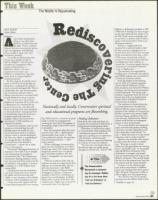
Nationally and locally, Conservative spiritual
and educational _programs are flourishing.
lists. While the R.A. continues to push
study in Israel, its congregational
counterpart, the United Synagogue, is
developing a large Conservative center
in Jerusalem.
Even the emotional splits that once
created serious rifts — egalitarianism,
homosexuality, East Coast vs. West
Coast rabbinical schools, the participa-
tion of intermarried Jews — seem
under control.
Of the challenges, homosexuality
gains the most headlines, as it did a
month ago when JTS students chal-
lenged the school's ban on openly
gay and lesbian students. But the
issue is manageable, say movement
insiders.
"The fact is that at some time we
will have to look at it again and it'll be
difficult, but homosexuality will not
split the movement," says Rabbi
Arnold Goodman of Ahavath Achim
Synagogue in Atlanta, a long-time
member of the R.A.'s Committee on
Jewish Law and Standards. As Rabbi
Mark Loeb, co-chair of the R.A. con-
vention, says, - Right now, as far as I'm
concerned, there is no big issue."
Finding Definition
Both from the inside and from the
outside, the Conservative Movement is
being forced toward greater clarity.
Orthodoxy in America has surged
in recent decades while wrestling with
a simultaneous general shift to the
right and a growing cry to experiment
with feminism. Simultaneously,
Reform Judaism is vigorously debating
its embrace of ritual and tradition.
"You have two movements that on
the left and right are rapidly going
through an internal war," says Dr. Neil
K=?-
anNiE
m am a ta
ns am E
RE:r
A
mikanBM'a,
The Conservative
Movement is sharpen-
ing its message. Rabbis
say it's a lot more than
"not too Orthodox" or
"not too Reform."
CENTER on page 24
4123
1999
Detroit Jewish News
21