

gd2blaarrnY.7teNilr'"Iiririt8
SPECIAL COMMENTARY
P hoto cour
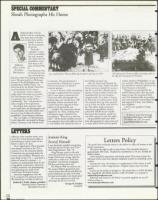
frightened boy with his
hands in the air, wondering
why these men with rifles
want to hurt him and his
family. A man at
the last moments
of his life.
Both pho-
tographs I've seen
many times before,
but only recently
did I learn that my
grandfather recov-
ered them at the
JOSHUA
close of World War
PAUL CANE
II.
IN Online
I am fortunate that
Web Producer
my family has been
very vocal and can-
did about their lives during the Holo-
caust. My great-uncle is a Holocaust
lecturer in the Philadelphia area. My
grandmother, Bubbie Esther, was
interviewed by the Shoah Visual His-
tory Foundation for five hours.
At restaurants, when a waitress
might notice the tattoo on my bub-
bie's left forearm and ask, "Is that...?"
my grandmother would tell her
unabashedly, "Yes," and proceed to
talk at length of her experiences.
But despite their openness, I had
never heard about the photographs until
I joined Bubbie and other family mem-
bers on a tour of where she and my
grandfather, Zayde Herman, had been.
The tour began in Thereisenstadt,
Czech Republic, and ended in Bergen-
Belsen, Germany, with Poland much
U. S. Ho locaus t Memo rial Museu m
Shoah Photographs Hit Home
Jews expelled from Warsaw following the ghetto uprising in 1943.
in between. The anti-Semitism I
encountered in Poland was so preva-
lent and tenacious as if almost a
national pastime.
It was in Warsaw, while meandering
through a neglected Jewish cemetery,
that I came upon a memorial with
black-and-white photographs dis-
played, these two among them. Off-
handidly, Bubbie mentioned that
Zayde found the originals of those
photos at the end of the war.
I nodded. The information almost
slipped by me. Then, realizing what
she had just said, I turned to her,
incredulous: "What do you mean by
that?" All the family members around
me seemed to know this tidbit too, but
it was Bubbie who related the story in
1942 photo of a German soldier executing a Jew at
the edge of a mass grave in Vinnitsa.
her Yiddish-accented way.
After the Americans liberated the
concentration camp, Zayde and other
former prisoners roamed the country-
side for several days. Wandering, he
passed a German soldier's home and,
emboldened by his new freedom,
charged inside. On a desk or bureau,
he found the two photos and a third.
He snatched them up, then stormed
out as if that was all he came there to
do. The soldier made no protest,
allowing my grandfather to leave
unharmed. Maybe he saw Zayde's
fierce eyes that stated he would not
ever allow anyone to hurt him again.
My grandfather held onto those
three photographs for many years and
in many places till he and my grand-
mother settled in Philadelphia. It was
not until the 1960s when my grandfa-
ther decided to send the photos to the
Israel Museum in Jerusalem.
Perhaps he was prompted by the
Adolf Eichmann trial, when the world
began to learn the meaning of Holo-
caust. But fundamentally, my grandpar-
ents wanted people to never forget what
had happened to them, their families,
their neighbors.
I don't want people, to forget
either. E
To leave a voice-mail message
for Joshua Paul Cane, call (248)
354-6060, ext. 225, or e-mail
jcane@thejewishnews.com
LETTERS
influence other member states, even
some if its closest European allies, is
diminishing as a direct result of the
failure to pay U.N. dues.
As an organization whose founders
were deeply involved in the U.N.'s
creation, we at the American Jewish
Committee are concerned about the
current state of affairs. Whatever one
may think of the U.N. — and there is
plenty of room for criticism — it
remains an indispensable body for fos-
tering global cooperation, advancing
conflict resolution and peacekeeping,
and addressing the needs of the
world's least-developed nations.
American engagement with the
U.N. promotes the national interest.
We should pay our debt in full now.
Frederick J. Frank, chapter president
American Jewish Committee
Bloomfield Township
4/16
1999
26 Detroit lewish_Ne_w_s
Jordan's King
Served Himself
I was absolutely appalled seeing King
Hussein's picture on the cover ("Jor-
dan's King Hussein," Feb. 12).
King Hussein stood on the side
where he benefited the most. Lest we
forget! Did he not occupy what the
Arabs like to refer to as "Arab East
Jerusalem" and destroy synagogues,
kill Jews and chase them out?
The Western Wall was used as a sta-
ble, ancient Hebrew gravestones were
used as latrine floor blocks and didn't he
permit Jordanians air space to be used
by Iraqi Scud missiles to hit Israeli cities?
He was an opportunist and took
advantage for his own survival.
George H. Duchin
Southfield
Letters Policy
The Jewish News welcomes letters to the editor on topics of interest to the
Jewish community.
We reserve the right to edit or reject letters. They should be limited to
approximately 350 words. Deadline for consideration is 10 a.m. Tuesday for
Friday's edition.
Letters should be typewritten and double spaced. They must contain the
full name of the writer and a daytime telephone number so authorship can be
verified.
Include the town of residence or employment of the writer as well
as a position or title, if appropriate. Original copies must be hand
signed.
Letters can be mailed or brought to The Jewish News at 27676 Franklin
Rd., Southfield, MI 48034; faxed to (248) 354-6069; or e-mailed to:
rsklar@thejewishnews.com
Editorials and Letters to the Editor are posted regularly on our JN
Online website at
wvvw.detroitjewishnews.com