
Center Cannot Hold
Despite initial fanfare, Yitzhak Mordechai's
Center Party is running a distant third.
C\
O
0
ERIC SILVER
0
Israel Correspondent
Jerusalem
N
o doubt to Yitzhak
Mordechai's dismay, park-
ing was no problem Sunday
night near the Jerusalem
Theater, where the new Center Party
launched its assault on the hearts and
minds of the capi-
tal's voters.
"Only Mordechai
can win big," pro-
claimed the banners
and posters of the
movement's leader.
The trouble is,
despite the initial
fanfare, the former
Likud member and former defense
minister doesn't look like he'll be a
player when the ballots are tallied after
the May 17 national election.
And the voters smell it, which is
why the theater, which can hold 950,
was barely nvo-thirds full. The Center,
it seems, is beginning to ring hollow.
Indeed, the polls continue to show
that in head-to-head competition,
Mordechai would beat incumbent
Prime Minister Binyarnin Netanyahu
by six points and Labor's Ehud Barak
by three points. But those polls also
show that Mordechai will not be one
of the two finalists in what's widely
expected to be a June 1 runoff, assum-
ing no candidate wins 50 percent or
more of the votes.
Neither the Center Party nor its
candidate has established a clear iden-
tity or message. The slogans call for
national unity, an end to the ethnic,
religious and social divisions racking
the nation. However, so do Barak's —
and to prove it, the Labor leader has
drawn the Moroccan standard-bearer
David Levy and the moderate
Orthodox Meimad movement under
his "One Israel" umbrella.
Of the "Four Musketeers" running
4/16
1999
26 Detroit Jewish News
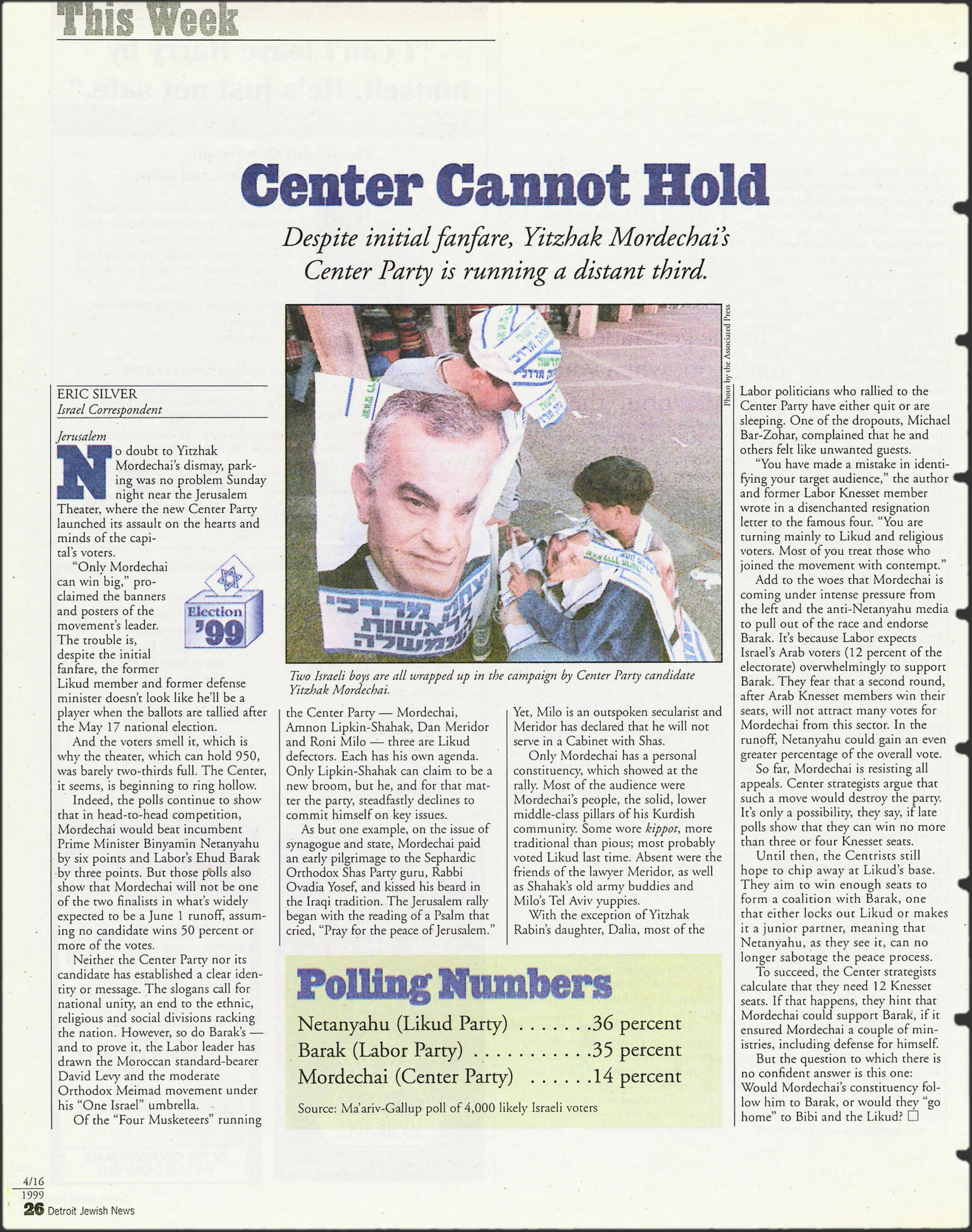
Two Israeli boys are all wrapped up in the campaign by Center Party candidate
Yitzhak Mordechai.
the Center Party — Mordechai,
Amnon Lipkin-Shahak, Dan Meridor
and Roni Milo — three are Likud
defectors. Each has his own agenda.
Only Lipkin-Shahak can claim to be a
new broom, but he, and for that mat-
ter the party, steadfastly declines to
commit himself on key issues.
As but one example, on the issue of
synagogue and state, Mordechai paid
an early pilgrimage to the Sephardic
Orthodox Shas Party guru, Rabbi
Ovadia Yosef, and kissed his beard in
the Iraqi tradition. The Jerusalem rally
began with the reading of a Psalm that
cried, "Pray for the peace of Jerusalem.
Netanyahu (Likud Party)
Barak (Labor Party)
Mordechai (Center Party)
Yet, Milo is an outspoken secularist and
Meridor has declared that he will not
serve in a Cabinet with Shas.
Only Mordechai has a personal
constituency, which showed at the
rally. Most of the audience were
Mordechai's people, the solid, lower
middle-class pillars of his Kurdish
community Some wore kippot, more
traditional than pious; most probably
voted Likud last time. Absent were the
friends of the lawyer Meridor, as well
as Shahak's old army buddies and
Milo's Tel Aviv yuppies.
With the exception of Yitzhak
Rabin's daughter, Dalia, most of the
36 percent
35 percent
14 percent
Source: Ma'ariv-Gallup poll of 4,000 likely Israeli voters
Labor politicians who rallied to the
Center Parry have either quit or are
sleeping. One of the dropouts, Michael
Bar-Zohar, complained that he and
others felt like unwanted guests.
"You have made a mistake in identi-
fying your target audience," the author
and former Labor Knesset member
wrote in a disenchanted resignation
letter to the famous four. "You are
turning mainly to Likud and religious
voters. Most of you treat those who
joined the movement with contempt."
Add to the woes that Mordechai is
coming under intense pressure from
the left and the anti-Netanyahu media
to pull out of the race and endorse
Barak. It's because Labor expects
Israel's Arab voters (12 percent of the
electorate) overwhelmingly to support
Barak. They fear that a second round,
after Arab Knesset members win their
seats, will not attract many votes for
Mordechai from this sector. In the
runoff, Netanyahu could gain an even
greater percentage of the overall vote.
So far, Mordechai is resisting all
appeals. Center strategists argue that
such a move would destroy the party.
It's only a possibility, they say, if late
polls show that they can win no more
than three or four Knesset seats.
Until then, the Centrists still
hope to chip away at Likud's base.
They aim to win enough seats to
form a coalition with Barak, one
that either locks out Likud or makes
it a junior partner, meaning that
Netanyahu, as they see it, can no
longer sabotage the peace process.
To succeed, the Center strategists
calculate that they need 12 Knesset
seats. If that happens, they hint that
Mordechai could support Barak, if it
ensured Mordechai a couple of min-
istries, including defense for himself.
But the question to which there is
no confident answer is this one:
Would Mordechai's constituency fol-
low him to Barak, or would they "go
home" to Bibi and the Likud?