

Binding The Wounds
7-ZZ
JULIE WIENER
Staff Writer
/—`
IV hile Detroit
Jews debated
from the corn-
fort of suburban
Passover tables over whether
or not the plight of Kosovar
Albanians can be compared to
the Holocaust, Dr. Sheri Fink
skipped her family seder alto-
gether to volunteer in the
refugee camps.
A recent Stanford
University Medical School
graduate, Dr. Fink, 30, had
promised her parents,
Herschel and Annette Fink of
Bloomfield Hills, that she
would fly home for Passover
this year. Instead, she flew to
the Balkans.
A volunteer with the
Boston-based Physicians for
Human Rights, she is in
Macedonia offering medical
assistance and documenting
human rights violations.
Dr. Fink, who grew up
attending Temple Beth El, has
been closely following the sit-
uation in Bosnia and
Yugoslavia for the last five
years. As a medical student, she
founded a group called Students
Against Genocide, which organized
lectures, demonstrations, letter-writing
campaigns and collected money for
humanitarian organizations. She also
volunteered at a summer camp for
Croatian refugees and has visited the
region several times for conferences on
medical conditions there.
Although a long way from home, a
cellular phone and laptop computer
have enabled Fink to stay in touch
with family. The Jewish News reached
her on her cellphone Monday. Her
voice was tinged with exhaustion and
a hint of sadness.
Q: How did you end up where you are?
A: From the moment that things start-
ed to get bad, I really wanted to be
here. I was in Kosovo in December
and met a lot of people who stayed in
my mind and heart. I started to won-
der where people were and tried call-
bunals. When I landed here I
also got pulled into helping out
with medical care.
re•
=zi
Q: What has shocked you most?
A: Seeing all this with my own
eyes, the border crossing where
people were stuck for days,
before the Macedonians
allowed them in. People from
all walks of life — from vil-
lagers to highly ranked profes-
sors at the university — were
standing there side by side hav-
ing been forced onto train cars,
just standing in the mud with
nothing.
It's incredible to be there and
see how inhuman people can be
to other people — to actually
see it. Nothing surprises me
anymore, but to see it is some-
thing different.
.
Q: What has been most diffi-
cult about your experience in
Macedonia?
A: Seeing the refugees stuck in
a pit of mud on the border for
a week.
The decision to come was
also difficult — I felt bad
because I had been planning to
be home for Passover and visit
my grandmother, who's in the hospi-
tal, and I had to decide between com-
ing here and seeing her.
My parents were upset and worried
at first, but what made me happy was,
a few days later, I was on the border
standing in the mud with refugees who
were cold and hungry and sick, and
then my cellphone rang and it was my
mom who said she saw what was hap-
pening on TV and was so proud of me.
To me, that was one of the special
moments of our relationship — the
fact that my family understood what
was going on and why it was impor-
tant for me to be here.
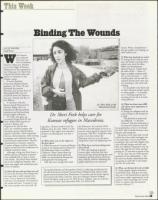
Dr. Sheri Fink, at the
Macedonian border
Dr. Sheri Fink helps care for
Kosovar refugees in Macedonia.
ing them. I'd been involved with the
Balkans since the early 1990s so I feel
attached to this region and wanted to
be here contributing any way that I
could.
Q: What drew you to the region in
the first place?
A: When the wars in Croatia and Bosnia
started, I was doing research projects for
the Holocaust Center in northern
California. When I heard about the
camps and people being raped and
killed, my ears perked up because the
word genocide was being used.
I felt that even though this wasn't
the Holocaust, the memory of the
Holocaust should inspire us to try to
prevent crimes against humanity from
occurring. I felt like I would be a hyp-
ocrite to just learn about the
Holocaust and not try to do some-
thing about what was happening now
Q: What have you been doing since
you arrived?
A: We're also looking at general
human rights violations that have
been occurring: documenting the mass
expulsion, getting witness testimony
that could be used for informing the
public and future war crimes tri-
The Jewish Federation of Metropolitan Detroit is collecting contributions for
the UJA Federations of North America Kosovo Refugee Fund, which is help-
ing the American Jewish Joint Distribution Committee and the Jewish Agency
for Israel provide shelter, medicine, food and clothing to Kosovar refugees.
Checks should be made out to the "JDC Kosovo Mailbox" and sent to Jewish
Federation, PO Box 2030, Bloomfield Hills, MI 48303-2030.
MiNzfil*Alooka-MWNOMENCOMMWERSIWAgMagOar 14'''
Q: What can Detroit Jews do to help?
A: I hope people support American
involvement here, and give any help
they can to the humanitarian agencies
and human rights organizations work-
ing here. Also, encourage the United
States to support the international
criminal tribunal. fl
4/16
1999
Detroit Jewish News
19