

JULIE WIENER
Ste' Writer
ith rising enrollment
and rising Jewish
Federation of
Metropolitan Detroit
allocations, times are good for
Detroit's Jewish day
schools. Many of the
News
afternoon Hebrew
Analysis
schools — the tradi-
tional venue for
American Jewish edu-
cation — wish they could say the
same.
With a reported 6,000 students
locally and an estimated 60 to 70 per-
cent of Jewish students nationally,
Hebrew schools, also known as congre-
gational or supplemental schools, still
educate the majority of Jewish chil-
dren. But many are strapped for cash,
strapped for qualified teachers and
unable to attract the big philan-
thropists who have been drawn to day
schools in recent years.
Unlike day schools, which can point
to various studies linking them to a
strong adult Jewish identity, there is lit-
tle consensus about the goals or effec-
tiveness of Hebrew schools.
They range from Temple Israel's
highly-structured curriculum in which
1,600 students learn Reform liturgy,
Hebrew and history, to the 40 chil-
dren studying Yiddish at the secular
Workmen's Circle Sunday school.
Generally run out of synagogues,
supplemental schools are charged with
imparting the rudiments of Jewish
culture and preparing children for a
bar or bat mitzvah in anywhere from
two to seven hours a week. While
many congregational schools are
launching creative efforts to engage
students and parents alike, they still
suffer from an image problem.
"We have to change the mindset of
American Jews, which is, 'Well I hated
Hebrew school and I went, so I don't
care if you hate it, you're still going,"'
said Dr. Paul Flexner, who is staffing a
Jewish Education Service of North
America task force on improving
Hebrew schools.
The good fortune of day schools was
underlined earlier this month when
West Bloomfield philanthropists Dr.
Milton and Lois Shiffman donated $5
million, which will be matched with
Federation dollars to generate $800,000
Julie Wiener can be reached at (248)
354-6060 ext 247, or by e-mail at:
jweiner@thejewishnews. corn.
4/16
1999
10 Detroit Jewish News
The `Other' Schools
While day schools flourish, congregational
programs face a host of challenges.
of Detroit synagogues complained to
Federation leaders that while their
schools educate far more students than
the day schools, they received virtually —\
no communal funds.
In response, Federation and its
banking/real estate arm, the United
Jewish Foundation of Metropolitan
Detroit, more than tripled the amount
of scholarship funds available for
Hebrew school students (to $500,000
in 1998-99). The duo also announced
that a $10 million endowment to
improve congregational schools would
be the "centerpiece" of a $25 million
campaign for a "Jewish Life Fund"
and invested more than $700,000 to
bring computer technology and a
locally produced educational Web site
into Hebrew schools.
Unfortunately for the congregation-
—/
al schools, none of the $10 million
endowment has been raised yet,
although $9 million has been donated
for other components of the Jewish
Life Fund. The promised technology
resources are expected to be available
in the next few months, although the
Web site — originally to be completed
is more than
in September 1998
six months behind schedule.
As burgeoning scholarship endow-
ments enable day schools to entice
Jewish families that might have found
them too expensive in the past, will
Hebrew schools quietly fade out of exis-
tence? Most Jewish policymakers, even
the ardent day school advocates, say no.
"Many American Jews are extreme-
ly assimilated into American life and
aren't looking for something as
Jewishly intensive as a Jewish day
school," said Yossi Prager of the New
York-based Avi Chai Foundation.
"Our foundation is a terrific supporter
of day schools but you can't take it to
the extreme and say Hebrew school
has no place in Jewish life. Where
would the other kids go?"
Avi Chai is conducting a pilot pro-
ject to determine the "price elasticity"
of day school enrollment by offering
$3,000 vouchers for new students in
Atlanta and Cleveland day schools.
The preliminary findings: money is
indeed a factor for some families, but
many parents also object to the "ghet-
toization" of day schools, said Prager.
Detroit's Hebrew school educators
have also heard concerns about ghet-
toization.
"I have a very involved father at our
school that would like us to add an
hour or two to our seven-hour acceler-
ated program, but he doesn't want to
put his kids in day school," said Elissa
Berg, director of education at Adat
—
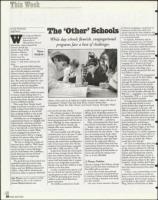
Hebrew school work can be informal or highly structured for students, like these at
Congregation rchiyah. From left, Jordy Rossen, Detroit; Tammy Ram,
Huntington Woods; Ben Filler, Pontiac; and Doniele Traurig, Huntington Woods.
each year for area day schools.
Day schools emerged in the United
States in the 1950s, combining Judaic
and secular studies under one roof and
devoting approximately half the day to
each. Although far more expensive to
operate than Hebrew schools, day
schools offer more intensive Hebrew
and Judaic studies.
The venue quickly took off among
Orthodox Jews, but in the past 15 years
Conservative, and to a lesser extent,
Reform and nondenominational ele-
mentary day schools have proliferated as
well. At last count, there were 700 day
schools in the United States, compared
with 500 in 1988 and 248 in 1958.
Studies have found day school grad-
uates to have stronger Jewish identities
than their Hebrew school peers, but
that may be less a function of the edu-
cation itself and simply that it is gener-
ally the more religiously committed
families who send their children to day
schools in the first place:
Locally, enrollment has grown at all
but one Jewish day school, and fund-
ing has grown as well, with Federation
in 1998-99 providing more than $2
million in day school allocations,
grants and assets.
The Shiffman endowment should
enable day schools to grow further by
offering more scholarship assistance to
middle-class as well as low-income fami-
lies, both of which often find the tuition
— $4,575 to $7,400 — prohibitive.
Other communities have been slower
than Detroit to fund day schools, but
— thanks in part to their increased visi-
bility and a national movement to cre-
ate endowments for day schools — they
too are investing serious funds. Many
day school advocates, like Chicago lay
leader George Hanus, argue that these
schools are the single most effective
investment in a Jewish future and thus
communities should not only make day
school funding their priority, but
should encourage all Jewish families to
choose day schools by making them
free, or at least affordable.
A Money Problem
No one is trying to shut Hebrew schools
down, but few have been extending mil-
lion-dollar gifts to save them.
And as day schools have enjoyed
increased communal and philanthrop-
ic funding, Hebrew school stakehold-
ers are starting to demand more funds
for their schools.
Last year, several executive directors