

COMMUNITY VIEWS
Ordinary And Extraordinary
ROBERT J. DEUTSCH
Special to The Jewish. News
I
n honor of his 85th birthday,
Alfred Deutsch has been
selected as an honoree for the
Jewish Theological Seminary
dinner. This is not unusual for my
father, who has received numerous
honors and awards during a lifetime of
leadership in the Detroit Jewish com-
munity. In the 50-plus years since the
end of World War II, my father has
served as a role model for me, my
brothers Dennis and Morris, and
countless others in his service and
commitment to the Jewish people.
When my mother Bernice asked me
to write an article for The Jewish News,
I consulted the JTS biography sheet.
However, I soon realized that my
father's accomplishments also reflect
the history of the Detroit Jewish com-
munity and the experience of an entire
generation.
My father is a first-generation Amer-
ican, the second son of Hungarian
immigrants. Born in New York in
1914, he is rooted in the Hungarian-
Jewish neighborhood that was
anchored by Dexter Boulevard in
Detroit. In that vibrant melting pot,
Europeans became Americans while
their children realized parental dreams
of education, economic success and
religious freedom. My father still
warmly greets friends in shul or subur-
ban delicatessens in Hungarian. The
men in our family still kiss Hungari-
an-style, a tradition that transports us
to the old country.
The backdrop of my father's teenage
years was the Depression and the tur-
moil in the family and world. My
grandfather's business failed; my
grandmother died and frightening
news began to filter out of Europe in
Robert J. Deutsch is an Asheville,
NC., attorney. His parents, Alfi-ed and
Bernice Deutsch, live in West Bloom-
field. Alfred turns 85 on April 13.
EDITOR'S WATCH
Even Kupat Cholim, Israel's most-
used health maintenance organiza-
tion, may climb aboard the band-
wagon. Specifically because of the
Shiffman project's transatlantic sup-
port base, the HMO may soon con-
vert home health care and palliative
medicine for the terminally ill into a
4/9
with the Holocaust. My father and
letters from relatives. After working
mother helped and comforted relatives
his way through the University of
who had survived the horrors, as our
Michigan and graduating from
family learned the fate of those who
Detroit College of Law in 1937, he
had perished. My father became presi-
found there were no jobs for new
dent of Congregation B'nai Moshe,
lawyers. My father went to work sell-
the historically
ing clothing at
Hungarian syna-
Harry Sufferin's,
gogue and
where he learned
presided over its
his lifelong appre-
move from Dex-
ciation of the ele-
ter to Oak Park.
gant suit and per-
As
Rabbi Moses
fectly matching
Lehrman
shov-
shirt and tie.
eled
the
first
Typical of his
spade full of dirt,
generation, my
my father
father found his
explained that 10
career plans inter-
Mile Road would
rupted by the
soon be in the
Nazis and Pearl
center of the
Harbor. In 1941,
community's
he enlisted in the
northwest migra-
Army, where be
tion. Forty years
served through
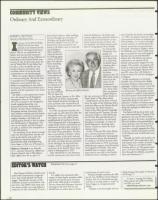
Bernice and Alfred Deutsch
later, my parents
the end of World
helped dedicate
War II. After the
the
new
sanctuary
of
B'nai Moshe on
war, like Jimmy Stewart in It a Won-
Drake
Road
in
West
Bloomfield.
derful Life, my father (and grandfa-
Establishment of the State of Israel
ther) 'formed American Savings and
from the ashes of the Holocaust had a
Loan to finance the construction of
profound effect on the Detroit Jewish
houses for returning soldiers and their
community. My father became a
families.
leader of the Allied Jewish Campaign
In 1946, my parents married, anx-
and United Jewish Charities. He was
ious to get on with their lives after the
chairman of AJC in 1967-68 during
disruption of the war. My brothers
the Six-Day War and led Detroit in
and I grew up in the idyllic Jewish
raising record millions for the Israel
neighborhood of northwest Detroit.
Emergency Campaign. A stream of
The widespread grid of homogenous
Israeli dignitaries, including Ariel
single-family homes, anchored by pre-
Sharon, visited our home for fund-
dominantly Jewish public schools, is
raising events.
the prototype of the "good old days "
In the 1970s and '80s, Sinai Hospi-
for many of my generation. On Sun-
tal,
a central institution of Jewish
day, we ate dinner at Darby's, where
Detroit,
was buffeted by demographic
we met leaders of the local, national
and economic forces that threatened
and international Jewish communities.
its existence. My father became chair-
By 1963, my father became president
man of the board in 1979, increasing
of the Michigan Savings and Loan
philanthropic support and refinancing
League, and he was appointed vice
the hospital's bond debt. This work
chairman of the Federal Home Loan
enabled Sinai to remain viable for
Bank of Indianapolis in 1965.
years
until it was sold to the Detroit
After World War II, the American
Medical Center, creating an endow-
Jewish community came face to face
TERMINALLY ILL
ment fund for the Jewish community. r
In 1997, my parents took my wife
Carol and me to Israel to celebrate our
50th birthdays. As we drove through-
out the country, we talked about the
historic events that my parents have
witnessed. Arriving at Zippori, where
the Mishnah was written 2,000 years
ago, we toured the vast archeological
clic, that had uncovered beautiful
mosaic tiles. My father's eyes shone
with pride as we learned of the
Detroit community's support for the
project. This month, my parents will
travel to Israel with my brother Den-
nis. as part of Michigan Miracle Mis-
sion III, where they will dedicate a
fund to restore the ancient synagogue
in Zippori.
In the introduction to his book
Invisible Lines of Connection, Rabbi
Lawrence Kushner relates stories of
seemingly "ordinary.events" in his life:
"These stories begin with the discov-
ery of reverence. This guides us back
to our place in a galaxy of generations.
The third section moves beyond fami-
ly and out into a community where
responsible deeds are the price of
admission. Finally, we become aware
that everything is connected to every-
thing else through invisible lines of
connection."
My father's life has been both ordi-
nary and extraordinary. Typical of his
generation, he was the son of immi-
grants, served in the army, married for
life, had children and grandchildren,
built a business and was (and still is)
involved in his community. His 85
years have virtually spanned the 20th
century, a volatile and historic period
in the Detroit and world Jewish com-
munities.
Through my father and mother, my
brothers and I are connected to this
rich history and a wealth of Jewish tra-
dition. These are my father's 85th
birthday gifts to us. His greatest plea-
sure is to watch these legacies come
alive through his children, grandchil-
dren and community. I 1
from page 31
benefit.
I've ridden the emotional roller
coaster of close family members suffer-
ing from the horrific pain of cancer
and stroke while lying in a hospital.
For me, those dark days gave concrete
meaning to the tenet that no one
should have to endure pain or loneli-
ness because the end is near.
Distance hurdles confront the Mil-
ton & Lois Shiffman Israel Hospice
Project, but it's a humanitarian ges-
ture for us to help make it work. As
Sister Eagan so compassionately
relates:
"Hospice is not for people who are
dying because the people in them are
still living."[l
To leave a message for Robert
Sklar, please call (248) 354-6060,
ext.258, or e-mail
rsklar@thejewishnews.com
a:smat-ma : ::::AlawaMitEMUK O M P AMIsaMtaziL*