
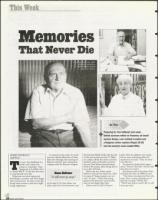

Memories
That Never Die
C ockwise; f.o top right:
,
aftiniLozven eig,
truth A/Arks-Bolton
and Sam Seltzer.
Pho tos by Krista H
,
m
xtt -4*
a
0
:wee kw ;M
a a Pa
:a
n
Zik?e,
a it b;
a re M 14:
Preparing for Yom HaShoah next week,
Detroit survivors reflect on Passover, an Israeli
survivor brings a war criminal to justice and
a Bulgarian author explains (Pages 22-24)
how his country's Jews evaded Hitler.
HARRY KIRSBAUM
Staff Writer
T
. most, Yom HaShoah is a
yearly event where one
pauses to remember what
happened to 6 million Jews
in World War II. To the few, the event
is remembered every day.
Holocaust survivors, aging and
dwindling in number, can never forget
their personal loss. To some, every day
brings some memory, and every night
brings nightmares.
4/9
1999
16 Detroit Jewish News
In interviews this week, five local
survivors shared reflections of what
they went through, the meaning of
Passover and how their experiences
compare with the Kosovar refugees.
Sam Seltzer
"It will never go away"
At the age of 14, Sam Seltzer was
taken away from his hometown near
the German-Polish border. By the end
of the war, he had survived 17 differ-
ent camps. Of his five sisters and four
brothers, only one brother survived
the war. Sam Seltzer dreamed about
food in the camps, about being able to
cut a slice of bread.
Before the war, Seltzer spoke
Hebrew well and was observant. After
six years of "being treated as an ani-
mal," he said, "I don't feel strong
going to the shul now" and attends
only on the High Holy Days.
Seltzer used to hold a Passover
seder when his children were small,
but he never told them about his
experiences, he said. "They are sensi-
tive, like me.''
He penned a book of his experi-
ences, "Fences That Kill," but his chil-
dren have not read it.
His dreams used to be about slices
of bread, but they are different now.
"I'm always running away from the
train, from a camp, jumping out of
bed and running," Seltzer said.
"That'll stay forever until I die. It will
never go away.
"