
LESLIE KATZ
Special to The Jewish. News
S
hortly after completing the manuscript for
his novel Memory's Tailor (University Press
of Mississippi; $25), Lawrence Rudner
received shattering news.
The professor of world literature and Holocaust
studies at North Carolina State University
(NCSU) in Raleigh had a malignant brain tumor.
The prognosis looked bleak.
At 47, with a flourishing academic career, a wife
and two teenaged children, Rudner was in his
prime. Among the many goals he had for his
future was the publication of his second novel,
which he had worked on for years.
. That wish came true last October, though
Rudner did not live to revel in the accomplishment.
Diagnosed in 1994, he died the following year in
May — just before he was due to visit his mother,
Marion Rudner of Southfield, for Mother's Day.
"I think half the university attended Larry's
funeral," she recalled.
In Rudner's book, retired Russian tailor
Alexandr Davidowich Berman, who once sewed
costumes for the Kirov Ballet, sets out on a
grand, self-appointed mission to preserve the his-
tory of Jews. The story is set during the period of
Soviet Premier Mikhail Gorbachev's perestroika.
With an elderly glassblower friend in tow,
Berman crisscrosses the Soviet Union, recreating
centuries of Jewish history, from the Napoleonic
Wars to the Holocaust to the 1956 Soviet inva-
sion of Hungary Rudner's metaphor-rich style
has been compared with that of South American
magical realist Gabriel Garcia Marquez.
"Getting this book published was so impor-
tant," said Rudner's sister, Eleanor Greenberg of
San Francisco. The lead character Berman is
[his) alter ego, a teller of tales."
History, and particularly Jewish history, always
fascinated Rudner, who traveled extensively in
Eastern Europe and taught Holocaust literature
in Krakow as a Fulbright fellow in 1986 and 1987.
He crafted many stories set in Eastern Europe,
pursuing what he later called his "obsession ... to
reinvent some lost lives."
His first novel, The Magic We Do Here, tells the
story of a blond, blue-eyed Jew who survives the
Holocaust posing as a half-witted Polish farm laborer.
Born Jan. 7, 1947, Lawrence Rudner became a
Leslie Katz is a writer for the
San Francisco Jewish Bulletin.
Rotner Sakamoto discusses how Japan
unexpectedly faced the absorption of
Jewish refugees who began fleeing
Europe in the late 1930s and early
1940s. She draws upon the archives of
the Japan Ministry of Foreign Affairs as
well as files of Jewish organizations and
the U.S. government. Three thousand
refugees transited Japan and China,
and more than 21,000 spent the war in
bar mitzvah at Congregation Beth Abraham in
Detroit. He graduated from Mumford High
School and went on to earn three degrees at
Michigan State University. There he met his wife,
the former Lauren Janowitz.
After teaching in Wisconsin, the Rudners
'moved to North Carolina for his university post.
Lauren Rudner, a schoolteacher, remains in the
state with the couple's two children, Joshua, 21,
and Elizabeth, 19, both college students.
Rudner's mother, Marion, who worked nearly
25 years as a secretary for the Detroit Board of
Education, credits her late pharmacist husband,
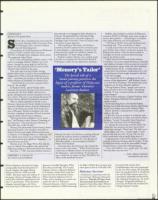
`Memory's Tailor'
The lyrical tale of` a
Soviet journey preserves- the
legacy of a professor of Holocaust
studies, .Armer Detroiter
Lawrence Rudner.
Edward, for their son's interest in writing. Edward
would tell made-up stories at bedtime to their
three children, who include Dr. Earl Rudner of
West Bloomfield, a dermatologist at Detroit's
Henry Ford Hospital.
Learning about the Holocaust also shaped the
future writer and teacher. "When [Lawrence] was
a little boy in Hebrew school, he saw pictures of
the Holocaust," said Greenberg. -"As young as he
was, it had such an impact on him. He said to me,
`How could somebody do that?'"
Japanese-controlled Shanghai. When
few others would help, Vice Consul
Sugihara Chiune, a Japanese diplomat
in Lithuania, issued transit visas that
saved the lives of thousands of Jews.
Writer-historian Sakamoto lives in
Tokyo and is working as an expert con-
sultant for the U.S. Holocaust
Memorial Museum, which is preparing
a special exhibition in 2000 concerning
Rudner, who initiated a number of Holocaust
courses at NCSU in Raleigh, spent years trying to
answer that question — and posing it to students
who might otherwise not have examined it.
"The kids at NCSU were rural Southern kids,"
Greenberg said. "This was all new to them."
A social activist from the time he was a young
man, Rudner also created a course for inmates in a
Raleigh state prison, where he stood outside at
midnight on several occasions demonstrating
against the death penalty.
Called "Survival and Growth Under Adverse
Conditions," the course imparted lessons on fortitude
and resiliency through written accounts by survivors
of concentration camps, battle and other hardships.
When Rudner fell ill, a student from that
course wrote the professor, imploring him to rely
on the lessons he had taught inmates to aid him
in his own struggle.
"He was known by his colleagues as the con-
science of the department," said Rudner's broth-
er-in-law Burt Greenberg. "He questioned moral
judgment in the best talmudic tradition."
During Rudner's illness, "people came over to
him and read to him every night," Greenberg
recalled. "It was a constant stream of students
and colleagues."
One of those colleagues, English Professor John
Kessel, helped get Rudner's book published
posthumously.
Kessel spent long hours at his friend's bedside.
During one of their discussions, Rudner asked Kessel
to serve as a literary executor for Memory's Tailor.
Kessel, himself a science fiction writer, gladly
took on the task.
"I felt there was no question it would get pub-
lished if I could find an editor who had any faith
or sense," he said. Eventually, Kessel found suc-
cess at the University Press of Mississippi.
Co-editing the manuscript word by word, "the
thing that was amazing was how much Larry's
voice came through," Kessel said. "He had a won-
derful, deep, rich voice, a hearty laugh. I could
just see him and hear him. To me, that was the
most emotionally and powerful thing about it."
A special section of the NCSU library is named in
memory. of Lawrence Rudner, said his mother. "It has
his Holocaust books and all his memorabilia. People
donated money to keep [the collection] going.
"Larry was brilliant, just a terrific guy," she said.
"He was taken way too soon."
the flight of Polish Jews to Japan and
other parts of Asia in 1940 and 1941.
Holocaust Survivors
• Published in association with the
United States Holocaust Memorial
Museum, Triumph of Hope: From
Theresienstadt and Auschwitz to
Israel, by Ruth Elias (John Wiley &
Sons Inc.; $24.95), is the story of a
— Esther Allweiss Tschirhart
contributed to this story
young Jewish woman from
Czechoslovakia who was imprisoned
in the two Nazi camps. She describes
how, having given birth in Auschwitz,
she and her baby became part of an
experiment personally conducted by
the infamous SS physician, Dr. Josef
Mengele. Originally published in
German, the book was translated by
Margot Bettauer Dembo.
4/9
1999
h
Ne_w_7/1
Scanned image of the page. Keyboard directions: use + to zoom in, - to zoom out, arrow keys to pan inside the viewer.
April 09, 1999 - Image 135
- Resource type:
- Text
- Publication:
- The Detroit Jewish News, 1999-04-09
Disclaimer: Computer generated plain text may have errors. Read more about this.