

This Week
An Enduring Institution
• S1 11 ItUll II In
The CA
Surrounded by neglect,
the Isaac Agree Downtown
Synagogue is a tenacious
outpost of spirituality.
JULIE WIENER
Staff- Writer
O
n a gray downtown Detroit block where the vacant store-
fronts are covered with graffiti and the cracked sidewalks
overgrown with weeds, the only bright spot is the Isaac
Agree Downtown Synagogue's fire engine red doors.
Save for the doors, this shabby brick building looks more like a
warehouse than a house of worship. Its back wall has worn for
weeks a disturbing graffiti mural of a man shooting a gun. The
inside is like an elderly person's basement, where the scent of
cleanser hangs over 1960s furnishings, linoleum floors, cheap wood
paneling and bookshelves full of old paperbacks.
This Conservative congregation, nonetheless, draws a small
but loyal group of Jews each Shabbat.
Some, like David Powell and Louis Nino, are converts to
Judaism who are attracted to the synagogue's diversity. For others,
like 90-year-old Julius Garber and social worker Dr. Bruce
Friedman, it is the only shul within walking distance of their
downtown apartments. And for a few suburbanites, like Jack Felsot
and Cynthia Leven, who have their choice of more convenient
shuls, the downtown synagogue is a more intimate alternative and
an important Jewish presence in the city.
Detroit once boasted scores of synagogues, stretching from the
Hastings Street area, where Jews were concentrated 90 years ago,
to the northwest city limits. But now the Downtown Synagogue
is the last of them save for the Reconstructionist congregation
T'chiya, which divides its time between Royal Oak and a rented
space near Wayne State University.
Like much in the city of Detroit, the Downtown Synagogue
has been almost forgotten in the exodus of people and resources ,____/
to the suburbs. Once a bustling shul with twice-daily services
attended by attorneys and shopkeepers, the synagogue now can
pull together a minyan only on Shabbat morning and holidays.
Its rabbi since 1963, 74-year-old Noah Gamze, officiates at far
more funerals than weddings and cannot remember the last time
the shul hosted a bar or bat mitzvah.
Yet Gamze and his congregation are- not giving up. Like other
Detroiters, they pin their hopes for continuance on the promise of
urban renewal that has been in the air since Mayor Dennis Archer
took office. But the renewal is taking some time.
"We're in a holding position, waiting for the city to go
through a renaissance," said Felsot, the synagogue's president.
We hope Jewish people will start working and living in the city.
Otherwise there isn't much of a future for the synagogue."
The Family Gathers
Each Shabbat morning, starting at 8:30 and continuing until just
before the congregation adjourns to the sanctuary for a simple
Kiddush lunch in the social hall, about 20 people ring the doorbell.
Raymond Henley, the synagogue's soft-spoken custodian, ushers
them in, pointing newcomers upstairs to the sanctuary.
It is a small room with wood paneling and about 14 pews, lined
with scratchy olive-green cushions. On sunny days, the light pours
through the red, blue, orange, green and yellow windowpanes
behind the pews, directing splashes of color onto the wall of memo-
rial plaques. On darker mornings, many of the congregants keep
their coats on for warmth (the heat, like the other facilities in the
aging building, is a bit unreliable) and Cantor Israel Idelsohn uses a
an
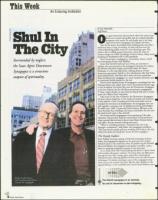
Rabbi Noah Ganzze
and President Jack Felsot
outside the synagogtre.
4/2
1999
6 Detroit Jewish News
The Detroit synagogue is an anomaly.
Its cast of characters is also intriguing.