

Fleeing Serbia
)4
C.
a .
2
U
7.5
0
0
Yugoslav Jews find refuge from bombings in Budapest.
MICHAEL J. JORDAN
Jewish Telegraphic Agency
Buda test
n other circumstances, there
would be nothing unusual about
busloads of Yugoslays visiting the
capital of their northern neigh-
bor, Hungary. •
But with NATO's daily assault on
Kosovo and other locations through-
out Yugoslavia, these are no ordinary
tourists."
Roughly 200 Yugoslav Jews —
some of whom arrived one day before
NATO fired its first missile on March
24 — are now in Budapest, hosted by
the Hungarian Jewish community.
As the Jews wait to see how events
unfold at home, more buses are on
their way.
"We are not refugees; we're still
tourists, who crossed the border legally
with our passports," said one woman
from Belgrade, the Yugoslav capital,
who arrived March 23 with her two
grown children.
"The plan was just to come for a
couple of days until things settle down,
then go back. But we're still waiting."
Indeed, there is a huge distinction
between these citizens of Yugoslavia —
comprised of two republics, Serbia
and tiny Montenegro — and the eth-
nic Albanians of Kosovo, Serbia's
southern province.
During 14 months of conflict, the
((
Yugoslav army and Serbian police have
forced tens of thousands of ethnic
Albanians — known as Kosovars —
to flee south into Albania proper. And
more are coming every day. Escalating
tension in the province, fueled by
Yugoslav President Slobodan
Milosevic, prompted NATO to launch
its unprecedented air campaign.
Hungary is bracing for a wave of
ethnic Hungarians from northern
Serbia, and many Serbs are believed to
be already staying with relatives in
Hungary.
With Yugoslavia a pariah state,
Hungary is one of the few countries in
the world that hasn't slapped visa
requirements on Yugoslavia's citizens.
And as NATO strikes loomed last
week, the Hungarian Federation of
Jewish Communities offered shelter to
the estimated 3,000 Yugoslav Jews.
On March 23, the Belgrade com-
munity took up the Hungarian offer,
and rented the first two buses to make
the 400-mile trip.
As NATO bombing intensified in
the days since, so, too, has the stream
of Yugoslav Jews into Budapest.
Two-thirds of them are teen-agers and
young adults, sent away for safekeeping
— and for their parents' peace of mind.
"I'm here because my mom made
me," said Iva, 23, a university student
who on Monday sent her first e-mail
back home.
"She said, `Go, while you can. You
1.1.)
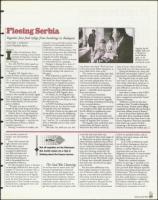
Yu oslav Jewish
retees talk with
a Hungarian
Jewish doctor,
right, in the
Budapest Jewish
community center.
can always come back.' But I have just
a few more exams before I graduate, so
now I don't know what to do."
The visitors are spending their days
gathered at the center, the adults sit-
ting on wooden chairs, chain-smok-
ing, nervously talking about the war.
Community officials are trying to
come up with activities for the kids —
such as arts and crafts and basketball
games — especially those separated
from their parents.
The American Jewish Joint
Distribution Committee is assisting
with individual needs of the Yugoslav
Jews, including counseling and finding
better accommodations.
Steven Schwager, associate executive
vice president of the JDC, has alerted
Jewish officials in neighboring coun-
tries — including Romania and
Bulgaria — about the potential need
to help provide temporary shelter if the
exodus of Yugoslav Jews increases.
The Yugoslav Jews, aside from their
anxiety about the future, also fret
about how they will be viewed by
those at home. Most of those inter-
viewed did not want their names used.
During the Bosnian war, many who
left Serbia were branded "traitors" by the
government-controlled Serbian media.
But Yugoslav Jews are quite loyal
and want to return home when the
dust settles. Many have opted not to
come to Budapest for fear of losing
jobs difficult to come by in a country
in economic ruin.
And when it comes to the NATO
assault, most share the hostility of
their compatriots toward the United
States and Europe.
"Milosevic is a jerk, but this does
nothing to him," Iva said, echoing the
views of many. "Instead, they're killing
people like my friends, who are forced to
serve their military service in Kosovo."
Jews in Kosovo have declined offers
to help them leave, according to Jewish
aid workers who have been active in the
former Yugoslavia. Plans have reportedly
been drawn up to extract 50 Jews
remaining in the Kosovar capital of
Pristina if necessary, the workers said.
❑
.
not provide a means of
go
escape, nor did assimila-
gg oz.
in r.
0.
go
tion.
-A
From 1933 onward, the
n
oo
tffi
rights of Jews were system-
mmogmgmelbak,
atically taken away in
Not all tragedies are the Holocaust.
Germany and in German-
occupied or allied territo-
But Jewish values are a help in
ries. Discrimination and
thinking about the Kosovo horrors.
prejudice soon gave way to
legal disenfranchisement
and to the gradual but ever-
growing loss of liberties.
On the economic front, it became
The Goal Was Cleansing
increasingly difficult for Jews to par-
As we have seen in recent years, the
ticipate in German economic life, to
process of expropriation continued
hold property or even to earn a liv-
even after the war and spread to neu-
ing. Four hundred pieces of legisla-
tral parties; states claimed "heirless"
tion were enacted over 12 years that
and "abandoned" property, insurance
took the Jews from being an inte-
companies denied claims for policies,
grated part of the German economy,
and banks turned a blind eye to
isolated them, segregated them and
depositors. Great museums soon for-
led to their demise.
got the original owners of great works
of art that had come their way.
Yes, the goal of these initial stages of
the Holocaust was ethnic cleansing, to
make Germany Judenrein, free of Jews.
But Nazi ethnic cleansing policies were
not an exclusively anti-Jewish policy.
Poles were forced to evacuate entire
areas that Germany seized after the
1939 invasion of Poland so that they
could be inhabited by ethnic Germans
re-embraced by the Third Reich. Cities
of Europe were ethnically cleansed of
their Jews who were forced into ghet-
tos in the East.
But here some differences arise
from today's situation. In the evolu-
tion of German policy, ethnic cleans-
ing was a way station to annihilation.
Nazi policy toward the Jews was not
in quest of territorial gains or geo-
graphical expansion, the goal was the
mass murder of an entire people,
which moved from the concentration
,
.
of Jews in specified locales, such as
ghettos and transit camps, and then
the killing itself.
So as awful as Milosevic's poli-
cies of ethnic cleansing are, they are
not the Holocaust. Yet just because
Kosovo is neither Warsaw nor
Auschwitz does not free us of an
obligation to respond. A consciousness
of the Holocaust must not raise our
threshold of tolerance for evil.
Permit me a personal example.
About 16 years ago, I attended a con-
ference on Ethiopian Jewry. A delega-
tion just back from Ethiopia reported
that Jews were dying of starvation and
malnutrition. They were facing sys-
tematic discrimination and disease,
but they could discern no systematic
program of annihilation. Suddenly,
the audience breathed a sigh of relief:
Ethiopia was not a holocaust, we
could return to business as usual. I
4/2
1999
Detroit Jewish News
23