

c
David At 20
DR. KENNETH W. STEIN
Special to The Jewish News
ITI
wenty years ago,
President Jimmy
Carter brokered a his-
toric peace agreement
between Israel and Egypt. What
that pact accomplished is relevant
again today as Israel and the
Palestinians are embroiled in an
emotional peaCe process that
America seeks to advance.
The twists, turns, and motiva-
tions that led to the 1979 treaty
were extraordinary; its impact on
the countries, the region and
American foreign policy have
been no less exceptional.
In the 1970s, the Arab-Israeli
negotiating process enjoyed dedi-
cated, knowledgeable, hard-work-
ing and imaginative leaders, willing
to take calculated
political risks.
Carter, Egyptian
News
President Anwar
Analysis
Sadat and Israeli
Prime Minister
Menachem Begin were never
timid. Each was capable of
manipulating a conversation for his
own purposes, each was willing to
alienate domestic constituencies for
the sake of the greater good as they
saw it. While making difficult com-
promises, each feverishly protected his
country's national interest.
Most of all, each understood the
historic impact an Egyptian-Israeli
peace would have upon the region and
its peoples.
Though the outstanding issues
being negotiated now to resolve the
Arab-Israeli conflict are admittedly
more complicated and sensitive, politi-
cal leadership remains wanting. There
are too many political managers.
There is too little collective vision of
where the region should be headed.
Carter's National Security Adviser
Dr. Kenneth W Stein, William E.
Schatten Professor of Contemporary
Middle Eastern History and Israeli
Studies at Emory University, is author of
the soon-to-be published Heroic
Diplomacy: Sadat, Kissinger, Carter, Begin
and the Quest for Arab-Israeli Peace.
3/26
1999
18 Detroit Jewish News
The 1979 agreement offers lessons
fir today's peace-makers.
Zbigniew Brzezinski predicted that the
Jerusalem. Both countries have sus-
treaty would be contagious. That hasn't
tained warm, militarily beneficial and
quite happened, but the treaty has inoc-
financially rewarding relationships
ulated the Middle East against another
with Washington. And America's com-
outbreak of major war. The result is not
mitment to Egypt, coupled with the
sufficient but it is adequate.
defense of Arab oil producing states
Though Sadat was assassinated
this decade, has made Washington's
before the treaty's completion, his
alliances with the Arab world stronger
objective of combining war and diplo-
and deeper than 20 years ago.
macy to regain the Sinai was a success
In addition, Arab anger against
by the end of the 1980s. For its part,
Sadat and Egypt for peace with Israel
Israel successfully removed the most
has dissipated. And once-uniform
militarily powerful Arab state from the
Arab state reluctance to deal with
circle of countries once unalterably
Israel has, because of the Egyptian
determined to destroy the
precedent, changed.
Jewish state. Israel also
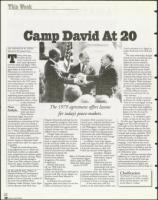
Above: As President Jimmy Israel has a peace treaty
received overt political
with Jordan, negotia-
Carter beamed, Egypt's
recognition of its nation-
tions with the
Anwar Sadat and Israel's
al legitimacy.
Palestinians and eco-
Menachem Begin agreed
America had its pay-
nomic or diplomatic
to peace in 1979.
off, too. Well before the
relationships with more
collapse of the Soviet
than two dozen Arab
Union, the United States celebrated its
and Moslem states. The Arab League,
greatest Cold War success. Egypt's ori-
originally established to combat
entation turned from Moscow to
Zionism and Israel's existence, has lost
Washington.
its ideological zest. The Arab econom-
And despite the cool Israeli-
ic boycott of Israel is no longer potent.
At the same time, with the
Egyptian peace since then, no war has
broken out between Cairo and
decline in the Arab-Israeli conflict and
Cairo's centrality to it, Egypt no
longer dominates inter-Arab pol-
itics.
The treaty relationship changed
formal ties, but not informal ones.
Some Israelis believe that the
diplomatic process started by
Sadat is the continuation of the
Arab confrontation with Israel
through political means. Israel's
greatest physical size was immedi-
ately after the October War when
its physical boundaries went to the
Suez Canal, the Jordan River and
Golan Heights. When Israel gave
up the Sinai, it relinquished strate-
gic depth, oil fields, and airfields.
Egypt and Israel remain two
culturally different societies
whose past and future do not
easily intersect.
Israelis still sustain a measure
of distrust for Arabs in general.
They do not want Egypt stirring
in every negotiating pot it pre-
pares with other Arab neighbors.
Israel prefers its relationship with
Egypt to be like the one the
United States enjoys with
Canada — an unrealistic expec-
tation, at least in the near term.
For their part, Egyptians will not
haggle over what they consider an
Arab right to have Israel withdraw
from all territories taken in the June
1967 war. They fear Israel's economic
strength and nuclear capability. With
some regularity the Egyptian media
lambastes Israelis, its leaders and
Zionism in harsh and unbecoming
language. Cairo believes that every
Israeli hesitation in negotiations with
the Palestinians is intended to end the
negotiations before the establishment
of a Palestinian state.
No treaty could have overcome those
differences in a mere two decades. But
the one that was signed 20 years ago
today assured one crucial outcome —
the relationship between Egypt and
Israel may bend, bunit will not break. ❑
Clarification
The March 19 story on valvulo-
plasty research in India, conduct-
ed by Detroit doctors, was writ-
ten by Shari S. Cohen.