

ft k ake,
.kkr'aa \ aa.: •
16N:utak
ft
** ***1**t
N
ga•
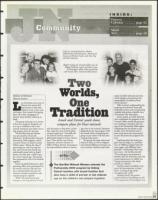
(Left) An Israeli family from Moshav
Nahalal hosts American guests. Pictured are
Stacey and Michael Crane, with Yair, Noy
and Reut Hammer.
(Right) Visiting the Central Galilee town of
Migdal HaEmek, Sarah and Ilene Crane,
of Farmington Hills, make new friends
with Israelis Meir, David and Bill Tamari.
0
SHELLI DORFMAN
Editorial Assistant
L
ast December, seven sets of
Detroit-area parents left
their homes to take their
children to bar or bat mitz-
vah lessons. But instead of dropping
them off at their synagogues or
schools, these families ended up in
Israel.
The group took part in an unusu-
al first-time program designed, not
as a trip to celebrate a bar or bat
mitzvah ceremony, but rather one to
help prepare them for that day.
The Bar/Bat Mitzvah Mission
was sponsored by the Jewish
Federation of Metropolitan Detroit's
Partnership 2000 program, which
connects Detroit to Israel's Central
Galilee region. Taking the idea of
partnering two cities one step fur-
ther, each Detroit-area family was
individually paired with an Israeli
family, who also had a child of pre-
bar or bat mitzvah age. The groups
then prepared for their b'nai mitzvah
together.
Mark Davidoff, Federation's chief
operating officer who participated in
the mission with his wife and two
sons, said that before the trip, the
American families attended an edu-
cational program together.
While "the Israeli group goes
through a year-long process of study
Worlds,
One
Tradition
Israeli and Detroit youth share,
compare plans for bnai mitzvah.
and discussion to help them, as fam-
ilies, make the most of the bar/bat
mitzvah experience," Davidoff said
the Detroit families attended an
abbreviated program of four sessions
here. Their teacher was Miriam
Starkman, executive director of
Hillel of Metro Detroit. Focusing on
the responsibilities related to becom-
ing a bar or bat mitzvah, Starkman
designed the pre-trip program with
the overall vision of preparing the
group to join others with the same
coming-of-age issues.
The group discussed what Israel
means to them, as well as religious
and cultural differences between our
two countries. Starkman said other
The Bar/Bat Mitzvah Mission extends the
Partnership 2000 program by linking
Detroit families with Israeli families that
also have a child of pre-bar or bat mitzvah
age so the children can prepare together.
topics included "physical and emo-
tional changes and assuming the
responsibility of adulthood and
Jewish identity."
Talks involved understanding the
meaning of individual Torah and
Haftarah portions and incorporating
tzedakah and gelimut chasidim (acts
of kindness) into their plans.
Itamar Lapid, an Israeli educator
who coordinates the program in the
Central Galilee, joined the group at
one meeting to introduce the con-
cept of the Partnership 2000 region.
Explaining that he wanted to per-
sonally meet the families and to
learn more about the community,"
he also illustrated the program's his-
tory.
Lapid described the Israeli pro-
gram and its design as a combina-
tion of "different people, from the
same region with different back-
grounds," confronting "their corn-
mon issue - the bar/bat mitzvah."
I he Israeli group participated as
families, like the Americans, the only
course requirement, he added was
"being committed to the whole
process, as a family."
Another session included a com-
puter lab demonstration to learn
about "coming of age rituals
throughout the world."
Stressing family, discussions
involved parents and siblings as well.
"The uniqueness of the program was
6
3/19
1999
Detroit Jewish News
33