
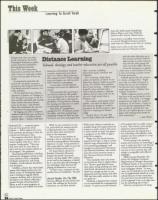

Learning To Scroll Torah
From left: Rabbi Joseph Krakoff helps
Rebecca Wapner and Leslie Finkel get
started in their Internet Talmud course.
David Beitner and Jeffrey Prussack listen
as a Jewish Theological Seminary professor
reads aloud the Talmud section they are studying.
Joshua Foster works on the lesson while
rabbinical student Joel Pitkowsky watches.
Perhaps more than any other
Jewish institution, the Jewish
Theological Seminary is explor-
ing the Internet's possibilities
for long-distance learning.
Since 1997, the Conservative
Movement's university has offered
cyber courses to a growing number
of Jews and non-Jews all over the
world.
Its proponents stress that the
courses do not replace in-person
encounters, but bring the New York
City-based university's resources to a
wider audience.
"If you don't live near a Spertus
(Museum of Judaica, in Chicago) or
JTS, this gives you access to the fac-
ility members and staff, and it breaks
down barriers -that have :limited
access in the past," said Michael
Starr, who coordina.tes the universi-
ty's distance learning program.
By logging onto their computers,
students readJewish texts, professors'
lectures and — via bulletin board
and live chats — interact with their
.
Talmud, theology and teacher education are all possible.
Basketball IQ— computer games
that ask trivia questions about
Judaism — Erlich replaces the trivia
with questions pertaining to what the
students are learning in class.
For programs that don't allow the
user to program in features, Erlich
works together with the ti.. cher to
prepare a study guide. "That way,
they learn what we want them to
learn and not just random details on
the program," she explained.
Exacerbating difficulties in finding
software for synagogue schools is that
most software is from a decidedly
Orthodox perspective, said Irving
Goldfein, a local software distributor
and developer.
Goldfein, a former day school head-
master who helped produce the CD-
ROM version of Encyclopedia Judaica
and is working to upgrade Akiva's
computer facilities, said in the future,
he hopes to see software reflecting a
greater diversity of Jewish philoso-
phies, as well as more programs on
Jewish history and Yiddish instruction.
3/19
1999
24 Detroit Jewish News
classmates and professor-. Students
complete assignments and subrnit
tliem via e-mail to their instructors,
who respond in-kind. While reading
texts, participants can click on unfa-
miliar terms for explanations.
Course topics include Talmud,
theology and women in rabbinic lit-
erature.
The university also is starting to
use Internet classes to offer profes-
sional development for teachers who
are Hi the field and is exploring the
possibility of using distance learning
for training new educator's in under-
served Jewish communities.
Since July, 475 epOitAY
enrolled in JTS
for adults, said S
surprising number of them are Jews
by choice, non-Jews and people from
e.
While he says computers are use-
ful, particularly for research and for
navigating Jewish texts, Goldfein
worries about their potential for
abuse in the classroom.
"My concern is that teachers are
looking to rely on technology as a sub-
stitute for creating effective, demanding
objectives," he said. It has potential to
help a great deal, but really it's up to the
person at the front of the room."
Dr. Susan Shevitz, director of
Brandeis University's Hornstein
Program for Jewish Communal
Service, said that ideally when comput-
ers are used in the classroom, it should
be in a way that takes full advantage of
the technology, rather than just dis-
playing old material in a new way.
"At their worst, computers are just
another form of workbooks," she said.
Jewish Studies On The Web
Internet offerings for the Jewish class-
room, like software for the Jewish
classroom, are still fairly limited.
other countries, including
Switz,erland, Japan, Gerniany and
Colombia.
JTS is piloting a high school
course via Internet, in which 16 stu-
dents from Shaarey Zedek are partici-
pating. The Talmud class combines
face-to-face learning — Rabbi Joseph
Krakoff teaches the loc,a1 cadre —
with computer projects, e-mail dis-
cussions and live chats with JTS fac-
ulty and a high school class in
Portland, Ore.
One student, ninth-grader David
Samlin, said when he ,signed up for
the course he thought it would be
just about the Jewish Internet in gen-
eral, but is enjoying the Tairmid
study
"So far I like it," he said. "We
haven't had a chance yet to talk live
While many reference materials are
available along with opportunities for
students to send e-mail to their peers
in other schools or Israel, few games
or programs on the Web are appro-
priate for youngsters.
"Right now, the Jewish Internet,
despite all the hype, is still at a pretty
infantile stage educationally in terms
of incorporating pedagogic, well
thought-out educational techniques,"
said Howard Freedman, who coordi-
nates the on-line resource center at
San Francisco's Bureau of Jewish
Education.
"Our standards tend to be lower
on the Internet than in regular educa-
tion. There's a good deal of excite-
ment about seeing anything out there
with Jewish educational content and
there's not enough yet that we can
adequately pick and choose and select
Web sites that really conform to what
),
our goals are.
Freedman is skeptical that comput-
ers are worthwhile for congregational
schools. "I need to see more research
with the other kids who use it,
but we have covered a little bit
and even got to read a conversa-
tion that the other group had
with one of the rabbis. Because
it's on the computers, it appeals
a little more to kids instead of sitting
in class and having a teacher dictate.
Its more interactive."
Krakoff agreed that the comput
er creates a unique draw. "Right
now, kids are really interested in
things that are on the computer.
I'm not sure how many people
would sign up for a Talmud class
without computers."
While computers may be a draw,
they have to be used properly, warns
JTS' Starr . Our focus .s to engage
people and not make this a passive
experience. In the future, I expect to
see more Jewish organizations offer-
ing a wealth of materials this way.
But this can't replace going to a syna-
g,ogue and meeting other people in
your community."
of the schools that are really using it,"
he said. "My concern is that people
respond to perceived failures of
Jewish education by hoping that a
new technology will suddenly make
students turn onto Judaism in a way
they haven't before.
"If we're going to be spending
money and resources on technology, I
want to make sure this is not because
of some blind faith that technology
can save us, but is proven that tech-
nology is compatible with effective
pedagogy.
Rabbi Leonard Matanky, who
directs the Goldman Computer
Department of Chicago's Association
of Talmud Torahs, is not convinced
that computers are cost-effective for
most synagogue schools. "In most
cases, use of computers is not as effec-
tive in supplemental schools as in day
schools because of time constraints.
You don't have time for half of what
you're supposed to do, so to take time
out for something else is hard."
However, proponents of using
' \