

Arts
ertainme
For artist Hariette Estel Berman,
the medium is the message.
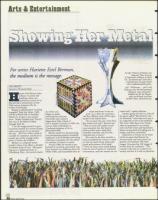
Far left: "Patterns of Position and
Possession," from the series
Pedestal for a Woman to Stand
On," pre-printed steel. Each side is
a representation of a game board
and a traditional quilt pattern.
LISA BRODY
Special to The Jewish News
Left: "Vellaivatee ... and I will
bring you into the land promised
Abraham, Isaac and Jacob,"
kiddush cup for the Passover
seder,pre-printed steel from
"pushken boxes, aluminum cup.
n
arriete Estel Berman takes
ordinary tin pieces and
transforms them into
extraordinary pieces of art
that provide a commentary on late-
20th century American life, for
women in particular.
Berman, a self-described "recycling
evangelist" from San Mateo, Calif.,
will be in Royal Oak on Saturday,
March 13, to open a one-woman
show, "Reality Studded with Thorns,
that runs at the Sybaris Gallery
through April 24.
"I use the images printed on post-
consumer material as a source of inspi-
ration and content in my artwork,"
she says. 'All of my work is made of
recycled tin containers, and the tin is
usually part of the message of the
piece, as well as the medium."
Berman is a sculptural metal-
smither whose work reflects a decided-
ly feminist point of view. After grow-
ing up in a traditional home in
Harrisburg, Penn., she earned a bache-
3/12
1999
92 Detroit Jewish News
lor of fine arts
degree in metal-
smithing from Syracuse
University and a master's
degree from Tyler School of
Art at Temple University. In 1990, she
was an Artist in Residence at
Cranbrook Academy of Art in
Bloomfield Hills.
Berman started out deconstructing
and reinterpreting modern household
appliances, such as blenders and sewing
machines, as metaphors for the utilitar-
ian position of women in society.
Around 1988, she turned to pre-
printed tin materials, particularly orig-
inal, domestic toy dollhouses from the
1920s-1960s, and reassembled them to
create statements via her art-
work. It is a form she continues,
and four different series will be repre-
sented in the Sybaris show.
The tin pieces she uses "come from
flea markets and such," Berman says.
"They are never [of] perfect or pre-
cious materials, but they become
almost perfect pieces made from
imperfect materials, and all of the
materials have a history"
Her work for the show includes a
series of pedestals for women to stand
on that are square boxes using tradi-
tional quilt patterns, all of metal.
"There are many issues raised dealing
with the role of women in a domestic
environment, and how women are not
valued well," explains Berman.
Another group of work is a series of
fan pieces called "The Deceiver and
the Deceived," which the artist says is
an outgrowth of one of her pedestals.
The series "talks about how women
often are portrayed in our society,
with tiny little waists and big bosoms,
always serving food and taking care, or
being a seductive commodity"
Depictions of women are on many
of the tin pieces that Berman has
deconstructed, and many pieces use
portions of containers with those
images. One piece has 140 images of
women from tin containers. "The
concept is the way art is used in our
society, and how it is sold on placemats