

An
ynne Avadenka's "Boundaries of the
Universe: A Suite of Prints" will com-
plement the works on display at the
DIA from the Jewish Theological
Seminary; the artist's series was JTS's first con-
temporary art exhibit. In the suite, Avadenka
combined images and words to explore the sym-
bolism of the Hebrew alphabet.
The Huntington Woods artist presented each let-
ter in abstract form, associated it with symbols from
mystical Hebrew texts and added an original poem.
The three-step process can be seen in the way
she approached the Hebrew letter "bet," compa-
rable to the "B" in English.
First, she redesigned it using color and shape to
derive a new aesthetic. Second, she picked up on
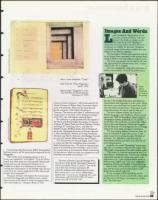
AbOve• Lynne Avadenka:
Left: From the "Prato Haggadah,"
Spain, 1300.
Artist
Lynne
Avadenka
at work in
her studio.
Opposite page: "Haggadah" scribe:
Issachar Baer ben Jacob Hayyim;
Germany (?); 1739.
/-'
Concerning individual items, Rabbi Schwarzbard
believes viewers will be particularly impressed by the
Haggadah.
"One of the most intriguing aspects is that it
never was completed," he explains. "Parts are illumi-
nated, but other parts are only partially illuminated.
Some parts are not illuminated whatsoever. It
enables us to learn the techniques of manuscript
writing and illumination in the Middle Ages because
we've seen the various [segments] of the manuscript
as they were composed."
Two guest lecturers will explore the environment
in which the Haggadah and Mahzor were created;
they are part of an extensive series of programs relat-
ed to the exhibition. "Salamoni Rossi: A 16th
Century Jewish Composer" will be discussed by Dr.
Martin Herman of Wayne State University's depart-
ment of humanities. Rossi was the most famous
Jewish composer of the Italian Renaissance.
"Judaism, Christianity and Islam: Confrontation and
Cooperation" is the topic of Dr. Benjamin Gampel
of the JTS, who will explore medieval Spain.
The exhibition is made possible with the support of
the Morris and Beverly Baker Foundation in memory
of Morris D. Baker, Dede and Oscar Feldman, Carolyn
and Hugh W. Greenberg, Rita C. and John M.
Haddow, Evelyn Hoffinan Kasle, Detroit Friends of
the Jewish Theological Seminary of America, Bernard
L. Maas Foundation, Barbara and Irving Nussbaum,
Marianne and Alan E. Schwartz, the Michigan Council
for Arts and Cultural Affairs and the city of Detroit.
"The documents are old and fragile, and we want
to make sure that the installation goes smoothly,"
Rabbi Schwarzbard says. "We have an extensive pro-
gram of conservation and restoration, and we have
two conservators at the seminary library monitoring
the documents, which are kept in a temperature and
humidity-controlled environment." ❑
"Treasures of Jewish Cultural Heritage from
the Library of the Jewish Theological Seminary"
will be on exhibit March 17-June 6. The exhibi-
tion is free with museum admission: $4
adults/$1 children and students/free for mem-
bers. Hours are 11 a.m.-4 p.m. Wednesdays-
Fridays and 11 a.m.-5 p.m. weekends. For more
information, call (313) 833-7900. To book a
group tour, call (313) 833-7981.
the dot in the middle of the letter and offered an
interpretation that represents it as the moon. Third,
she wrote a new verse based on research that main-
tains the letter connotes home: "Arms open to wel-
come and protect; the way in and the way out."
"I'm not a Hebrew scholar, but I love the
Hebrew language," says Avadenka, whose artwork
adorns the 1998-99 SourceBook: Jewish Living in
Metropolitan Detroit, published by The Detroit
Jewish News. Her work also is found in the collec-
tions of the Israel Museum, Library of Congress
and the Museum of Contemporary Art in Chicago
along with many other prestigious institutions.
"I've been taking Hebrew classes for years. As
soon as I decided to begin this project, I did
some research by looking through The Book of
Creation, The Alphabetic Labyrinth and the
Encyclopedia Judaica and then took off with my
own interpretations."
Avadenka, 46, started "Boundaries" several years
ago, after a conversation with the JTS curator, who
had bought a large group of the artist's earlier works.
"This exhibit is a natural extension of what I've
done before," Avadenka says. "I have been working
with Jewish themes for a long time, and I work
with letters a lot. I print limited-edition books in
Hebrew and English, and I also am a calligrapher
presenting Hebrew and English in hand lettering."
Nancy Sojka, DIA associate curator of graphic
arts, saw the series and recommended it with
Rabbi Schwarzbard's approval,
"It's an example of how somebody can be
inspired by Jewish history and Jewish culture and
use the past to develop a contemporary vocabu-
lary," the rabbi says. ❑
,
3/12
1999
Detroit Jewish News
85