
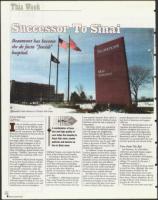

main entrance on Thirteen Mile Road.
JULIE WIENER
StaffWriter
I
t has no Jewish symbols, names
or plaques in the hallways and
no formal ties to the organized
Jewish community. But William
Beaumont Hospital has become the de
facto Jewish hospital.
It is the only metro Detroit hospital
that helps rabbis visit their congre-
gants by faxing synagogues a list of
Jewish patients every day. And the
administration is exploring the possi-
bility of building a kosher kitchen and
creating a "Shabbat" apartment where
Orthodox Jews could stay while visit-
ing family.
As Detroit's official Jewish hospital,
Sinai has lost Jewish patients and doc-
tors and struggled to maintain a pres-
ence through formal ties to the orga-
nized Jewish community, while the
929-bed Beaumont — with its subur-
ban location and reputation for quali-
ty care — has quietly gained them.
Beaumont, which also operates a
189-bed hospital building in Troy and
medical buildings, nursing homes and
rehabilitation services throughout
3/12
1999
6 Detroit Jewish News
A combination of loca-
tion and high quality of
care helps the hospital in
Royal Oak claim Jewish
patients and doctors as
ties to Sinai wane.
Oakland County, now enjoys the lion's
share of the Detroit Jewish market.
According to Beaumont's director
of pastoral care, the Rev. Diane
Morgan, it is not uncommon to have
more than 100 patients (including
outpatients) in the Royal Oak hospital
at any one time who identify as
Jewish. As recently as 1992, only 20 to
25 patients identified as Jewish on any
given day.
In addition, a 1998 Simmons/Jewish
News study found that half of all sub-
scribers who visited a hospital in the
past year went to Beaumont; the next
most popular hospital, Sinai, which is
owned by the Detroit Medical Center,
had been visited by only a quarter of
respondents.
Like Sinai, which now operates at
less than half of its 600-bed capacity
and will merge into neighboring
Grace Hospital by fall, Beaumont
opened in the early 1950s, just east of
Greenfield Road. But Beaumont, a
secular institution, was six and a half
miles to the north of Sinai. The geo-
graphic difference was crucial in the
decades that followed.
As Oakland County has prospered,
location appears to have been a major
key to Beaumont's success. In contrast,
the DMC's stable of primarily urban
hospitals are less conveniently located
for many middle-class and affluent
people, and serve a higher percentage
of uninsured and under-insured peo-
ple for whose care government reim-
bursements have rapidly declined.
But Beaumont's success — the hos-
pital is now so full that it has issued a
three-month moratorium on granting
admissions privileges to new doctors
— goes beyond the plot of real estate
it owns in Royal Oak. Patients also
praised Beaumont for its cleanliness
and level of physician and support
staff care.
Beaumont's Jewish physicians and
chaplains described Beaumont as a
pleasant workplace that strives to
make people from all backgrounds
comfortable. Several Jews described
Beaumont's staff as "bending over
backwards" to accommodate the com-
munity's spiritual and cultural needs.
View From The Bed
Joe Roisman, 52, of Franklin,
underwent quintuple bypass surgery
and suffered a stroke while at
Beaumont in December. Nonetheless,
he described his stay as "pleasant,
adding "if it weren't for the pain, I
would have enjoyed it."
Roisman even liked the food, which
is served on china, although, like most
Jewish patients, he didn't try the
kosher meals. Beaumont serves some
2,000 kosher meals each year, ordering
them from a Detroit distributor for an
average of $6 per meal. Patients do not
pay extra for the service.
"The doctors were there every day,
"