

•
E
\Th
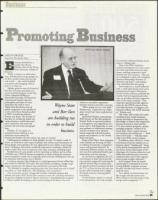
Pho to by Kris ta Husa
MEGAN SWOYER
Special to The Jewish News
veryone should have a
teacher like Harvey
Kahalas, dean of the Wayne
State University College of
Business.
When it comes to a solid educa-
tion, Kahalas strives to get people out
of their comfort zones and into the
real world — the world of global
economies and changing cultures.
Join in or miss out.
Kahalas spoke to some 40 Friends of
Bar-Ilan University and others at a
recent luncheon-program at the Max
Fisher Federation Building in
Bloomfield Township. He shared his
international business expertise,
philosophies and ideas on every-
thing from the need to move
Wayne State forward in areas of
global recognition to the specifics of
a new center that is being launched
at WSU to build ties between
Detroit and Israel. The Friends of
Bar-Ilan try to help the Israeli uni-
versity become a world-class acad-
emic institution and create ties
between the university and people
here.
Kahalas, 57, an expert on
competitiveness, believes a true
education must extend far
beyond the borders of one's native city, state or country.
Challenging his audience to think globally, he said, "In today's world, if
you're not attuned to other types of peoples and cultures and orientations of
doing things, you're going to be very segmented in your ability to get things
done." Helping is the current worldwide information revolution, which has
made it easier than ever to create ties with other countries, including Israel.
Furthermore, he said, thanks to lower spending on defense and an influx
(730,000 since 1990) of Russian immigrants to Israel making the economy
more competitive, Israel now is enjoying rapid economic development that can
be enhanced with business ties in Detroit.
Luncheon attendee Alan Muskovitz is a third-generation Friend of Bar-Ilan
who works for WOMC-FM radio. He said Kahalas is building a bridge to get
people interested in the Detroit area and Detroit interested in Bar-Ilan.
"He [Kahalas] is tangible, something that they [Jews both here and in Israel]
can relate to," said Muskovitz. "He's building a real connection."
The connection, in fact, is huge and includes a detailed program that
Kahalas and other WSU faculty have created to move the university forward in
the pursuit of global awareness. Recent initiatives in the globalization program
at Wayne include developing a solid understanding of the factors that con-
Wayne State
and Bar-Ilan
are building ties
in order to build
business.
tribute to successful cooperation
between America and other countries.
"We're setting out on a new path,"
Kahalas said, "a path that one might
argue should have been implemented
years ago."
Spurred by Kahalas, participating
WSU faculty are Bar-Ilan graduates
Yitzhak Fried, an associate professor
in management and organization sci-
ences, and A. Arik Ragowsky, an assis-
tant professor in information systems,
and also members of an advisory
board composed of Jewish business
people and academics in the United
States and Israel.
Many of the Wayne State programs
under Kahalas are focusing on Israel
to enhance its economic competitive-
ness as well as metro Detroit's. To
understand Wayne's mission, he said,
one must first understand Israel's past
relationship with this country.
At one time, he explained, the U.S.
commitment to Israel was in provid-
ing economic support for ensuring the
nation's survival. But in recent years,
the growth of Israel's economy has led
the U.S. to focus on how the state can
become self-sustaining with a highly
developed economy stressing global
orientation.
"At the business school, we intend
to be among those who help strength-
en economic relations between Israel
and us," Kahalas said.
One of the WSU initiatives
includes development of a new center
for Israel and Israeli-American busi-
nesses, enabling cooperative work
between the two countries. "The cen-
ter is designed to assist and strengthen
business relationships between us
[Detroit] and Israel," said Kahalas,
who visited Bar-Ilan last spring.
Israel today has a varied industrial
base, a small agricultural sector and a
growing service sector. Electronics,
metals, textiles, fashions, polished dia-
monds, food and agricultural indus-
tries are prevalent and play important
roles in the state's economy. "This
impressive growth provides opportu-
nities for the [WSU] school of busi-
ness administration to engage in col-
laborative efforts with Israeli business-
es," Kahalas said.
The center will increase the under-
standing of how Israeli businesses
operate and help to disseminate this
knowledge to improve the cooperation
between business in Israel and the
U.S. Joint research programs, student
exchange programs, creation of an
Israeli sister center, united ventures,
and seminars and conferences — both
here and in Israel — will play major
roles in the WSU center's mission.
In addition, there will be an "active
recruitment of Jewish students to our
business school," Kahalas said. "Many
of the Jewish immigrants from the for-
mer Soviet Union aren't aware of the
advantages of a business education and
suffer from relatively poor economic
conditions that restrict their opportu-
nities to gain a higher education."
As for support from the Jewish
community in metropolitan Detroit
to keep Kahalas' programs moving
forward, the dean says there's always a
need for more.
"As a school, we haven't been visi-
ble enough with the community.
We're trying to move forward on that
and get more recognition." fl
3/5
1999
Detroit Jewish News
91