

Mixed Media
Re
ews
New On CD
Sing Out for Justice, a col-
lection of contemporary and
traditional social justice songs
performed by the artists who
made this genre of music
famous, has just been
released by the Religious
Action Center of Reform
Judaism for the Union of
American Hebrew
Congregations (UAHC).
The recording captures a
concert recorded live before
4,500 leaders of the Reform
movement at the UAHC's Dallas
Biennial on Nov. 1, 1997. It fea-
tures Peter Yarrow (of Peter, Paul
& Mary) singing duets with his
daughter Bethany, Debbie
Friedman, Linda Hirschhorn,
Doug Mishkin, the duo Kol
B'Seder (Dan Freelander and Jeff
Klepper) and other artists. In
addition, Theodore Bikel and
the group Beged Kefet con-
tributed studio recordings to
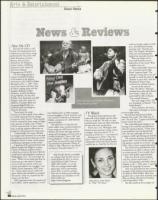
Peter rizrrow
and Debbie Friedman
Sing Out for Justice.
"Sometimes the songs
remind us of the origins of our efforts
on behalf of positive social change,"
comments Peter Yarrow. "Some people
will be inspired by these songs to begin
their process of tikkun olam. Others
will be reassured that we have, indeed,
been working together effectively on
behalf of critical issues for many years.
"Undoubtedly, the songs will help
re-energize and recommit us to the task
of working toward the objectives of the
Religious Action Center: social justice,
community and peace in the world."
A portion of the proceeds from the
album benefit the Religious Action
Center of Reform Judaism (RAC),
which has served as the hub of Jewish
social justice and legislative activity in
Washington, D.C., for more than 35
years. When we are tired and fear we
cannot go on, the music of justice
serves to lift our spirits, renew our
vision and redirect our struggle," says
Rabbi David Saperstein, RAC direc-
tor. "Music alone cannot clothe the
poor, shelter the homeless or conquer
the tyrant. Only we, inspired by the
music, can do that."
RAC operates under the auspices of
the UAHC, which represents 1.5 mil-
3/5
1999
80 Detroit Jewish News
lion Reform Jews in 880 congrega-
tions throughout North America, and
the Central Conference of American
Rabbis, comprised of 1,800 Reform
spiritual leaders.
The selections on Sing Out For
Justice reflect many musical traditions.
Some songs are well known to the
Reform movement through summer
camps and synagogue services (such as
Debbie Friedman's "Save a Life" and
Doug Mishkin's "Olim") while others
grow from the powerful roots and soar-
ing emotions of spirituals ("River of
Jordan"), folk ("Blowin' in the Wind")
and blues ("Homeless Blues")."
Sing Out for Justice is available
on compact disc for $25 and on
audiocassette for $18. It can be
ordered from UAHC Press at
(888) 489-UAHC or on the
Web site at http://www.uahc-
press.com . More information
about RAC as well as samples
from the recording and ordering
information are available on the
RAC's Web site:
http://www.rj.org/rac.
TV Watch
The grass is always greener on the
other side of the decade, and for those
who can recall the '70s only in a pot-
scented stupor, there are other reminders
of what that time was all about.
There was a war, Watergate, bell-
bottom pants, protests, minis, maxis,
mishegas. And now there's TV to
remind us of all of it — or most of it.
Starting out in 1976, "That 70's
Show" shows us all the pimples and
whiteheads of the time that Clearasil
couldn't get to. Aired by the Fox net-
From Russia
Milo
to "That 70's Show."
work on Sunday nights at 8:30
p.m., the half-hour comedy
connects with '70s kids and
their "Me Decade" decadence,
while not overlooking their
hapless hip wannabe parents.
Who can forget an era
when bell-bottoms were a
bellwether of the times? Who
wouldn't want to?
Those memorable times are
not in Jewish actress Mila
Kunis' memory bank. The
striking 15-year-old is not old
enough to recall the days of
"flowers in your hair" and the
Woodstock Nation that
evolved into a Prozac Nation.
As one of the stars of
"That 70's Show," Mila gets
mileage from what she's heard
from others. After all, she
spent half her life in Russia,
),
"just outside Moscow.
Her one image of the '70s
as a youngster in Russia? "The
Brady Bunch."
In her opinion, the times,
they aren't a-changin' as much
as one might think.
Noting that bell-bottoms didn't
bottom out in the '70s, Mila says of
the '70s and '90s, "I guess everything's
pretty much the same."
One noticeable good change is not
having to live with the anti-Semitism
that Jews faced in Russia. "There were
some problems" for her family back
then, she says, although she was too
young to recall experiencing any herself.
The constant prospect of prejudice
against Jews "was one of the reasons
my parents wanted me to leave, says
Mila. "Also to have a good education."
The States have provided her with
an education in what it means to live
on streets paved, if not in gold, then
at least with golden opportunities.
After her arrival in Los Angeles
with her parents and brother — "I
was in second grade, and didn't know
English at all"— Mila, then 7, quickly
learned the language of success.
Mila was discovered by her current
manager while taking acting classes at
the Beverly Hills Studio. She's been
guided into a career that includes such
films as Honey, We Shrunk Ourselves
and Krippendorf's Tribe.
She also starred as the younger ver-