

COMMUNITY VIEWS
A Jewish Community
On The Periphery
AMY GROSS
Special to The Jewish News
hen was the last time
religious services made
you cry from the depth
of your soul as a sign of
discovering your voice? Students and
staff from Project STaR, University of
Michigan's graduate training program
in Jewish communal service, were for-
tunate to experience two such oppor-
tunities during a recent Shabbat.
On Feb. 5-7, nine students and
three staff members observed Shabbat
in the Upper Peninsula, spending erev
Shabbat with Jewish prisoners at Kin-
ross Correctional Facility and Shabbat
with Congregation Beth Jacob, a small
Jewish community in Sault Ste. Marie.
For some, connection to our Jewish
heritage, religion, culture, spirituality
and Israel, is something taken for
granted. For others, like those we wor-
shipped with in the Upper Peninsula,
these things represent a holy sense of
community that many of them have
never had.
Kinross Correctional Facility has
1,300 inmates, seven of whom attend
its Friday night services. Our service
was led by Project STaR and several
Beth Jacob members who regularly
lead services at Kinross. While stu-
dents led the service, two prisoners
each prepared divrei Torah on the
week's parsha, Yitro, on forming com-
munity. The preparation and passion
that went into their work was remark-
able.
Few prisoners at Kinross were born
Jewish, but many are converts or
interested in converting. They are
intelligent, curious and dedicated peo-
ple striving to form a sense of Jewish
community and connection to God.
Several prisoners cried throughout the
service as this was the first time they
had heard prayers sung with guitar or
heard the Torah chanted.
"It was an amazing feeling to have
this people-to-people connection that
was beyond time and place," said
Sharri Umansky, a STaR student. "All
that really mattered was the common
denominator of Judaism." Student
Hayley Warshaw called the entire
weekend "the spiritual pinnacle of my
life.
Our common experience of
Judaism was important in what
occurred between Congregation Beth
Jacob and the Project STaR staff and
students. The themes of Yitro, com-
munity and leadership, were played .
out through our learning from each
other what the true essence of
Judaism is: interpersonal relation-
ships.
Congregation Beth Jacob is an
unaffiliated synagogue built in 1945;
it now serves 35 family unit members
from Canada and Michigan. Rebecca
Line, a STaR student who grew up in
Beth Jacob, brought the congregants
to tears in her d'var Torah on how the
two groups, Project STaR and Beth
Jacob, exemplified true leadership and
sense of community. This small Jewish
synagogue has a big heart and a big
) 5
synagogue lends
an extended fam-
ily feeling in rais-c-/
o ing the children
▪ of the communi-
tY.
There is a real
concern here for
the young people,
to make sure they
are educated and
remain active
Jews. Beth Jacob
has no formal or
informal struc-
tures for children
between 16 and
college age. Dur-
ing a needs
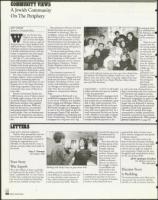
Project StaR staff and students are: front row, Dina Shtull-Leber, assessment con-
ducted by several
Sue Sefansky and Katherine Sholder; middle row, Amy Gross,
STaR students, L\
Rebecca Line, Josh Cohen, Sharri Umansky, Stefanie Pessis and
the young peo-
Renanit Levy; and back row, Hayley Warshaw, Marty Zimmer-
ple's future
man and Hila Reichman.
emerged as the
primary concern,
responsibility — to have its self-taught
as well as the lack of connection to
leaders and educators pass on Judaism
larger communities that have resources
to the next generation.
for education and religious services.
While Beth Jacob congregants look
The assets of the prisoners and the
to the future and see much left to do,
Beth Jacob congregants are great, but <
they already have accomplished a great
so are their needs. While both have
deal in their small community. Con-
people who are dedicated to learning
gregant Jeff Arbus felt that in his pre-
and teaching, they lack the resources
vious large Jewish community experi-
needed to enrich their experiences.
ence, there was no place for him. In a
The need for outreach from larger
small community like this one, he has
communities to smaller communities
a role, whether it is to make a minyan
should be a priority for future Jewish
or teach religious school classes. The
communal professionals. When people
multigenerational approach to the
JEWISH COMMUNITY on page 30
E/
LETTERS
made such a character judgment.
I believe these perceptions and reac-
tions foster and perpetuate hostility
between Jews and gentiles. Instead of -
looking for opportunities to be
offended, we should look for ways to
educate, and give others the benefit of
the doubt.
Gary L. Fineman
Farmington Hills
Your Story
Was Superb
We at the Abilities Center would like
to thank you for the article "Out Of
Sync," published Feb. 19. Keri Guten
Cohen did a superb job of portraying
the out-of-snyc child and describing
the services available to help these
3/5
1999
28 Detroit Jewish News
quently feel alone and
misunderstood by
▪ family and friends
alike.
§ Your clear and can-
• did description of the
problem has already
brought response
from parents and
teachers. Parents who
have out-of-sync chil-
dren at home were
thrilled to discover
they are not alone in
the struggle to identi-
fy and address the
Working with Kathy Dovey on gross motor skills.
needs of their chil-
dren. Some were not
children and their families. It is some-
aware that there are local resources
times difficult to understand the trau-
available that specialize in the treat-
ma these families endure because of
ment of Sensory Integrative Disorders.
their child's dysfunctional behavior
Teachers and professionals have
and impaired social skills. They fre-
expressed the desire to know more
about sensory integration and specific
treatment options.
There is a lot more work to be
done in the area of proper schooling ,y
and services for the out-of-sync child, L`
but the awareness you have helped
create is sure to make an impact in
our community. Thank you for your
thoughtful and comprehensive article
on the out-of-sync child.
Jill D. Spokojny, President
The Abilities Center Inc.
West Bloomfield
Election Fever
Is Building
The Israeli elections aren't likely to be
a panacea for the country's multifac-
eted ills. It is safe to assume, however,