

Presidents In Midstream
AVI MACHLIS
Jewish Telegraphic Agency
Jerusalem
:8
very year, a mission of lead-
ers of American Jewish
organizations travels to
Israel to survey the situa-
tion. Every year, they meet with lead-
ing political figures and various seg-
ments of the Israeli population. But
this year, something was different.
For the first time, delegates
from the Conference of
Presidents of Major American
Jewish Organizations began to
see the umbrella group as a
forum for dialogue on issues that
have been at the forefront of the
debate on Jewish unity and
Israel-Diaspora relations.
Conference members from all
streams of Judaism agreed that this year's
mission, which ended Monday, was
marked by unprecedented discussion of
issues related to religious pluralism.
Orthodox and liberal representa-
tives had conflicting perceptions of
why issues once considered taboo for
the conference were such a focus of
attention. However, they agreed that
the group must continue to refrain
from formulating positions on matters
pertaining to Jewish law in order to
maintain consensus among the group's
diverse members.
"The Conference is made up of
organizations from all four streams of
Judaism," Melvin Salberg, chairman of
the Presidents' Conference, said on
Monday. "There will be no discussion
of halachic content in the conference."
However, Salberg said there has been
a "change in the general environment"
of the Presidents' Conference regarding
its role as a forum for dialogue.
"There is greater evidence that there
is a problem within our community of
tolerating differences, and there is a
greater willingness to discuss this with-
in our meetings," said Salberg.
According to Reform and
Ehud Barak, the opposition Labor
Party's candidate for the premiership,
pledged to work toward a "tolerant,
open society" if elected. But his
remarks against fervently Orthodox
groups angered Orthodox delegates to
the conference.
Barak told the delegates that his
party would oppose any legislation
that would delegitimize Reform and
Conservative Jews, such as the contro-
versial conversion bill which would
Breaking tradition, conference gets
into the pluralism debate.
Conservative leaders, these issues —
including the debate over the
Orthodox monopoly on religious ser-
vices in Israel — played heavily in dis-
cussions because they are now hotter
than ever on the Israeli public agenda.
"It is a revolution as far as Israel is
concerned and as far as the Diaspora is
concerned," said Rabbi Eric Yoffie, pres-
ident of the Reform movement's Union
of American Hebrew Congregations.
"An issue that was off the agenda in
Israel 10 years ago has now moved to
the center. The conference has realized
that there is no way to discuss Israel-
Diaspora relations without discussing
pluralism and the religious question."
The three leading candidates for
Israeli prime minister seem to realize
this as well.
codify the lack of recognition of non-
Orthodox conversions in Israel.
Prime Minister Binyamin
Netanyahu said the only way to deal
with divisive issues is "to adopt a series
of compromises." Non-Orthodox
Conference members, however, said
the familiar message had no substance
behind it, and Netanyahu has yet to
show that he can turn his slogans into
viable compromises with fervently
Orthodox groups.
But Reform and Conservative leaders
reserved their heaviest fire for Yitzhak
Mordechai, the prime ministerial candi-
date of the new Centrist Party.
They were angry that Mordechai
— whose party preaches unity —
recently cast a vote in the Knesset in
favor of an Orthodox-backed bill
aimed at bypassing a Supreme Court
ruling requiring the Interior Ministry
to allow liberal representatives to take
seats on local religious councils.
Richard Stone, chairman of the
Union of Orthodox Jewish
Congregations of America's (OU)
Institute for Public Affairs, said he did
not believe the pluralism issue was on
the Israeli agenda.
"But given the obsession of the
Reform and Conservative move-
ments to push the issue," he
said, it is impossible to keep
it out of the question-and-
answer sessions."
Betty Ehrenberg, the OU's
director of international
affairs, said the pluralism
debate was a distraction
"when, in reality, issues of Israel's
security are really paramount."
These comments surprised some
non-Orthodox participants on the
mission.
"There were 250,000 haredim
recently demonstrating in Jerusalem
and 65,000 secular Jews," Yoffie said.
"To say it isn't on the agenda is an
absurdity. Just read the newspapers."
Rabbi Joel Meyers, executive vice
president of the Conservative move-
ment's Rabbinical Assembly, said the
Orthodox groups refuse to recognize
that there are small Conservative and
Reform movements in Israel. "The
question is not whether it is an
American brand of Judaism, but
whether it has a right to fair play in
Israel." E
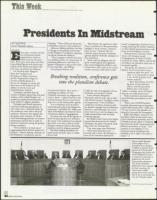
Eleven Israeli Supreme
Court judges sit in a
Jerusalem court Tuesday
to debate a petition by the
parents of a 10-year-old
Paraguayan boy to force the
Israeli Rabbinical Court
to accept his conversion to
Judaism by the Jewish
Conservative movement.
The Israeli Orthodox
Rabbinical Court rejected
the boy's conversion by
Conservative rabbis,
saying that the boy would
have to be re-converted, this
time by Orthodox rabbis.
Photo by the Associated Press/Zoom 77
2/26
1999
20 Detroit Jewish News