
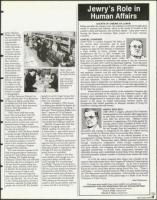

pantry, Yad Ezra
(Hebrew for "help-
ing hand") provides
non-perishables to
approximately
1,000 families, or
1,800 individuals, a
month. The vast
majority of clients
are Jewish; gentiles
who show up are
served once, but
then referred to
other community
food banks. Clients
go through a brief
intake process and
then schedule
appointments to
pick up food (home
delivery is available
for those who can-
not make it to the
warehouse), but Yad
Ezra does not keep
statistics on trends
or demographics.
Yad Ezra Executive Director Lea
Luger estimates that 70 to 80 percent
of clients are elderly, mostly from
Southfield and Oak Park. However,
people also come in from downtown
Detroit, West Bloomfield and
Farmington Hills.
"Some clients walk here to get
food, often several share rides and
some come by bus," says Luger. -
"Some have no cars, some have no
homes and live in their cars, some are
battered women living in motels.
There are so many different situations,
but they all need food. "
Founded in 1990, Yad Ezra is funded
primarily through individual donations.
Another source of help for poor
Jews is Jewish Family Service's finan-
cial assistance program. It receives
three or four requests for assistance
each week, according to Program
Manager Debra Edwards.
The most-common requests are for
help buying prescription medication,
paying rent and utilities and purchas-
ing clothing. JFS, funded through
Federation, United Way and individual
donations, also has an emergency med-
ical care fund for people facing cata-
strophic illness. Edwards refers clients
to Yad Ezra for the food and tries to
find other sources of help as well.
"We try to help with long-term
planning and not just provide a Band-
Aid," says Edwards. "In a lot of cases
in the working population, poverty is
temporary, especially for high-skilled
people who are laid off. The disabled
GIANTS OF AMERICAN LABOR
Before and after the century's turn, the industrial revolution brought great
wealth to business and industry, which in the minds of workers in the
country's mills and factories, was not fairly shared. Labor grew restive,
fanning the flames of unionism. Meet several of its most visionary
crusaders.
Above: Clients
at Yad Ezra make
their food selection.
Left: Volunteers
help out at Yad
Ezra, the kosher
food pantry in
Oak Park.
people we see for longer because they
don't have the capacity to pull them-
selves out of poverty."
Kadima, founded in 1984, focuses
on helping Jews disabled by bipolar dis-
order and schizophrenia. According to
Executive Director Janette Shallal, more
than 75 percent of 150 of Kadima's
clients are low-income. That's because
mental illness requires expensive med-
ications and the symptoms often pre-
vent people from holding a steady job.
Mentally ill people also often have
difficulty managing money, says
Shallal, recalling one client who — in
a manic phase — spent all his money
on a trip to Italy. Others find them-
selves forgoing food to pay for med-
ication or vice versa.
The agency, funded by government
agencies, fees for services and individ-
ual donors, offers mental health care,
helps place people in appropriate jobs
through JVS and runs subsidized
group homes in Southfield.
"Not to have a place to live when
you're healthy is bad enough, but wor-
rying about shelter and bills when
you're mentally ill is overwhelming,"
says Shallal. "Because of the long-term
cycle of illness, families can't be there all
the time, and some people have become
alienated from their families or their
families have already spent all their sav-
ings on treatment. A lot of families are
burnt out emotionally and financially.
We're picking up the pieces for these
people so they can get stability and find
a reason that life is worth living."
SAMUEL GO1VIPERS
(1850-1924) b. London, England The father of
our nation's labor movement, and its chief
spokesman for a generation, also prompted
Congress to make the first Monday in September
a legal holiday to honor working people.
Emigrating to the U:S. in 1863, Gompers was
employed as a New York City cigar maker, an
joined the profession's national union; within
three years he assumed its leadership and steered it into the American
Federation of Labor (AFL) which he had helped establish. From that point
on, Gompers devoted a purposeful lifetime, as AFL president, to building
the country's largest and most effective labor organization.
Conservative in nature, he was opposed to political, governmental
and employer controls over his craft union members. He advocated
collective bargaining, as well as strikes and boycotts, to secure better
wages, shorter hours and improved working conditions. Rejecting social-
ism and radicalism, Gompers was a steadfast believer in workers'
democratic rights to shape their own destinies through economic action. A
man of great personal integrity and patriotism, he was later approached by
Woodrow Wilson in a successful bid to win AFL support for the President's
World War One policies.
Determined to promote stability in the workplace, Gompers also
served as vice president of the National Civic Federation (since 1900)
through which industrialists, bankers and labor leaders could air and
reconcile disagreements to minimize labor unrest. More than any other
pioneer in the cause, he forged relationships between unions and
management that helped guarantee an adequate standard of living for
America's working men and women.
SIDNEY HILLMAN
1887-1946) b. Zagare, Lithuania The Yeshivah-
‘-
trained grandson of an orthodox rabbi experienced
an early taste of union activity and conflict three
years after his arrival here. Hillman joined
coworkers in organizing a 1910 strike against the
Chicago plant of Hart, Schaffner & Marx which
also crippled the city's massive garment industry.
He had brought from his homeland a record of
persistence and courage in struggling for the rights of workers--having
spent nine months in a Russian prison for proposing labor reforms.
Relocating to New York City, he was elected president of the
Amalgamated Clothing Workers of America, a post in which he served
from 1915 to 1946. During these years, Hillman preached moderation
through "constructive cooperation" which brought employers and
employees together in a heightened spirit of understanding and harmony.
The union thereby won sweeping and historic benefits for its greatly
expanded membership: a 44-hour week, employment insurance and
affordable housing, and it established several banks which, through loans
and stock purchases, helped a number of clothing firms weather the Great
Depression.
In 1938, the widely respected labor figure was a founder of the
nation's other major trade union--the Congress of Industrial Organizations
(CIO) to which he was elected vice president. As he rose in political
prominence, Hillman became a trusted confidant of President Franklin D.
Roosevelt and his chief labor advisor during World War Two. "Clear it
with Sidney," was the oft-quoted remark by FDR to his party faithful during
the 1994 Democratic nominating convention. Following the war and until
his death, Hillman appeared on the global stage as a leader of the World
Federation of Trade Unions.
- Saul Stadtmauer
,.
Visit many more notable Jews at our website: www.dorledor.org
COMMISSION FOR THE DISSEMINATION OF JEWISH HISTORY
Walter & Lea Field, Founders/Sponsors
Irwin S. Field, Chairperson
Harriet F. Siden, Chairperson
Detroit Jewish News
2/26
1999
17