

On The Bookshelf
By John Logan
The Life & Death Drama
of Leopold & Loeb
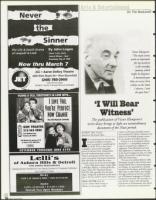
Victor Klemperer:
"The main events
aren't as important
for my record as
is the everyday
tyranny, which
might be forgotten.
A thousand gnat
bites are worse than
a blow on the head.
I observe, I note
the gnat bites."
Outer Critics Circle
Award Winner - Best
Broadway Play of 1998
Now thru March 7
JCC • Aaron DeRoy Theatre
6600 West Maple Rd • West Bloomfield
(248) 788-2900
http://co m n et. o rg/j et
Student • Senior • Group Discounts Available
`I Will Bear
Witness'
The publication of Victor Klemperer's
secret diary brings to light an extraordinary
document of the Nazi period.
The Hit Musical Comedy
GEM THEATRE
313-963-9800
333 Madison Ave.
Detroit, MI 48226
Special to The Jewish News
Call Nicole for groups of 15
or more (313) 962-2913.
of Auburn Hills & Detroit
FINE DINING RESTAURANTS
Catering Services Provided For Your Special.Occasion Or Company Celebration.
Our Location Or Yours.
Becky
Lelli's of Auburn Hills • 248-373-4440
Andre
Lelli's of Detroit • 313-871-1590
Detroit Now Open Mondays
2/19
1999
76 Detroit Jewish News
ROBERT DEL VALLE
t is a reassuring irony of sorts that
the great murderers in history
never succeeded in murdering his-
tory itself That is, they never
managed to prevent the intangible
power of memory from refuting their
lies and condemning their actions.
There is and always will be some rem-
nant, some ghost of personal experience
that rises from the ashes like a sum-
moned witness to set the record straight.
Victor Klemperer's diary, justly titled
I Will Bear Witness: A Diary of the Nai
Years 1933-1941 (Random House;
$29.95), falls squarely into this para-
digm. Originally published several years
ago in the late author's native Germany
l
Robert del Valle leads the
Jewish Authors Book Group at
Borders in Farmington Hills.
(where it still enjoys bestseller status)
and translated by Martin Chalmers, the
book is an invaluable primary source
for the student of modern history.
Further, it is an immensely human
document — a compelling word-por-
trait of a civilized man trapped in a
nightmare. That Klemperer survived
that nightmare is a testament not only
to his moral courage, but also, to a lesser
degree, the peculiar mindset that typi-
fied Nazi bureaucracy.
The son of a modern Reform rabbi,
Klemperer served in the German army
during World War I. Returning home
to Dresden, he searched for a suitable
vocation for his talents, and after several
false starts in other fields, rose steadily
through academia to become a profes-
sor of Romance languages at Dresden
Technical University. His marriage to a
non-Jewish woman and subsequent
conversion to Protestantism also afford-
ed him a small measure of protection
/