
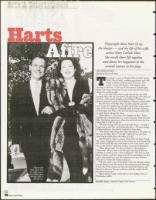

Playwright Moss Hart lit up
the theater — and the life of his wife,
actress Kitty Carlisle Hart.
She recalls their life together
and shares her happiness at the
revived interest in his plays.
JENNIFER POYEN
Special to The Jewish. News
T
Playwright
Moss Hart and
his wife, actress
Carlisle Hart,
shared a life in
the theater:
he setting: A suite at Boston's Ritz-Carlton Hotel,
1948. Piles of food, overflowing ashtrays and half-
empty tumblers of booze litter the room. The
mood is tense and chaotic, with theater types
buzzing in and out. At the eye of the storm is a playwright,
busily rewriting a Broadway-bound script that has just had a
disastrous opening night.
It's a scene from Moss Hart's Light Up the Sky, the 1948
comedy about the ups and downs of mounting a new play out
of town, which opens tonight at the Hilberry Theatre in
Detroit and next month at the Baldwin Theater in Royal Oak.
But for Hart, his bride, Kitty Carlisle, and the cast and
crew of the first production of Light Up the Sky, it also was a
case of life imitating art. Opening night in Boston didn't go
swimmingly, and Hart, who also was directing the play, had
to work fast to salvage the show.
"Poor Mossy — it was sort of a baptism by fire," Kitty
Carlisle Hart remembered in a recent interview from the East
Side Manhattan apartment where she has lived since her hus-
band died in 1961 at age 57.
"We had to keep the suite stacked with food — we had a
huge suite at the Ritz. And those ashtrays — I'll never forget
all those ashtrays. Everybody smoked in those days.
"The Sturm and Drang that Moss described in the play was
all true, my dear, all true, though I think he was too busy
rewriting to think about the irony of it all."
Determined to make a success, Moss Hart set about fixing
the script, changing the tone of the second act and broadening
the humor until the play took shape as the wryly comic valen-
tine to the theater world that became a success on Broadway.
"Moss always said, 'You have to listen to the audience.
They won't tell you how to fix the play, but they'll tell you
whether it works or not," Hart explained. "The first act had
been so funny, and then Moss was off on something very seri-
ous in the second act, and the audience was very let down.
He had to rewrite the whole second act.
"He also used to say, If the play's a hit, the elevator comes,
you go down across the street to the restaurant, and the soup
is hot. But if the notices are bad, you press the button, and
there's no elevator. You go to dinner, and the waiter has his
thumb in the soup."'
Hart's throaty laugh trailed off into the midday blare of
Manhattan traffic.
Jennifer Poyen writes for Copley News Service.
2/12
1999
78 Detroit Jewish News