

aspects of the Hungarian story. I want-
ed to tell their stories from their pre-
war lives to how they managed to
rebuild their lives."
Each survivor in the film is respond-
ing to questions posed by Moll, who is
edited out of the documentary.
Lantos, 16 when Nazi Germany
occupied Hungary in 1944, escaped
from a work camp to move around
Budapest delivering food and medi-
cine that could mean the difference
between life and death for others. A
Hillel Foundation scholarship brought
him to the United Stares.
Cahana, sent to Auschwitz, was
saved because the crematorium had
malfunctioned. She was rescued from
Bergen-Belsen by the Allies, recuperat-
ed in Sweden, immigrated to Israel
and then settled in Houston.
Firestone, who educates adults and
students on the principles of tolerance
through the Simon Wiesenthal Center's
Educational Outreach Program as well
as with the Shoah Foundation, was at
Auschwitz and at an ammunitions fac-
tory before being liberated.
Basch remembers experiencing anti-
Semitism from the early years of his life
and went on to work for the under-
ground in helping Budapest Jews. He
was sent to Buchenwald and was on a
forced march before being rescued.
Zisblatt, subjected to medical exper-
imentation at Auschwitz, escaped dur-
ing a death march to Bergen-Belson,
was discovered by two American sol-
diers and joined an uncle in New York.
A non-Jewish hero in the film is
Swedish diplomat Raoul Wallenberg,
who attended the University of
Michigan. Lantos found refuge in a
Wallenberg safe house, one of the apart-
ment buildings rented and designated
for diplomatic protection of Jews.
When the five went back to film
return to the places they had not seen
since the war. For example, Zisblatt
had been to Auschwitz, so the crew
did not take her there. Instead, she
returned to her hometown, her first
visit since she was expelled.
We didn't know until we were there
that Renee Firestone would want to go
to Auschwitz and look up the records
of her family," Moll recalls. "She found
the records of her sister and learned she
had been subjected to medical experi-
ments while at Auschwitz. It just so
happens that at the bottom of the
form, it mentions Dr. Hans Munch
and a medical clinic that he ran. Two
days after that, we were planning to
interview him, and we had no idea that
tion for the five survivors who
returned on a pilgrimage to the camps
and their hometowns, who had the
courage to revisit the ashes."
Spielberg is scheduled to attend
the Berlin Film Festival later this
month, where, in addition to intro-
ducing The Last Days, he will discuss
the possible integration of the
archive into Germany's planned
national Holocaust memorial.
In general, however, Spielberg has
purposely kept a low profile in pro-
moting the documentary, mainly to
keep media attention focused on the
survivors.
"The way television works, you
can get 60 seconds," he says. "If I'm
there, they spend 45 seconds on me,
and the survivors don't get a chance
to speak. I've tried hard to take a
back seat.
Although Spielberg's Survivors of
the Shoah Visual History Project has
reached its planned goal of collect-
ing 50,000 video testimonies, the
work continues at the rate of about
50-75 interviews a week, mainly in
Hungary, the eastern Ukraine and
the Baltic states.
If there are still sizable numbers
of survivors in Israel who wish to be
interviewed, Spielberg says he will
reactivate the Jerusalem office.
Survivors
The Holocaust Memorial Center in West Bloomfield has filmed and
archived testimonies of survivors living in Michigan and is always looking
for more people whose stories have not been recorded for history.
The center requests that survivors with still unrecorded personal histo-
ries make an appointment by calling (248) 661-4204.
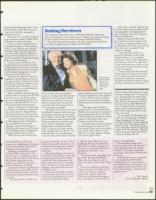
Tom Lantos
and his wife,
Annette, in
a scene from
"The Last
Days."
The Last Days, they were asked to
there would be a connection there and
that they would be on screen together."
As the The Last Days was being
filmed, close connections developed
between survivors and the production
team.
"There was a special bonding
among all of us," says producer June
Beallor, who is Jewish and worked on
the previous Shoah films with Moll.
Each of them has become an extend-
ed part of my family, and I have
learned so much from them.
"I started exploring my heritage in
a much deeper way because I felt
that much of the culture was wiped
out, and I really wanted to learn
about it. I've been going to temple
on a more regular basis."
But the main effort now is on
cataloging the mass of material on
hand, and it will be a lengthy job.
It takes one individual 20 hours to
catalog one testimony," says
Spielberg.
The material will eventually reach
_the public through CD-ROMs,
films, television specials, and, in
about two years, an interactive Web
site.
Even more ambitious and long
range is the plan to "redraft social
science curriculums in schools
around the world to reflect the
Holocaust and hate crimes against
any ethnic group, homosexuals and
Moll, who is Catholic, believes that
survivor experiences can relate to audi-
ences regardless of background and
any connection they may or may not
feel to the Holocaust.
Before locking the film, Moll
gave each survivor the opportunity
to watch it, making sure they were
comfortable with what they said and
how they were portrayed. They
made no changes.
"I also showed the film to a
group of culturally diverse high
school students in Los Angeles,"
Moll says. "Some of the experiences
the survivors had in the early days
of the Holocaust were similar to dis-
crimination the kids faced growing
up in Los Angeles.
"There was one kid who said he'll
always speak out from now on when-
ever he hears any racial comment to
matter how harmless it may seem,
and that's the kind of impact I hoped
the film would have on audiences." I I
The Last Days will be shown at 7 and
9:30 p.m. Friday, Feb. 19; 7 and 9:30
p.m. Saturday, Feb. 20; and 4 and 7
p.m. Sunday, Feb. 21, at the Detroit
Film Theatre, located at the Detroit
Institute of Arts, 5200 Woodward
Ave., in Detroit. $5.50. To reserve
tickets with a credit card, call (313)
833-7942. Tickets also will be avail-
able at the door.
See next week's 'At The Movies" for a
review of "The Last Days" by Professor
Sidney Bolkosky of the University of
Michigan-Dearborn. Professor Bolkosky
also will review "Healing By Killing," a
1997 Israeli film inspired by Robert Jay
Lifions book "Nazi Doctors." That film
will screen at the Detroit Film Theatre
7:30 p.m. Monday, Feb. 22.
others," says Spielberg.
A documentary project now
under consideration will deal with
what Spielberg calls "the miracle
children," the second- and third-
generation descendants of Holocaust
survivors.
As for his other hat, as a principal
in the studio DreamWorks SKG,
Spielberg says, "I am returning to
another part of my schizophrenic life
and doing a science-fiction film with
Tom Cruise. It'll be a soft-drink-and-
popcorn movie."
— Tom Tugend,
Jewish Telegraphic Agency
2/ 12
1999
Detroit Jewish News
73