

Farewell To A King
Hussein, dead at 63,
had an instinct for people,
for politics and for peace.
MITCHELL DANOW
Jewish Telegraphic Agency
ing Hussein bin Talal was a
political survivor. And he
used his survival skills to
,ofinie, as he will perhaps.
§
-red, a champion of
m.
, who'd:fed last wee
at 63 of cancer after 46 years on the
Hashemite throne, was more liberal
than any other Arab ruler — particu-
larly in his attitude toward Israel.
Hussein might well have made
peace with the Jewish state a decade or
two earlier than he actually did in
October 1994 had it not been for the
staunch opposition to such a move
from the rest of the Arab world and
from the Palestinian population that
made up the majority of Hussein's
kingdom.
With an eye toward achieving a
peace with Israel that would also serve
Palestinian needs, he held a series of
secret meetings with Israeli officials
over the years, some of which have
been made public only recently: with
Defense Minister Moshe Dayan in
1972, with Foreign Minister Shimon
Peres in 1987 and with Prime
Minister Yitzhak Shamir that same
year.
The meetings were of necessity held
in secret. In 1951, when he was 15,
Hussein witnessed the assassination of
his grandfather, King Abdullah, by a
Palestinian gunman angry at the king's
perceived willingness to carve up
Palestinian lands with Israel. Had his
meetings with the Israelis become
widely known, Hussein was certain he
would suffer a similar fate.
Perhaps the most famous of the
2/12
1999
6 Detroit Jewish News
secret" meetings was Hussein's
encounter with Prime Minister Golda
Meir on the eve of the 1973 Yom
Kippur War.
Days before that meeting, Egyptian
President Anwar Sadat and Syrian
President Hafez Assad had, tried to
convince the Jordanian monarch that
Israel was about to attack thetn. They --
asked him to aflow Syrian troops to
move through northern Jordan to
head off the Israeli assault.
Six years earlier, in the 1967 Six-
Day War, Hussein had learned the
cost of allying himself with Egypt and
Syria. As a result of that war, he lost
eastern Jerusalem and the West Bank
— "I had never received a more crush-
ing blow than that," Hussein said in a
recent interview.
In 1973, he was not about to make
the same mistake again. Far from
reaching any agreement with Sadat
and Assad, Hussein flew off alone to
meet Meir.
He warned the prime minister that
Egypt and Syria were planning a sur-
prise attack on Israel. But Meir, with
no intelligence reports to back up
Hussein's assessment, did not heed the
warMng.
The king's meeting with her was in
no small part the repayment of a debt
to the Jewish state dating back to
September 1970, when he was
attempting to remove the PLO from
Jordanian soil.
In the wake of the 1967 war, the
PLO had entrenched itself in Jordan,
from where it launched repeated raids
on Israel. By 1970, PLO leader Yassir
Arafat and other factional heads were
attempting to overthrow the king,
"
CHILD OF ABRAHAM on page 16
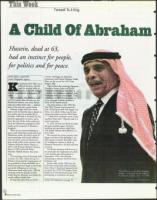
King Hussein at the King Abdullah
mosque, named for r his grandfitther;
in Amman, Jordan, Nov. 19, 1996.
Photo by the Associated Press/Dusan Vranie