

Farewell To A King
O
-0
U
0
C)
_0
0
0
ERIC SILVER
Israel Correspondent
between, Israelis knew that this was a
warm" peace from a former enemy.
Praise fOr the Arab ruler came
from throughout Israel. Chief Rabbi
Yisrael Meir Lau, who visited Hussein
in the Mayo Clinic in Milwaukee six
months ago, celebrated him this week
as "a hero of heroes." The Jewish
sages, he explained, defined a hero of
heroes as "he who makes his enemy
into his beloved."
Eitan Haber,
Rabin's adviser,
speechwriter and
confidant, recalled
his first private con-
versation with
Hussein. The Israeli
told the king about
friends killed in bat-
tle by Jordanian
troops. Hussein's
answer: "The Israelis
also killed us, many
of us." Then Haber discussed the
number of casualties. The king
poignantly responded, "People are
not numbers. Every dead person is
100 percent dead for his family. Every
one dead is one too many."
In mourning Hussein as one of its
own, Israel may have crossed a
Middle Eastern Rubicon, wrote
Chemi Shalev of the Mdariv news-
paper. "There are cynical people
among us," he wrote, who are
impatient with the collective sadness
that has descended upon us, but ...
the public in Israel never loved an
Arab leader as it loved Hussein, and
never felt so close to its neighbors as
it will feel today.
It is an emotional and psychologi-
cal experience which, in the future,
might seem like a turning point,
maybe even a momentous one."
So perhaps that explains why a vast
Israeli delegation, which included
President Ezer Weizman, Prime
Minister Binyamin Netanyahu and
even the head of the Mossad secret
service, mingled with Arab and world
"
Jerusalem
srael mourned King Hussein
this week as one of its own.
The government ordered flags
flown at half-staff on all public
buildings. The "flower children," last
seen after the murder of Yitzhak
Rabin, lit memorial candles in Tel
Aviv's Rabin Square. In a conscious
echo of Bill Clinton's vale-
diction to Rabin, the two
mass-circulation daily
papers headlined their
lead stories "Shalom,
Friend" and "Shalom,
King.
Perhaps most remark-
able was the response of
Ruhama Cohen, whose
daughter was one of seven
Belt Shemesh schoolgirls
shot dead two years ago by a
Jordanian soldier during a trip to the
"border of peace." She gave birth to
another daughter on Saturday just as
Hussein was losing his last battle. In
the king's honor, she has named her
baby "Jordan.
"He was a good man," Cohen told
reporters from her bed in Jerusalem's
Hadassah hospital. "I remember how
he came to our house after the
tragedy, knelt and wept. He helped
us, our families, and also the peace.
Even when he was ill, he kept in
touch with us."
Indeed, that moving visit of con-
dolence and contrition convinced
Israelis that the peace with Jordan was
for real. A crowned monarch went
from house to house, knelt beside
mothers and fathers sitting shiva on
shabby mattresses. And he movingly
begged forgiveness for the "shame"
brought on his nation by one of its
soldiers.
Precisely because Jordan's army had
fought against Israel in the 1948 and
1967 wars, and sundry skirmishes in
Israel
mourns King
Hussein as
no other
Arab leader.
2/12
1999
14 Detroit Jewish News
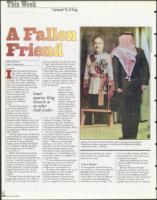
Jordan's Crown Prince Abdullah stands in front of a portrait of his father,
King Hussein, before being sworn in as king, at the Parliament building
in Amman, Jordan, on Sunday.
leaders at Hussein's funeral. And no
one marveled. The transformation
had become routine.
Eike A Brother
The king's death united Israelis in a
way reminiscent of the mourning that
engulfed the nation following the
November 1995 assassination of
Yitzhak Rabin. As Kinneret Elhanani,
a tour guide, said while lighting a
candle for the king on Sunday: "For
me, he was like a brother. We have
always liked him, even when he was
considered our enemy.
Diplomats, politicians and army
officials recalled Hussein's personal,
human touch.
Shimon Shamir, Israel's first
ambassador to Jordan, said that dur-
ing their first meeting, Hussein gave
him his private telephone number
and urged Shamir to call whenever he
deemed it necessary. They met
together five or six times in informal
"