

U
deputy director, the person usually
charged with making a museum run,
doing everything from planning new
galleries and managing staff to shoring
up weak organizational infrastructures.
Her greatest challenge came as
deputy director of the U.S. Holocaust
Memorial Museum during its forma-
tive years in the early 1990s.
"I did everything that didn't make
it famous," she jokes about her role
overseeing the budget, security, the
end of construction and establishment
of an infrastructure.
Gurian resisted going to the Holo-
caust museum, though she was asked
three years before saying yes.
"I knew there were alligators all
around," she says. "But I learned at
the Smithsonian and the American
Indian museum that when elders tell
you to come home, you have a duty to
do so. I did it for my parents because I
felt the obligation to come home."
Gurian turned to consulting after
her three-year stint at the Holocaust
museum. Now she bounces across the
world — to such destinations as New
Zealand, Australia, Egypt and Puerto
Rico — then back home to Arlington,
Va., to baby-sit her grandchildren and
catch up with her husband, Dean
Anderson, acting director of the
Woodrow Wilson International Cen-
ter for Scholars.
The consulting suits her forthright
"I've learned a lot from her, espe-
Hoffman says. "She is willing to bring
style, her ability to make people feel
cially about putting people first. She
them
all out on the table and talk
good about change.
really has a wonderful way of setting
about
them, then she ties them to the
"I'm an honorable broker, an auto
priorities and goals, of attaining those
really big picture."
mechanic who can listen and try to
goals and of making people feel they
Gurian says her proudest contribu-
translate what I'm hearing into how to
are crucial to making a project work."
tion at Cranbrook has been her
put museums together. I listen with
Hoffman, who also is Jewish, likens
involvement with the "Destination:
fascination and respect and with sym-
Gurian to his Aunt Eleanor, who
Cranbrook"
campaign, which fits her
pathy," Gurian says.
always greeted him during the holi-
notion
of
inclusiveness.
Through
Always a "people person,
cross-marketing
of
the science
Gurian's strong drive is bal-
and
art
museums,
the
gardens,
anced by an emotional side
historic
homes
and
grounds,
that occasionally moves her to
Cranbrook hopes to dispel its
tears and by her view of herself
private, elitist image and
as a "Jewish grandmother" to
embrace a broader spectrum of
staff. The combination engen-
visitors.
ders loyalty.
Gurian expects to be at Cran-
At Cranbrook, Gurian
brook
through March or per-
walks the halls in stockinged
haps
longer
as the search for a
feet, a diet Coke or bottled
new director continues. Then
water ever present. Her staff
she plans to write about her
meetings are well run and pro-
museum experiences, do more
ductive, and focused on mov-
consulting work and definitely
ing the organization forward.
spend time with her family.
"Change was not difficult
"I've really enjoyed every
here," she says. "This staff was
chapter
of my life," says Guri-
Elaine Gurian talks with visitors to the Cranbrook Museum
hungry to go forward."
an, who clearly relishes life's
of
Science.
Dan Hoffman, Cranbrook's
challenges. At age 40, for
campus architect whose office
example, she had a bat mitz-
designed exhibits for the museum's
days with the question, "So, Danny,
vah, learning Hebrew with difficulty
new wing, had heard of Gurian
what's really happening?"
because of dyslexia.
through the museum world grapevine.
"For. me, Elaine has the best aspects
"I never imagined that every day
"We are very lucky to have her," he
of the Jewish culture — frankness and
would be such a privilege," she says.
says. "Not many people specialize in
warmth and the ability to engage peo-
"This has not been a planned tra-
assisting museums in transition.
ple in a whole range of emotions,"
jectory but a surprising adventure."
))
❑
Roger Berkowitz takes over the helm
at the Toledo Museum of Art.
SUZANNE CHESSLER
Special to The Jewish News
R
oger Berkowitz's first day as
director of the Toledo
Museum of Art turned out
to be very colorful. On
Jan. 15, he served as tour and lun-
cheon host during a visit by former
Polish head of state Lech Walesa.
"It was an exciting start," said
Berkowitz, deputy director since 1986
and successor to David Steadman,
who retired and moved to California.
"Walesa was in Toledo to speak at a
Junior League fund-raising program,
and he visited a church in the area
before coming to [our galleries]."
Berkowitz, who began at the muse-
urn in 1969 as an intern and later
became curator of decorative arts, has
seen lots of colorful days and is look-
ing forward to more.
The new appointee organized many
exhibitions, including "Impressionism:
Selections From Five American Muse-
ums" and "El Greco of Toledo." He is
in the midst of arranging for the muse-
um's centennial celebration in 2001
and the use of property recently
acquired across the street from the
main building.
"The centennial is a huge project,
and we want it to be something that
has a sense of substance, fun and
involvement for the whole communi-
ty," Berkowitz said. "It gives us a real
sense of pride about what's developed
over these 100 years and a good
sense of what's to come in the next
100 years."
Among three scheduled exhibitions
will be one curated by Detroit area
resident Davira Taragin. It will trace
the contribution of Toledo to industri-
al design.
Born in Denver and raised in
Youngstown, Ohio, where his father
was the Reform rabbi for 35 years,
Berkowitz is a 1966 cum laude graduate
of Western Reserve
University. He
earned a master's
degree in museum
practice in 1970
and a doctoral
degree in art history
in 1977, both from
the University of
Michigan (U-M).
"I've been well
immersed in Jewish
cultural life," said
Berkowitz, who ini-
tiated a program
that reflects his reli-
gious background.
"Early on in my
time here, I devel-
oped a talk on Jew-
ish art as found in the Toledo museum.
"There's some ancient glass that
had been used for religious purposes,
and we have a wonderful silver
megillah cover that was part of our
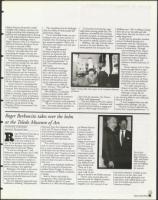
On his first
day as director,
Roger Berkowitz,
right, took former
Polish head of
state Lech Walesa
on a tour of
the museum.
rare book collection. I looked to Jew-
ish artists to see how their work
expressed a Jewish philosophy and
experience, and I talked about a por-
trait of a Jewish man active in the
American military"
1/29
1999
Detroit Jewish News
81