
Yedwab says the trip was the most
important and exciting program
Federation has sponsored. "If these
young people become leaders in their
respective movements, imagine what
that will do for our communal future
(– in terms of all three movements work-
ing together," says Yedwab.
The whole issue of division
between the movements will really
begin to soften because these people
are sharing intense experiences. They
will probably take on leadership posi-
tions at the same time and, in a sense,
grow up together as leaders. If that
connection continues, then the friend-
ships will become institutional."
The 10-day package to Prague and
Israel had a deeper significance than
seeing holy sites, says Weiss. "The
future of the Jewish people depends
on our ability to pull together. All the
infighting among Jews weakens us.
The Jewish community as a whole
;nationally puts too much attention on
trying to draw lines.
"The reality is we seek the same
goals. That is part of what the group
learned on the trip. We all are trying
to fight against intermarriage, we all
are worried about assimilation and
preserving Jewish traditions. What we
have in common is much more than
what separates us."
Initially, people gravitated towards
those they knew. Place cards at dinner
were used the second day to integrate
the couples. Some Reform members
thought of the Orthodox as strangers
before the mission, says Yedwab, but
that changed. By the end of the trip,
they were sad to leave each other, and
I
stereotypes were dispelled.
Through prayer, discussions, sight-
seeing and noshing the group became
close. There were healthy debates until
the morning hours about the different
movements. There were joyous
moments like dancing while watching
the sun rise in Jerusalem. Tender
moments included singing together on
the bimah in a synagogue-turned-
museum in Prague.
And there were burning moments,
like touching the crematoria at Terezin
to try and feel the pain of the lost
concentration camp victims.
Julie August, a member of Temple
Israel with her husband Larry, says it
was an honor to be invited. "It was so
much better going to Israel on a mis-
sion like this because you get a
stronger sense of your Jewish identity
and a better sense of the importance
of American Jews' support of Israel,"
she says. She admits she felt a barrier
at first, but was able to get past it. "I
felt uncomfortable around the
Orthodox people in the beginning. I
come from a very non-observant,
home, and to see women wearing wigs
and to see a lot of prayer services was
very foreign to me. Now I look
beyond it."
The trip joined suburban Jews who
are often separated. "There are really
not a lot of opportunities to mix with
Orthodox in our community," says
August. "If I go out on Friday night,
they are in celebrating Shabbat. If I go
out to dinner, it's not to a kosher
restaurant. Frankly, before this trip I
really didn't have any interest in mix-
ing with Orthodox people."
Larry August recalls sharing stories
never been to Eastern Europe," says
about his family upbringing with oth-
David
Unger. "Eastern Europe was
ers on the mission. "We have a greater
everything
we thought it would be —
sensitivity to other movements that we
dark,
dreary
and depressing. And then
didn't have before," he says. "I think
we
traveled
to
Israel, and it's white and
the trip showed there was a face to the
gleaming."
different movements. People talked
Unger and his wife Leah, members
personally about what their experi-
of
Young
Israel of Oak Park, found
ences were in Judaism."
The challenge that remains is shar-
ing what was learned with others.
"Many went (on the mission) as stu-
dents and now we want them to come
back and be teachers in the communi-
ty," says Andrew Echt, Campaign staff
associate at Federation who was on the
mission.
Adds Tanya Mazor-Posner, senior
community development associate for
Federation,
"They are continuing to socialize
with one another and create some pro-
grams in the community to further
the mission of this particular trip."
Mazor-Posner, who helped plan and
traveled with the mission, says the
couples showed a great deal of respect
towards each other.
"This trip," says Yedwab, "was a
paradigm for how we can make corn-
ing together a reality in people's lives.
If we could do this for every Jewish
leader, I think the problems in the
Jewish movements would go away.
The sense of anger and disillusion-
ment and distrust would disappear,
and it did for the future leaders on
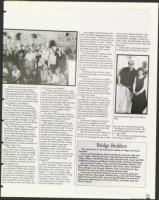
Leah and David Ungar at the Western
this trip."
Wall .
Going from Prague, the remnants
of what was a magnificent Jewish
community, to Israel, the most vibrant
the trip to be a growing experience.
Jewish community in the world, had
"We
shared so much in 10 days. We
an especially powerful effect.
socialized, laughed and cried togeth-
"W wife and I are both children of
er," says Leah.
Holocaust survivors and, as a result,
"We are all Jews and that's the glue
the trip was intriguing because we had
that keeps us together." LI
Bridge Builders
The participants in the Federation mission to Prague and Israel
included:
Karen and Neal Alpiner, Danny and Joann Aronovitz, Julie and
Larry August, Michele and Gary Chapnick, Lisa, Gary and Marc
Cohen, Robyn and Jeff Dwoskin, Julie and Jeff Frank, Laurie and Phil
Goldmeier, Margaret and Bernie Gonik, Sandra and Joey Greenberg;
Tara and Steve Grekin, Cheryl and Marc Jerusalem, Helayne and
Jeff Kaplan, Sandy and Sher Kaplan, Patty Kelter, Sherri and James
Ketai, Margery and Howard Klausner, Susan and Ed Kresch, Ken
Marblestone, Lynn and Elliot Margolis, Jannise Nagel;
Karen and Doug Rouff, Mirjam and Gary Schwarcz, Julie and
Eugene Sherizen, Kim Small, Sheldon Stern, Leah and David Ungar,
Rabbi Steven and Yael Weil, Jodi and Rob Weinfeld, Lisa and Steve
Weinstock; Rabbi Stephen and Naomi Weiss, and Rabbi Paul and
Wendy Yedwab.
1/29
1999
Detroit Jewish News
10
Scanned image of the page. Keyboard directions: use + to zoom in, - to zoom out, arrow keys to pan inside the viewer.
January 29, 1999 - Image 109
- Resource type:
- Text
- Publication:
- The Detroit Jewish News, 1999-01-29
Disclaimer: Computer generated plain text may have errors. Read more about this.