

A
ommunal Considerations
Newly completed eruv makes getting around easier on Shabbat.
SHELLI DORFMAN
Editorial Assistant
t's Friday afternoon, and
there's a young man at the
corner of Farmington Road
and Maple, sitting in his car
with a pair of binoculars.
He's not a bird watcher and he's
not doing anything illegal. His
name is Moshe Lavin and he's the
West Bloomfield eruv inspector.
Each week before Shabbat,
Letvin visually checks the six linear
miles of telephone poles, trees,
ground molding and cable wire that
make up the newly completed eruv
that surrounds homes, businesses
and three area synagogues.
The eruv is bounded roughly by
Walnut Lake, Maple, Orchard Lake
and Drake roads.
Dec. 25 marked the first Shabbat
for what Dr. Steven Borzak of the
West Bloomfield eruv committee
called a "completely functional
eruv. "
Rabbi Eli M. Jundef, the eruv pro-
ject's rabbinical supervisor, said that
by enclosing a specified public area it
becomes a private domain. This
allows observant Jews to carry items
on Shabbat and holidays that they
would be permitted to carry within a
private home, but not outside it.
The eruv only sanctions the car-
rying of objects that are for Shabbat
use, such as a tallit or siddur. It
excludes items to be used following
Shabbat, like keys or a Saturday-
night change of clothing.
After three years of trudging
through "wetlands, swamps and
heat" to start the eruv, Jundef
expressed gratitude for the "input
and financial support of the com-
munity." He described it as "one of
the most challenging jobs that I've
had — but one of the most satisfy-
ing."
The term eruv is actually short-
ened from eruv chatzayrot, meaning
boundary of yards, a boundary that
pools the yards of several pieces of
property into a common, shared
area. An eruv may be created from
natural surroundings, such as trees,
or from an enclosure of wire or
nylon_cord extended around the
perimeter of a community. Jundef
said both were used in West
Bloomfield, with "the bulk of the
eruv including already existing utili-
ty poles and cable wires."
He compared the eruv area to
that of an apartment complex,
which needs first to be physically
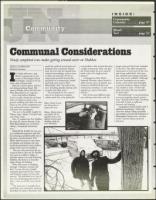
Right: Moshe Letvin
uses binoculars to
inspect the eruv.
Below: Moshe Letvin
and Rabbi Eli M.
Jundef survey a tree
affixed with ground
molding along the
eruv boundary.
surrounded so that its land becomes
a single community. Next, the peo-
ple living within the eruv must be
made a part of a single private
domain.
Congregation Ohel Moed-
Shomrey Emunah, where Jundef is
rabbi, houses a box of matzah, pur-
chased on behalf of all the eruv
community members, "to join them
together as a part of the same
domain."
One of the most difficult tasks
was making certain that only the
proper pieces of land were included
in the eruv. The rabbi stressed the
importance of every part of the eruv
area being usable land, with areas
like wetlands and swamps excluded
since they aren't walkable. Although
the eruv boundaries are on main
streets, some of the land belonged
to private residents, whose consent
was needed to have "10-foot-tall
poles and nylon fish line installed
on their land."
Remembering "it was painstaking
to secure property owners permis-
sion," Borzak said he feels "anything
is do-able if there is sufficient
demand and funding."
Congregation Shagrey Zedek made "a
significant contribution." Other help
came from Robert Naftaly, immediate
past president of the Jewish Federation of
Metropolitan Detroit and a member
of the Detroit Edison board of
directors.
0