

Twists Of Fate
PETER EPHROSS
Jewish. Telegraphic Agency
New York
.s.
fter more than five
decades, a window of
opportunity opened for
Holocaust survivor
Edith Golden.
Then, quickly, the window shut
again
As a result of a 1995 U.S. court
ruling, which awarded Hugo
Princz and 10 other Americans
imprisoned by the Nazis in con-
centration camps some $2.1 mil-
lion, Golden figured that she, too,
would finally receive some corn--
pensation for her and her family's
sufferings during World War II,
when they endured the worst
pogrom in Romania's history.
As part of the Princz settlement,
the U.S. government established
the Holocaust Claims Program,
which allowed American citizens
who suffered at the hands of the
Nazis to file for restitution.
The United States and Germany
announced last Friday that the
German government has agreed to
compensate an estimated 240
/-
Americans who were imprisoned by
the Nazis during the war.
Lawyers for the victims say they
have been told the average settlement
will be about $100,000, which would
make the total value of the settlement
about $24 million.
The State Department recently sent
letters to those individuals whose
claims were approved — and
Germany has promised it will make
payments before the end of the year.
One thing is clear: Golden will not
be among them. In August 1997,
Golden was denied compensation
because she was not in a concentration
camp or ghetto during the war. Unless
a new law is passed, it is unlikely that
she and her sister will ever receive
/—
compensation.
In addition to dramatizing the frus-
tration faced by a Holocaust survivor
who wants compensation for the suf-
fering that she and her family endured
during World War II, Golden's case
sheds light on the difficulties that can
arise when distinctions are drawn
.
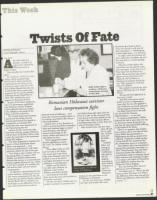
Edith Golden lights a
candle at a Holocaust
remembrance ceremony
in New York.
Romanian Holocaust survivor
loses compensation fight.
her father's head split open with the
between levels of suffering — even
butt of a rifle. In the courtyard, they
when the countries involved appear to
were forced to lie three people on top
be making a good-faith effort to pro-
of each other while German officers
vide compensation.
and Romanians shot at them from the
Golden, born in Iasi, Romania, in
roof of the police station.
1928 to an American father, remembers
After several hours, the men were
when anti-Semitism began to spread
taken off and
across Romania, with demon-
put in cattle
strations and beatings on the
cars. Golden
streets, curfews and separate air
never saw
raid shelters for Jews.
her father
These segregated bunkers
again.
became significant on June
Golden's
29, 1941. As Golden remem-
father was
bers it:
among an
"They called a false air raid
estimated
and we went to the shelter.
13,000 Jews
No sooner did we get there
who died in
than some Germans came and
the Iasi
pulled us out of the shelter
pogrom,
and began shouting at us and
according to
poking at us with bayonets."
Radu Ioanid,
Golden and her family —
a historian at
her older sister, Beatrice, in
Edith Golden (nee Hirsch)
the U.S.
addition to her mother,
at age 3 in Romania.
Holocaust
Rebecca, and father, Joseph
Memorial
— were lined up with Jews
Museum who specializes in the
from across the town and marched to
Holocaust in Romania.
the police courtyard.
For the next three years, Golden,
On the way there, Golden says, her
her sister and mother, like many
mother was beaten to paralysis and
Romanian Jews lived at home.
They were forced to sell most of
their possessions — including her
mother's gold teeth — to buy food.
At night, when the German sol-
diers made their roundups, she and
her sister hid in a nearby garbage
container.
After her mother died at the
end of the war, she and her sister,
-3 now teen-agers, made their way to
'0 New York with the help of an
uncle. She earned her high school
degree and met her future hus-
band, Al, who had been an
American serviceman during the
war. They married in 1949 and
have two children.
She worked at several jobs, retir-
ing in 1989 from the U.S. Postal
Service.
She says she has nightmares at
least once a week.
And she's never given up her
•
battle to receive compensation.
Soon after the war, she applied to
the Conference on Jewish Material
Claims Against Germany. Since
her father had served in the mili-
tary, she tried the Veterans
Administration — to no avail.
To receive compensation, Golden
believed she had to prove that she was
an American citizen during the war
and that she had experienced suffering
at the hands of the Nazis.
There is no question that Golden
was a citizen, and in two days of testi-
mony before the commission in
Washington, she left no doubt of her
suffering. "Claimant's ordeal was har-
rowing and left her scarred for life,"
the commission wrote in its decision.
But Golden's claim was turned down
because the commission had ruled in a
1997 "Final Decision" that only those
American citizens who suffered in a
concentration camp or subcamp, forced
labor march or were interned in a ghet-
to or camp in the region of Transnistria
were eligible for moneys from the
Holocaust Claims Program.
But, says Ioanid, there were no
ghettos in most of Romania.
As Golden puts it: "What's the dif-
ference where they beat you? What's
the difference where they starved you?
What's the difference where they shot
at you?" I I
,
1/2
19
Detroit Jewish News
2i