

PR g.RR
LEADERS Or
VrAle:t
. .
fQ
ESTIF ON BROTHENIOOD
.113Fti Irtc.4sw.uN
• t.
,01i,
,00 RIRROW PP** 44E-, 000.0?a0
L.Z. 0,00 RR 0
66 ,
aw,44
el?irly--Prirat Altarar.u1
010i4cR, 10* PR*40 04400
-*** 40040* 0400kRIP.s. ROMP Wie PROMRS0 RttO
■
10401Vg0AWA 0 00: spits
xf
%to ,
ontrItuttitg inyattirsgittfitil
'
:10 4§10
AoOitortuto of
e.1 furs.?elu
.4$rruir r
t4e 33,4vit to.litutr of
.uu etic&er
:**1 N.
ttilso ow*
TfitAT t
Art
1 g:a..Z
UNt,(1,78%
cmswr-ree
:OS
NVo
Independen
Courses
JILL DAVIDSON SKLAR
Special to The Jewish News
T
he interfaith movement in
the metropolitan area,
once a model for the
nation, has lost some of its
reach and effectiveness among the
general population.
Though hardly at a standstill, cross-
denominational, cross-faith relations
are fragmented and struggling to drum
up support or interest. Fewer people
are involved beyond the executive level
and relations outside of the Jewish-
Christian dialogue are, at best, slug-
gish.
A large number of groups exist but
1/22
1999
14 Detroit Jewish News
largely don't work together, the most
notable exception being the
Southfield-based Ecumenical Institute
for Jewish-Christian Studies.
Interfaith leaders say the reasons for
the decline in cooperative efforts
include:
• A rise in fundamentalism. Recent
years have seen a growing worldwide
trend toward fundamentalism in
Christian, Jewish and Islamic groups.
The rightward leaning individuals and
groups tend not to be interested in
interfaith dialogue, much less action.
"There is a tendency to say that my
religion is the best religion, the one
true faith," said Daniel Krichbaum,
executive director of the Michigan
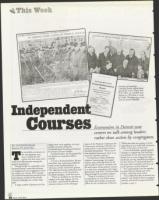
A history of leadership;
Christian leaders helped break
ground for a new Temple Beth
El in 1901; an interfaith sym-
posium in 1933 drew a crowd
of 1,600; Thanksgiving services
were an annual highlight.
't
Nit n.. Lb*
Att..'ott:
Co:wts..14,n$: Ckw
63.
Ecumenism in Detroit now
centers on talk among leaders
rather than action by congregants.
region of the National Conference for
Community and Justice (NCCJ), for-
merly known as the Greater Detroit
Interfaith Roundtable. "If you are of
that absolutist framework, there is no
room for interfaith relations."
• Inward focus within Abrahamic
religions. Intermarriage, low regular
turnout and a declining birth rate all
spell trouble for pastors, ministers, rab-
bis and imams, whose primary concern
is to help their congregants and congre-
gations grow and thrive. This leaves little
time or energy for interfaith relations.
"There is a tendency to be con-
cerned about our own faith's issues,"
said Father John Budde, ecumenical
officer for the Archdiocese of Detroit.
"While that does not exempt us from
responding to our world and its human
needs, it may leave us less time."
• Lack of definable, appealing goals.
Dialogue is happening, and has been
consistently, for the past three decades.
People live in more integrated neigh-
borhoods, leaving interfaith get-togeth-
ers less relevant or interesting than in
the past when interfaith and cross-cul-
tural exposure was less frequent.
Few organizations have set agendas
or goals beyond talking and social
events, eschewing mass action.
"It is a deficiency that we haven't con-
sidered," said Frederick Reeves, program
associate and Jewish campus service fel-
COURSES on page 16