

get
4*Z
At The Movies
Crossing "The Thin R ed Line.
DANIEL ZIMMERMAN
Special to The Jewish News
E
arly on in director Ter-
rence Malick's The Thin
Red Line, as the troop
transports float ominously
toward the beachhead at Guadal-
canal, a certain other recent World
War II movie jumps prominently
into mind, and for a good minute
we wonder at the respected filmmak-
er's gall in blatantly mimicking Mr.
Spielberg.
But then the troops land, the
Japanese are nowhere in sight, and
one of the soldiers with perfect tim-
ing — and as if to rebuke us —
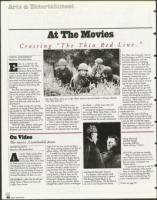
Left: Sean Penn, center, as 1st Sgt. Welsh, leads his men into battle in Terrence Malick's
utters, "If they didn't know this
"The Thin Red Line."
beach was deserted, what else don't
they know?"
the island — which many men will
to the director's chair after a two-
True to these words, the viewing
pay for with their lives.
fol-
The
Thin
Red
Line
decade
hiatus.
does
experience of Saving Private Ryan
Among the company's combatants
lows
an
Army
Rifle
company
called
C-
not transfer to The Thin Red Line.
are
1st Sgt. Welsh (Sean Penn), a kind
for-Charlie, whose cast of infantrymen
Malick's cinematic vision is panoramic
but
disillusioned spirit who stares
become our unknowing guides to the
and introspective; it does not attempt
unwaveringly
at war's insanities and
rigors of warfare on the protection-less
to duplicate the innovative mayhem
darkness;
his unruly interlocutor
man's
savannas of a hilly Guadalcanal isle.
and sentimental characterization of its
Like
in
many
war
films,
the
object
immediate predecessor.
of contention is a dubious piece of
With this film, Malick, whose pre-
real estate — no one knows, we are
vious work includes the acclaimed
told, why the Japanese have occupied
returns
Badlands and Days of Heaven,
On Video
George Macready
and Kirk Douglas
in Stanley Kubrick's
"Paths of Glory" (1957).
War movies: A worthwhile dozen.
DAVID ELLIOTT
Special to The Jewish News
A
re John Ford's cavalry films
war films? I don't think so,
except The Horse Soldiers,
not his best effort. So I chose
no Ford among 12 war movies most
rewarding for you to get on video or
disc. Ford filmed the mystique of com-
radeship in war, the beauty of men on
horses, and violence as a stressed form
of sacred bonding. He did it so mov-
David Elliott is film critic for the San
Diego Union-Tribune and writes for
Copley News Service.
1/15
1999
92 Detroit Jewish News
ingly, but I am not convinced that is
war. Most moving perhaps is his film of
gallant defeat, They Were Expendable.
I wouldn't go into combat with
any war film in my field kit, but a
great Astaire musical, a Bogart-Bacall,
something with Audrey Hepburn and
a W.C. Fields (Buster Keaton's The
General is the only "war" film I'd even
consider, though it might be nice to
rag the brass with Dr. Strangelove).
Some non-war films include aston-
ishing battles. Chief in fame are the
lyrical triumphs of massed carnage in
Eisenstein's Alexander Nevsky, Kuro-
sawa's Ran and Seven Samurai, Welles'
Falstaff (also called Chimes at Midnight)
Pvt. Witt (Jim Caviezel), who as
the film begins is AWOL among
the native islanders, and who
maintains faith in a twinkling
inner conscience; Pvt. Bell (Ben
Chaplin), who experiences the
memories of marital bliss and the
realities of anxious war; and Capt.
James Staros (Elias Koteas), the
company commander and a
lawyer, who in the exigencies of
battle balks at the notion of send-
ing his men to their deaths.
Indeed, under Staros' leader-
ship, the battle does not go well.
From their high positions on the
hill, the Japanese guns pepper the
troops, discouraging an advance,
and the company's casualties begin
to mount. Only when Lt. Col.
Gordon Tall (Nick Nolte), an
imperious and ruthless career mili-
tary man, takes the reins at the front
does the company's fortune almost
inexplicably turn.
Following the heroic flanking
efforts of a band of men led by Capt.
John Gaff (John Cusack), the Ameri-
cans are able to steal the upper
hand and force a Japanese retreat.
Also appearing at various times and
in various smaller roles are John
and Kenneth Branagh's Henry V.
The Russian Come and See, a full
assault of Fnstern Front hell, is hard to
find. Renoir's Grand Illusion is the
supreme POW drama. The Best Years of
our Lives is our best post-war drama.
M*A*S*H is the best war comedy.
Why no Vietnam movies? Not
even Platoon quite serves the com-
plexity of our most divisive war. A
fine one often overlooked: 84
Charlie MoPic.
As peacetime warriors in soft TV
foxholes, clutching a fully loaded
brew or candy bar, we can afford to
envision war as something filmable
and, let's admit it, entertaining. But
some "entertainment" strikes deep:
VIDEO
on page 94