

but in the end the unifying thing was,
of course, the Hebe-hop — the lyrics
—and the Mentsch Mob attitude
which unifies the record."
Hebe-hop is what they call the con-
glomeration, and in their typically
irreverent fashion, Dr. Dreidle and Ice
Berg list influences that include
"Schoolhouse Rock," Roxy Music,
Krusty the Clown, Woody Allen, the
Chasidic Song Festival (particularly
1977) and Schoenberg's atonal music.
Nonetheless, both Dr. Dreidle and
Ice Berg are well aware that some peo-
ple will be quick to dismiss M.O.T. as
little more than a gangsta-rap parody.
"It's not parody, it's satire, and
that's a far deeper word," says Dreidle,
describing the group's
musical bent. "Obviously
we've incorporated ele-
ments from hip-hop as a
starting point, but we've
taken it far beyond that.
"We didn't sit down
and steal choruses like so
many other artists in the
genre do. The hooks are
written by us, sung by us,
played by us, and those
people thus far who have
taken the time to give it a
listen, and not just write it
off as a gimmick, have real-
ized that this is kind of like
the Beastie Boys.
On their first CD, "19.99,"
MO.T cooks up some
Hebe-hoppin' tunes.
"They were thought of as a gimmick
when they started — white boys doing
rap — what a joke. Well, now you've
got Jews doing Hebe-hop, and the
truth is, we -really are being true to
ourselves. We're just letting our influ-
ences in comedy and hip-hop and in
pop music and culture come out."
Even if they never win a Grammy, the
duo is hoping that people will approach
their sound with an open mind and take
it for what it is. "Some people are going
to like what you do and other people
won't get it," says Ice Berg.
"You have to be your own judge,
and hopefully people take the time to
see the humor in it and the legitimacy
of the music and the satire." ❑
From ska to jazz, an increasing number of musicians assert their Jewishness in new CDs.
DEBRA NUSSBAUM COHEN
Special to The Jewish News
\Th
rtfully sculpted sideburns
emanating from a head of
closely cropped hair and
several small hoops run-
ning up each earlobe mark King
Django as a ska hipster.
Ska, a precursor of reggae that
weaves together elements of Ameri-
can rhythm and blues with the laid-
back sound of Jamaica's easy native
groove, has been embraced by anti-
Nazi skinheads as the music of their
movement.
Yet while Django — as he's
known to everyone but his parents,
who named him Jeffrey Baker —
may be big on the alternative music
scene, he's no Jamaican rasta.
He's a nice Jewish boy from
Brooklyn who now makes New
York's Lower East Side his home.
Now, after years working toward
success in a non-Jewish musical
idiom, Django is coming out of the
Jewish closet.
He recently put out a CD titled
Roots and Culture (Triple Crown
Records), which brings together reg-
gae rhythms and Yiddish lyrics, songs
about the sanctity of Shabbat and a
folksy version of "Shalom Aleichem"
with a ska sound.
On the CD's back cover, Django
reiterates
Maimonides' 13 articles of
.
faith without identifying them, giv-
ing simple testament to his Jewish
faith.
Debra Nussbaum Cohen is a writer
for Jewish Telegraphic Agency.
world-beat music and progressive
It puts Django in the company of
themes in traditional Jewish sounds.
other musicians — including the
They have been more successful
hip-hop duo M.O.T. and the hard-
than
just about any other overtly
core metal band Sons of Abraham —
Jewish
group, selling more than
who are putting their status as Jews
25,000
copies of their recordings
front and center.
Suddenly it's hip
— or at least
acceptable — to be
Jewish.
Many musicians,
of course, have
long focused their
entire professional
effort on Jewish
music — and
found themselves
limited to that
niche.
What's new is
that those who
have not been so
visibly Jewish are
staking a proud
claim to their reli-
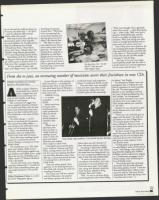
King Django, right, performs: A nice Jewish boy from Brooklyn.
gious and ethnic
identities and making
when other acts sell a fraction of
them explicit in their work.
that, said music industry sources.
Avant-garde jazz musicians John
According to Klezmatics fiddler
Zorn, Anthony Coleman and Marc
Alicia
Svigals, until now "a lot of Jew-
Ribot, among others, have for the
ish
artists
were into being Jewish, but
last few years been playing free-flow-
in
a
very
compartmentalized
way, out-
ing and often dissonant music that,
side of what they did professionally."
they say, is inherently Jewish because
"It used to be that Jews were
it's coming from a Jewish place
everywhere and nowhere. Jews were
inside them.
prominent in arts and politics and
They and others played "Jews-
hid at the same time," said Svigals
apalooza" at the Knitting Factory, a
who, along with klezmer clarinetist
New York club, during the week sur-
Andy Statman, played on King
rounding Christmas.
Django's Roots and Culture.
The trend may well have started
Now "it's nice to see Jews doing
with the Klezmatics, the popular
something Jewish rather than hiding
neo-klezmer group with roots in
in shame," said Svigals.
The Klezmatics helped create the
atmosphere that is making the new
Jewish renaissance in music possible,
she said. The band approached
klezmer as not wanting to recreate
the music of their grandparents, she
said. Instead, "we incorporated
sounds which were part of our musi-
cal psyche, but in an organic way.
Then people realized you could do
it," she said.
Django, for one, has gotten a grat-
ifying response to his new visible
Jewishness.
"There are a lot of Jewish guys in
reggae and ska music," he said over
an omelet at an East Village diner.
"I've mostly gotten cheers from
them, telling me 'Burn on, man.' A
lot of them have asked to be on the
next [Jewish] record."
Ska fans, mostly young men who
attend the more than 180 club dates
Django and his two ska bands play
each year all over the world, have
also given a warm response to his
new Jewish music.
"It feels good to give people who
are assimilated a sense of their Jewish
roots," said Django, who credits his
grandmother singing him Yiddish
lullabies, and his experiences singing
in a Conservative synagogue and at
Jewish camps, with inculcating his
love of Jewish music.
"A lot of the anti-Nazi skinheads
are Jewish" but feel really alienated
from their parents, he said. "I had this
blue-eyed blond kid in Atlanta come
up to me and say 'My mom doesn't
understand this whole ska thing. Now
I can show this to her.'" TI
1/15
1999
Detroit Jewish News
\ 3
1 I
85