
Scores of Scores
For Basketball, Bowling . . .108
Detroit Dazzles
Automotive World
114
jpr
The Cookie World
h .
-4„
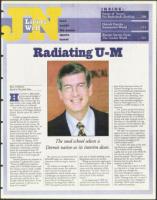
Radiating U
BILL CARROLL
Special to The Jewish News
e oversees 1,300 people
and an annual budget of
$500 million. He often
works 12-hour days in a
huge facility with a large staff, and
takes work home on weekends.
"He" is the new interim dean of
the University of Michigan Medical
School, Detroit native Dr. Allen S.
Lichter.
A widely recognized radiation
oncologist, Dr. Lichter is interna-
tionally known for his research in
the treatment of breast cancer. He
was appointed interim dean Dec. 18
by the U-M Board of Regents. He
replaces Dr. Loris A. Betz, who
served as interim dean for two years
before relinquishing the post to
rejoin the faculty and do research.
Dr. Gilbert S. Omenn, U-M
executive vice president for medical
affairs and who is Jewish, heads a
committee conducting a national
search for a permanent dean. Dr.
Lichter is reportedly near the top of
the list, but not a cinch to get per-
manent status.
"Interim positions are common at
universities," explained Dr. Lichter.
"There are differences of opinion
within the U-M Health System, and
Dr. Omenn wants to reach a middle
ground in the selection of a perma-
nent dean, define the position clearly
and make sure the person is right for
the university, and that he is com-
fortable with the final choice. So the
search continues. I will stay on as
long as I'm needed."
EE
The med school selects a
Detroit native as its interim dean.
He receives no increase from his
$206,000 salary as a department
chairman while serving as interim
dean.
Dr. Lichter, no stranger to the
medical school system, has zealously
taken over his new duties and
responsibilities, which include sever-
al challenges and opportunities. He
gained plenty of experience as chair-
man of the U-M Department of
Radiation Oncology from 1984 to
1997, leaving that position for the
past year to resume teaching in the
department and to do research.
"Being an instructor again gave
me a revitalized spirit, with a fresh
slant and new ideas on my tech-
niques and the operation of the
department," he said. "Now, I'm
carrying that spirit over into my
job as head of the medical
school."
At the beginning of 1998, he
needed more time away from the
department when he became presi-
dent of the American Society of
Clinical Oncology for two years,
one of 10 professional organizations
to which he belongs. He spent
much of the year attending meet-
ings and events, organizing pro-
grams, and working on legislative
issues in Washington, D.C. The
society has 12,000 members in 60
countries.
"Dr. Lichter served with distinc-
tion as chair of the Department of
Radiation Oncology, creating part-
nerships between the U-M Health
System and other hospitals (such as
Providence in Southfield) to bring
the expertise of U-M radiation ther-
apy to more state hospitals," said
Dr. Omenn.
"He and I are enthusiastic about
opportunities to make a significant
impact on medical school programs
and to integrate academic and clini-
cal functions throughout the
school's health system."
Dr. Lichter sees space at the med-
ical school as a tough challenge.
"The medical school is growing
rapidly and we need more offices for
new recruits and more laboratory
space for research. There is great
potential here for more health-care
business, but we must have the
resources to handle it.
"Obtaining more space to work
is a big task at a huge state univer-
sity, and even though the
University Hospital complex is
large, space is at a premium every-
where. Getting more of it is one of
my top priorities. It's a budgetary
challenge. We'll study some possi-
ble expansion projects.
Scanned image of the page. Keyboard directions: use + to zoom in, - to zoom out, arrow keys to pan inside the viewer.
January 15, 1999 - Image 103
- Resource type:
- Text
- Publication:
- The Detroit Jewish News, 1999-01-15
Disclaimer: Computer generated plain text may have errors. Read more about this.