

Assessing The Schools
Jewish education operates with little outside evaluation, but that may change.
JULIE WIENER
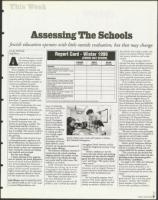
Report Card - Winter 1999
St±iffWriter
A
JEWISH DAY SCHOOL
s Jewish federations around
the country begin to invest
more heavily in education,
they are demanding some-
thing in return: accountability.
In Los Angeles, for example, the
Bureau of Jewish Education soon will
require all area day schools, congrega-
tional schools and early childhood
programs seeking Federation alloca-
tions to first successfully complete an
extensive accreditation process.
The New York-based National
Board of License for teachers and
principals in Jewish schools, founded
in the 1940s, says it is now stepping
up efforts to certify Jewish educators
throughout the country. Currently,
fewer than 15 percent of Judaic stud-
ies teachers are licensed.
And with the formation of a corn-
mission responsible for defining
Detroit's overall vision for Jewish edu-
cation, expectations of educational
institutions may be changing here as
well.
Touting themselves as the remedy
for Jewish continuity woes, day
schools are growing in number. The
United States had 625 of them in
1994, the last year for which reliable
data is available. The schools' visibility
and requests for community funds is
also growing.
Most operate with minimal scruti-
ny from government regulators and
Jewish federations, leaving parents to
rely on word-of-mouth assessments
from friends or their own impressions
from visiting the schools and talking
with teachers and principals.
But that may change.
A major national service organiza-
tion for schools, the Jewish Education
Service of North America (JESNA), is
now recommending that federations
link day school funding to educational
quality. JESNA recently completed a
highly critical report on the education
support programs offered in Detroit,
but that report did not address the
Julie Wiener may be reached by phone
at (248)354-6060 ext.247 or by e-mail
at jwiener@thejewishnews.corn.
.
Teachers
.
EXCEEDS -
Expectations
MEETS
Expectations
BELOW
Expectations
•
Support philosophies, goals of school
Possess adequate formal academic training
and experience
Participate in ongoing staff development
Curriculum
-
Gives instruction in Hebrew language, Bible,
prayer, Jewish life and observances, rabbinic
literature, Jewish values, Jewish history and
social studies
Has a challenging, coherent, relevant program
providing all students with suitable courses of
instruction and expectations
Offers variety of teaching strategies that
actively engage students
Using a variety of data, school examines how
well students perform and regularly informs
all its constituencies of results
Some of the standards the Los Angeles Bureau of Jewish Education uses to evaluate Jewish day schools.
issue of evaluating
individual schools for
funding purposes.
According to Dr.
Steven Brown, assis-
tant dean of the
Jewish Theological
Seminary's graduate
school of education,
Conservative day
schools are increasing-
ly seeking accredita-
tion through organi-
zations like the
Teacher Nancy Lauer works with students in Yeshiva
Independent Schools
Beth
Yehudahs kindergarten._
Association of Central
States (ISACS), many
throughout North America, said he
of which can incorporate evaluations of
would like heightened scrutiny of day
Judaic studies offerings.
schools.
The Solomon Schechter network of
"There's a tendency to use the
Conservative day schools mandates
mantra that day schools and anything
religious policies and number of class-
associated with day schools is labeled
room hours of its schools, but does
good, but their intensity and quality
not involve itself in other issues, like
vary," said Prager. "We need to think
staffing or curriculum.
about norms."
Torah Umesorah, the association of
Miami's Central Agency for Jewish
Orthodox day schools, has an accred-
Education and Los Angeles' Bureau of
iting program, but officials were not
Jewish Education both address Judaic
available this week to discuss how it
studies in their accreditation pro-
operates and what standards it sets.
grams.
Yossi Prager, executive director of
The Los Angeles program, devel-
the New York-based Avi Chai
oped in 1993, works together with a
Foundation, which provides over $3
secular accreditation agency that had
million a year to Jewish day schools
already accredited a number of area
day schools, but it adds a Judaic com-
ponent and assesses Hebrew schools
and nursery schools as well as day
schools.
The program, through which 41
schools have been accredited, requires
schools to provide detailed information
about their curricula and describe how
they address such topics as Hebrew,
Bible, prayer, rabbinic literature and
Jewish history. It also looks at issues
such as parental involvement, board
composition and faculty qualifications.
To be certified, schools must hire
only licensed Judaic studies instructors
and compensate them according to the
Bureau's pay scale, which bases salaries
on an instructor's amount of experi-
ence, level of education and participa-
tion in professional development pro-
grams. The Los Angeles Bureau of
Jewish Education allocates $1.8 mil-
lion of federation funds and $800,000
from other sources to 160 Jewish edu-
cational institutions. Of that, $1.2 mil-
lion goes to.the area's 37 day schools.
Miami's 15-year-old accreditation
program deals only with day schools.
According to Dr. Raymond Bloom,
director of the day school and teachers'
services department at Miami's Central
Agency for Jewish Education, schools
"must provide us with a well-sequenced,
well-structured Judaic curriculum.
"We don't interfere with philosophy
but expect that structure of program is
appropriate and all Judaic studies
teachers must be licensed by the
National Board of License," he said.
Miami's Jewish Federation allocates
approximately $1.6 million to 10 day
schools in southern Florida and con-
tributes $400,000 for teachers' benefits.
"This community has decided that
support for day schools means not just
providing money but ensuring deliv-
ery of service," said Bloom.
Founded in the 1940s, the National
Board of License certifies Jewish
instructors and has branches in 14
Jewish communities, generally under
the auspices of bureaus for Jewish edu-
cation.
"Licensing does not guarantee
good practice, but it is at least some
assurance," said Dr. Alvin Schiff, a
board member of the Board of
License and a professor at Yeshiva
.
1/8
19c,
Detroit Jewish News
9